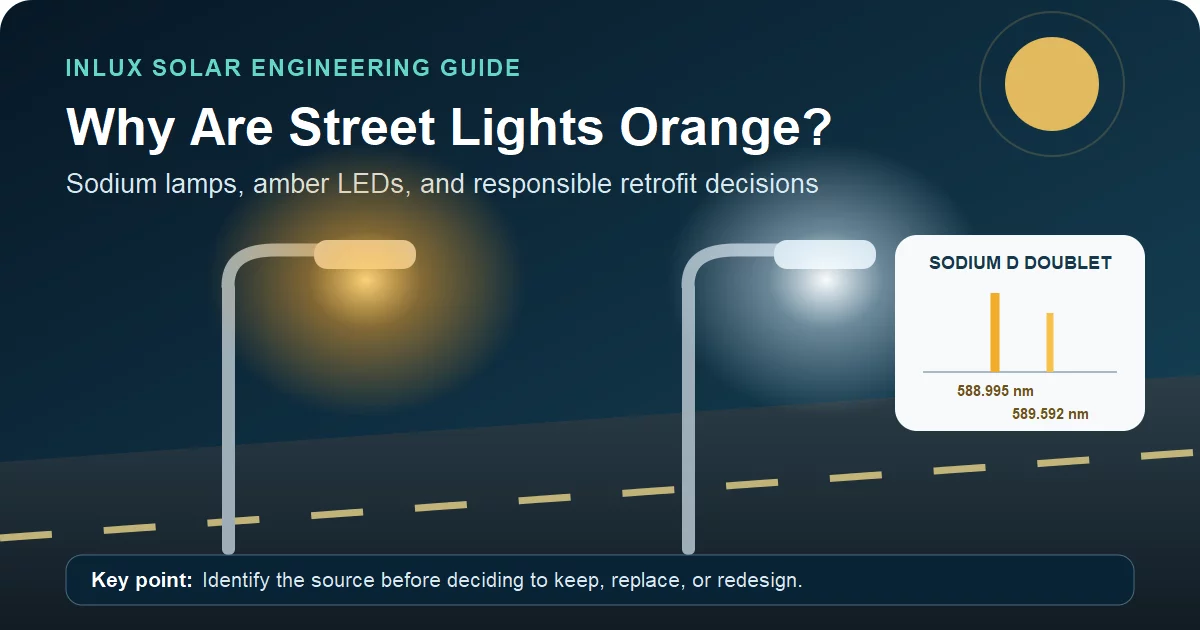
Most orange street lights get their color from sodium-vapor lamps. Excited sodium atoms emit strong yellow light near 589 nanometers, and legacy roadway lamps use that emission to produce the familiar amber or golden glow. Low-pressure sodium looks almost monochromatic; high-pressure sodium produces a broader, less saturated orange-white light.
However, an orange fixture is not automatically an old sodium lamp. Modern phosphor-converted amber LEDs can be selected intentionally for environmentally sensitive areas. The correct response is therefore not “orange means replace it.” First identify the source, then assess roadway performance, energy use, maintenance, controls, and local environmental requirements.
إجابة سريعة: Street lights commonly look orange because low-pressure or high-pressure sodium lamps emit strongly in the yellow-orange part of the visible spectrum. Some modern amber LEDs create a similar appearance intentionally. Color can suggest the technology, but the luminaire label, maintenance record, and spectral measurement provide a more reliable identification.
Orange Street Lights at a Glance
| Question | Practical answer |
|---|---|
| Why are many older street lights orange? | They commonly use low-pressure or high-pressure sodium lamps. |
| Is every orange street light an HPS lamp? | No. It may be LPS, HPS, phosphor-converted amber LED, a filtered LED, or decorative lighting. |
| Why did cities use sodium lamps? | They were mature, efficient roadway sources with long service histories. |
| Why are many being replaced? | LEDs can reduce energy and maintenance, improve optical control and color rendering, and support dimming and monitoring. |
| Is white LED always the right replacement? | No. CCT, spectrum, glare, shielding, controls, road class, and sensitive surroundings must be evaluated together. |
| Can orange light be intentional today? | Yes. Amber or very warm LED sources may be specified where shorter-wavelength output should be limited. |
The Science Behind Sodium’s Yellow-Orange Light
Light is produced when energized atoms or semiconductor materials release energy as photons. Sodium has two especially strong neutral-atom lines in the yellow region of the visible spectrum.
The U.S. National Institute of Standards and Technology lists strong Na I lines at:
5889.950 Å, equal to588.995 nm5895.924 Å, equal to589.592 nm
These closely spaced lines are often called the sodium D doublet. NIST’s sodium spectrum compilation also describes the characteristic yellow color produced when sodium or its salts are heated.
A street lamp is more complex than an isolated atom. Gas pressure, lamp construction, operating temperature, other materials, optics, and the observer’s visual response all affect the final appearance. The NIST wavelengths explain the physical origin of sodium’s yellow emission; they do not, by themselves, define a complete street-lighting system.
In a low-pressure sodium lamp, much of the visible output is concentrated near those sodium lines. The result is an intense yellow-orange appearance with very limited color discrimination. Under nearly monochromatic light, objects with different daylight colors can look surprisingly similar.
In a high-pressure sodium lamp, higher vapor pressure broadens the emitted spectrum. The light normally appears golden, orange-white, or peach rather than the saturated yellow of LPS. Color rendering improves relative to LPS, but it generally remains limited compared with a well-selected broad-spectrum white LED.
LPS vs HPS vs Amber LED vs White LED
The eye can provide clues, but color alone is not a definitive equipment record.
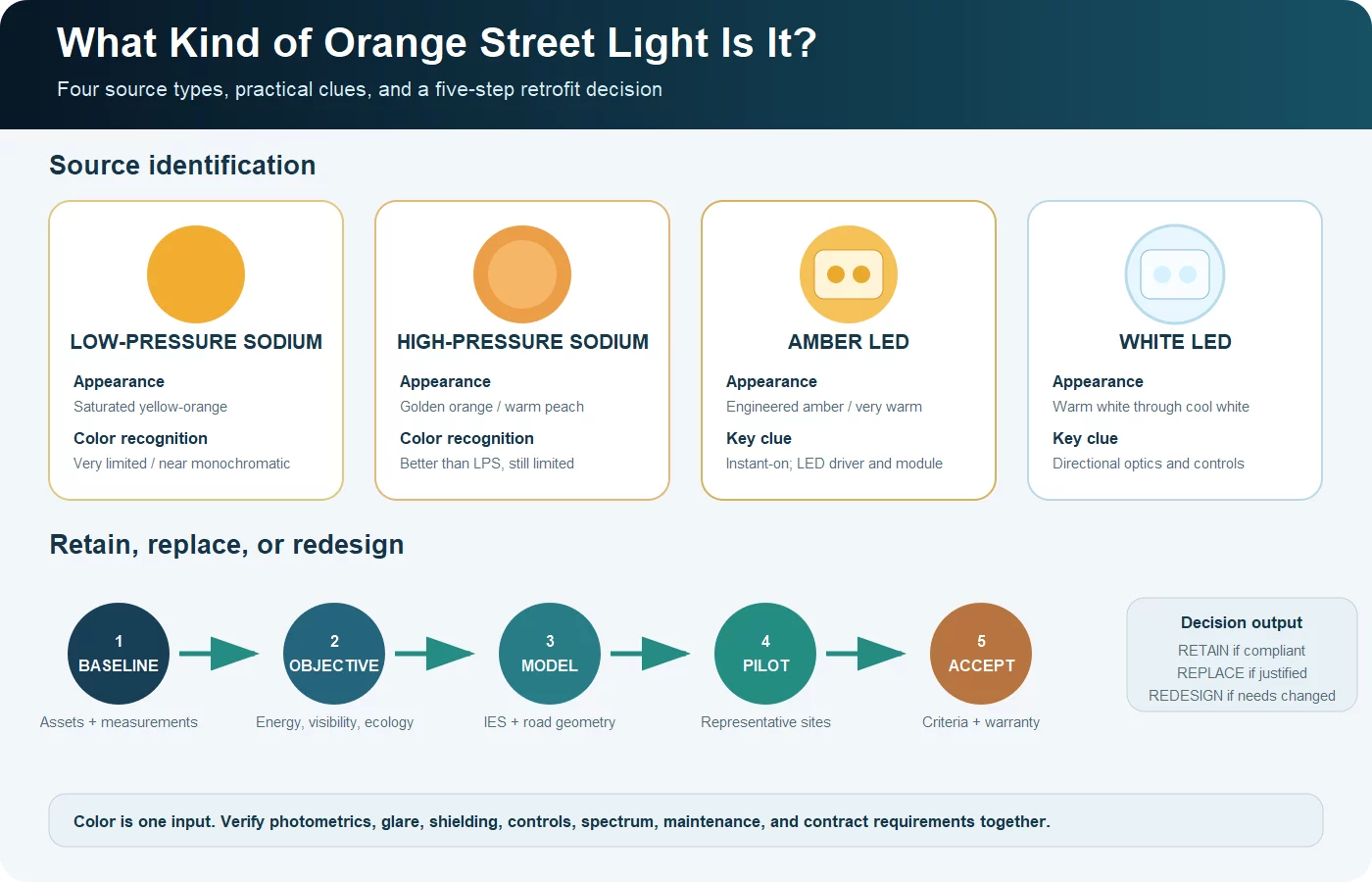
| Source type | Typical appearance | Spectral character | Color recognition | Useful field clues |
|---|---|---|---|---|
| Low-pressure sodium (LPS) | Saturated yellow-orange | Very narrow, dominated by sodium emission | Very poor | Objects lose most color distinction; older specialist installations |
| High-pressure sodium (HPS) | Golden orange to warm peach | Broader than LPS | Better than LPS but still limited | Common legacy cobra-head and area-lighting systems; warm-up behavior |
| Phosphor-converted amber LED | Amber or very warm orange | Engineered LED spectrum with limited short-wavelength output | Depends on product spectrum | Instant-on, electronic controls, LED module construction |
| White LED | Warm white to cool white | Broad phosphor-converted spectrum | Usually better than sodium | Instant-on, directional optics, dimming or network controls may be present |
Low-pressure sodium
LPS is the easiest to recognize visually because its light is close to monochromatic. It can illuminate a surface efficiently while making reliable color identification difficult. A red, blue, or green object may appear as a different shade of gray-brown under the lamp.
High-pressure sodium
HPS became much more common for roads, parking areas, and industrial sites. Its broader spectrum makes the scene look less monochromatic than LPS. The U.S. Department of Energy’s 2008 Oakland street-lighting demonstration measured the existing HPS luminaires at an average correlated color temperature of 1991 K, which is consistent with their very warm appearance.
For a full project comparison of energy, optics, maintenance, controls, and lifecycle considerations, use the Inlux guide to HPS versus LED street lights.
Amber LED
An amber LED is not a sodium lamp. It creates light using semiconductor and, in some products, phosphor-conversion technology. DarkSky International identifies 2200 K, phosphor-converted amber LED, and some filtered LED products as options where lower short-wavelength output is desired.
The spectrum and performance still depend on the actual product. The word “amber” does not guarantee good shielding, correct light levels, low glare, or suitable road visibility.
White LED
White roadway LEDs offer a wide range of CCT and spectral designs. They can provide better color recognition than sodium sources, but higher CCT or excessive short-wavelength output is not automatically appropriate for every site. Optics, output, dimming schedule, surrounding ecology, and road-user needs remain part of the specification.
Why Cities Used Orange Sodium Street Lights
Sodium lighting was not chosen merely because cities preferred orange roads. It solved practical infrastructure problems for decades.
Mature and established equipment
Utilities and public works departments developed standardized lamp wattages, luminaires, replacement cycles, inventories, and maintenance practices around sodium systems. Once thousands of fixtures use one technology, compatibility and workforce familiarity have real value.
High efficacy for its era
Sodium lamps converted electricity into visible light efficiently compared with many earlier roadway sources. LPS was especially effective when the objective was to produce large quantities of visually detectable light rather than accurate color.
Long service history
Road owners understood how sodium lamps aged, how ballasts failed, and how group relamping could be scheduled. A proven maintenance system can remain economically useful even after a newer source becomes available.
Roadway coverage
Sodium luminaires were designed for common mounting heights, spacings, pole arrangements, and road classes. A city could deploy a repeatable family of fixtures across a large network.
The broader sequence from gas and arc lamps to sodium and LED is covered in the Inlux history of street lighting.
These advantages explain adoption, but they do not mean every orange installation should remain unchanged. Color recognition, aging equipment, maintenance access, energy prices, controls, and current lighting requirements can shift the decision.
Why Many Cities Replaced Orange Lights with LEDs
The strongest retrofit cases combine measured energy and maintenance data with a photometric design. A change in color is visible, but it is not the complete business case.
Energy reduction
In the DOE’s Oakland demonstration, the measured average input power was:
| Demonstration source | Average power |
|---|---|
| Existing HPS luminaire | 121.0 W |
| Tested LED luminaire | 77.7 W |
| Difference | 43.3 W |
The report estimated 178 kWh of annual energy savings per tested LED luminaire. This is useful historical evidence from a defined installation, not a universal savings promise for modern projects. Actual savings depend on existing wattage, LED design, operating hours, dimming, spacing, and whether the retrofit preserves required light levels.
Better optical control
An LED luminaire can place light through purpose-designed lenses rather than relying on a large omnidirectional lamp and reflector system. In the Oakland test, the LED luminaires produced lower average illuminance but maintained or increased minimum light levels across the tested spacings and improved overall uniformity.
That distinction matters. A higher average lux value can coexist with dark spots, spill light, or poor uniformity. A roadway design should evaluate distribution and minimum performance, not just a bright reading directly under the pole.
Color rendering
The Federal Highway Administration’s profile of Portland’s replacement program identifies improved color rendering as one benefit of LED conversion. Better color recognition can help people distinguish road markings, vehicles, clothing, and surrounding objects, although the safety effect must still be evaluated in the context of the complete lighting design.
Maintenance and controls
LED luminaires can reduce relamping work and support dimming, scheduling, motion strategies, and remote monitoring. Those capabilities only create savings when the controls are commissioned and maintained correctly.
A real municipal program
Portland’s city project page described a program to convert 45,000 HPS street lights during 2015 and 2016. It projected:
20 million kWhless electricity per year$1.5 millionin annual savings- an initial program cost of
$18.5 million
The later FHWA project profile lists 46,700 HPS-to-LED replacements. The two figures represent different reporting scopes or project stages and should not be silently treated as one identical count.
Portland selected 4000 K for cobra-head fixtures and 3000 K for ornamental street lights. A current project may choose different CCTs based on policy, resident response, environmental sensitivity, road class, and available products.
Are Orange Street Lights Better for Safety or the Night Sky?
There is no responsible universal answer based on color alone.
Color recognition
Broad-spectrum white LED usually provides more accurate color recognition than LPS and many HPS sources. That can improve visual information. It does not prove that a particular luminaire has acceptable glare, uniformity, brightness, or placement.
Glare and adaptation
A poorly aimed or overpowered warm light can create glare. A well-shielded white light can control spill. Conversely, a high-output cool-white installation can be uncomfortable even if it is energy efficient. The luminaire’s intensity distribution, mounting height, tilt, output, pavement, and surrounding darkness all affect the result.
Short-wavelength output
DarkSky recommends warmer-color light where possible and limiting blue-violet wavelengths to the least amount needed. Its more detailed guidance identifies 2200 K, phosphor-converted amber LED, or filtered LED as options for reducing environmental impact, with still narrower spectra near sensitive sites.
DarkSky also makes the essential qualification: color alone does not make lighting responsible. Its five principles require outdoor lighting to be:
- Useful
- Targeted
- Low level
- Controlled
- Warm-colored
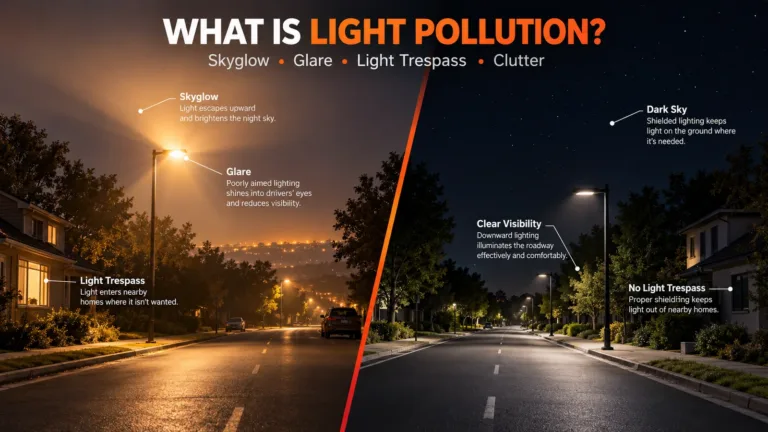
An amber fixture that shines upward all night at excessive output fails several of those principles. A project should select spectrum together with shielding, light level, operating schedule, and controls.
ذا إنلكس CCT, CRI, and beam-angle guide explains why color appearance, color rendering, and light distribution are separate specification decisions.
Orange does not always mean normal
An even corridor of documented sodium or amber fixtures may be operating as designed. A single orange or purple luminaire among white LEDs may indicate a mixed replacement, incorrect CCT, optical discoloration, or color shift.
If a white LED has unexpectedly turned blue-purple, use the separate guide to purple street lights. That failure pattern is different from a functioning sodium lamp or intentionally amber LED.
How to Tell What Type of Orange Street Light You Have
Do not climb a pole or open an energized luminaire. Public observers should report the pole location to the responsible utility or municipality. Qualified personnel can use the following process.
1. Check whether the whole zone matches
A consistent orange corridor is more likely to be a planned sodium or amber installation. One odd fixture among white lights may be a maintenance mismatch or product issue.
2. Review labels and asset records
The luminaire label, lamp code, ballast, driver, product model, installation date, and maintenance database are stronger evidence than appearance. Record the pole ID and fixture location before investigating.
3. Observe operating behavior
Legacy discharge lamps typically require a warm-up period before reaching their stable output and color. LEDs normally reach their intended output immediately. This is a clue, not a substitute for equipment identification.
4. Compare color rendering
If objects lose nearly all recognizable color, LPS is plausible. A golden scene with partial color distinction is more consistent with HPS. Amber LED performance varies by spectrum and cannot be confirmed from a phone photograph.
5. Measure when the decision matters
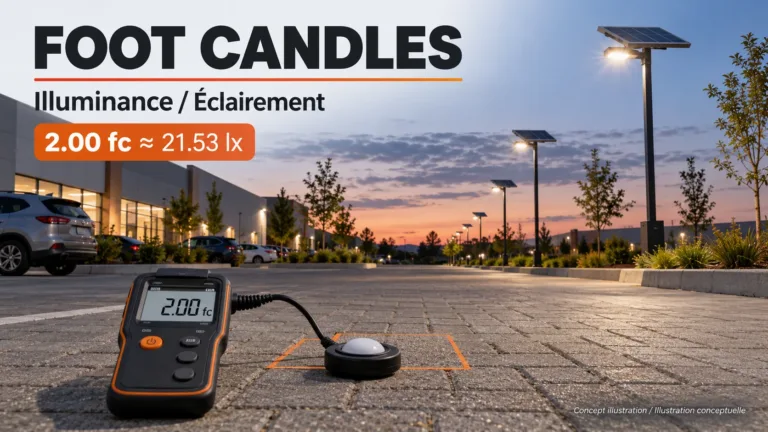
A handheld spectrometer can distinguish concentrated sodium emission from an LED spectrum. A color meter can document chromaticity and CCT, while a photometer measures illuminance or luminance. No single measurement replaces the approved road-lighting criteria.
6. Confirm the design intent
Check the road class, environmental restrictions, community policy, drawings, IES files, dimming schedule, and commissioning report. The same color can be acceptable in one site and inappropriate in another.
Keep, Replace, or Redesign? A Five-Step Decision
A retrofit should solve a measured problem. Replacing every orange light because it looks old can waste usable equipment; keeping an inefficient or poorly performing system indefinitely can also be costly.
Step 1: Establish the existing baseline
المستند:
- luminaire and lamp type
- input power and operating hours
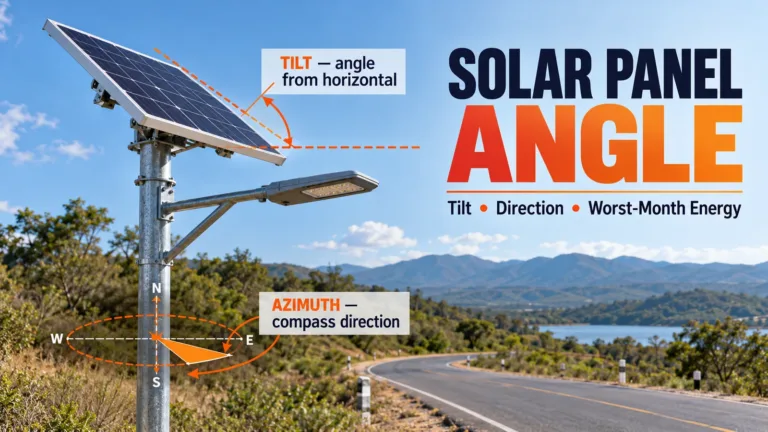
- pole height, spacing, outreach, and tilt
- road width and classification
- failure rate, relamping cycle, and maintenance cost
- current controls and electrical condition
- illuminance or luminance, uniformity, and glare
- complaints, sensitive receptors, and local lighting policy
Without a baseline, savings and performance claims are not auditable.
Step 2: Decide what must improve
Possible objectives include lower energy use, fewer night repairs, better uniformity, improved color recognition, reduced spill light, lower short-wavelength output, remote monitoring, or compliance with a revised standard.
Rank the objectives. A wildlife-sensitive road may prioritize spectrum and controls differently from a high-conflict urban intersection.
Step 3: Model the proposed luminaire
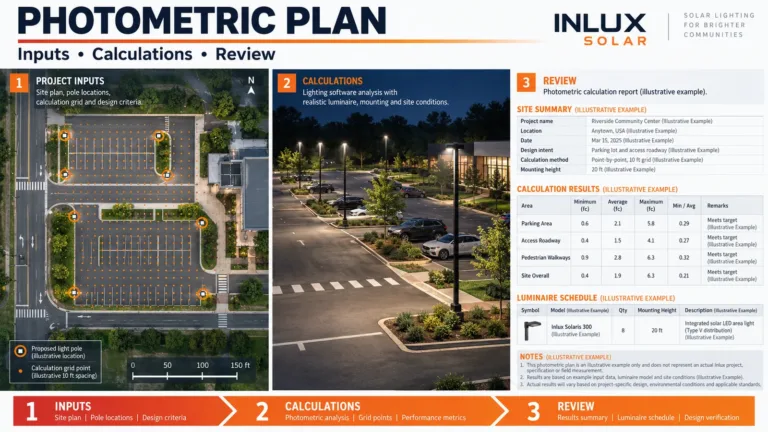
Do not perform a simple watt-for-watt swap. Use the candidate luminaire’s verified IES file with the actual pole geometry and pavement assumptions. Check minimum and average performance, uniformity, glare, conflict areas, pedestrian zones, and property-line spill.
Review the Inlux road and street lighting solution for the project inputs and photometric deliverables normally needed at this stage.
Step 4: Pilot representative locations
Test more than the easiest straight road. Include representative intersections, curves, pedestrian areas, dark surroundings, adjacent residences, and any sensitive habitat. Record measurements and structured feedback rather than relying only on photographs.
Where spectrum is a concern, compare appropriate warm-white and amber options at equivalent required road performance. Avoid comparing one overlit product with one underpowered product and calling the result a color test.
Step 5: Lock acceptance and warranty terms
The specification should identify:
- luminaire model and revision
- CCT, chromaticity tolerance, and CRI where relevant
- optic and IES file
- surge protection, driver, controls, and communication protocol
- batch and serial traceability
- photometric acceptance method
- warranty scope for driver, LED module, optics, housing, color shift, freight, and labor
- replacement response time and post-replacement verification
Inlux Solar’s standard warranty is five years. A project contract should still state exactly what is covered and how a nonconforming color, driver, control, or optical condition will be tested and remedied.
The available range of project-grade LED street lights can be evaluated against the road geometry and environmental requirements rather than selected by wattage alone.
الأسئلة المتداولة
Why are street lights orange instead of white?
Many older street lights use sodium-vapor lamps. Sodium emits strong visible light near 589 nm, creating a yellow-orange appearance. High-pressure sodium produces a broader golden light than low-pressure sodium. Some newer installations use amber LED intentionally.
Are orange street lights sodium or LED?
They can be either. Saturated yellow light with very poor color recognition suggests low-pressure sodium; golden-orange light may be high-pressure sodium. Amber LEDs can look similar but usually offer instant-on operation and electronic controls. Check the fixture label or spectrum for confirmation.
What is the difference between low-pressure and high-pressure sodium street lights?
Low-pressure sodium concentrates most visible output in a very narrow yellow band and renders colors poorly. High-pressure sodium has a broader spectrum, a warmer orange-white appearance, and better color recognition than LPS, though typically less than a suitable white LED.
Are orange street lights more energy-efficient than LEDs?
Sodium lamps were efficient for their era, but modern LED retrofits can reduce input power and maintenance while improving optical control. The actual result depends on the existing system and proposed design. A photometric and lifecycle comparison is more reliable than a technology label.
Are orange street lights safer?
Color alone cannot establish safety. Sodium light may provide useful visibility, but limited color rendering can reduce object-color recognition. A safe road-lighting design also depends on light level, uniformity, glare, geometry, conflict areas, maintenance, and controls.
Are amber street lights better for wildlife and the night sky?
Reducing short-wavelength output can be useful near sensitive environments, and DarkSky recommends warm or amber options where appropriate. Amber color is only one factor. Shielding, low output, limited operating time, and keeping naturally dark areas dark are also necessary.
Why are cities changing orange street lights to white LEDs?
Common objectives include energy savings, lower maintenance, improved color rendering, better light distribution, and controls. Portland’s conversion program projected 20 million kWh of annual energy reduction, but every city needs its own baseline and design.
Should every high-pressure sodium street light be replaced?
No. A functioning HPS system may remain serviceable until a planned renewal point if it meets local requirements and is economical to maintain. Replacement becomes stronger when measured energy, maintenance, visibility, control, or compliance problems justify the investment.
Get a Street-Lighting Retrofit Review
For a sodium-to-LED or amber-LED assessment, provide the road cross-section, pole height and spacing, current lamp or luminaire, wattage, operating schedule, maintenance history, local standard, environmental constraints, and any existing IES files or field measurements.
Request a street-lighting retrofit review
Technical References
- NIST: Strong Lines of Sodium (Na)
- NIST: Wavelengths, Transition Probabilities, and Energy Levels for the Spectra of Sodium
- U.S. Department of Energy: Demonstration Assessment of LED Street Lighting
- Portland Bureau of Transportation: LED Street Light Conversion Program
- Federal Highway Administration: City of Portland LED Lights Replacement Program
- DarkSky: Values-centered outdoor lighting
- DarkSky: Five Principles for Responsible Outdoor Lighting