To convert amp hours to watt hours, multiply battery capacity in Ah by its nominal voltage: Wh = Ah × V. A 100 Ah battery at 12.8 V is 1280 Wh; at 25.6 V it is 2560 Wh. Without voltage, an Ah figure cannot tell you the stored energy. This calculation gives nominal energy, not a promise of usable output or lighting hours.

If you are checking a quotation, keep the battery label or data sheet beside you. Find the pack capacity, confirm the voltage attached to that capacity, then do the multiplication. Do not substitute the solar panel voltage, charging voltage or a rounded system name. Those numbers may belong to different parts of the equipment.
Amp hours to watt hours: the formula and a quick chart
Ah measures electric charge. Wh measures energy. Voltage connects the two. For a battery nameplate calculation, use the nominal pack voltage specified by its manufacturer. For an actual discharge test, delivered energy depends on voltage and current throughout the test; one instantaneous voltage reading is not a capacity measurement.
Use Wh = Ah × V for the forward conversion and Ah = Wh ÷ V for the reverse. For milliamp-hours, divide by 1000 first: Wh = (mAh ÷ 1000) × V. These equations are also set out in the battery manufacturer’s RELiON explanation of Ah and Wh. The chart below is calculated from those equations, not measured performance of an Inlux model.
| Capacity (Ah) | At 12 V (Wh) | At 12.8 V (Wh) | At 25.6 V (Wh) |
|---|---|---|---|
| 20 | 240 | 256 | 512 |
| 40 | 480 | 512 | 1024 |
| 50 | 600 | 640 | 1280 |
| 100 | 1200 | 1280 | 2560 |
| 200 | 2400 | 2560 | 5120 |
| 300 | 3600 | 3840 | 7680 |
Choose the column that matches the actual nominal voltage. A missing voltage is missing information, not an invitation to assume 12 V. To express the result in kilowatt-hours, divide Wh by 1000: 2560 Wh is 2.56 kWh. Keep enough precision to reproduce the supplier’s calculation, then round the final comparison consistently.
Use the nominal voltage, not the charger setting
A battery described casually as “12 volt” may have a more specific nominal rating. For example, the Victron Lithium Smart technical data lists a 12.8 V, 100 Ah battery with 1280 Wh nominal energy at 25°C. This is a manufacturer example, not the specification of an Inlux street light. Using 12 V instead would produce 1200 Wh and change the comparison.
Charging voltage is not the substitute. Nor is the open-circuit voltage of a PV module. When converting amp hours to watt hours, the voltage and Ah value must describe the same battery assembly. If the data sheet states energy directly, compare it with the multiplication and ask about any material discrepancy, including temperature, test rate and rounding.

A smaller Ah number can buy more stored energy
Consider two fictional solar street-light quotations. Offer A lists 40 Ah at 12.8 V. Offer B lists 30 Ah at 25.6 V. Reading only the Ah column makes A look larger. Converting amp hours to watt hours shows B has more nominal energy. That does not make B automatically the better lighting system: voltage compatibility, usable capacity, PV recharge and the lighting task still matter.
| Illustrative offer | Ah × nominal V | Nominal energy | What it establishes |
|---|---|---|---|
| A | 40 Ah × 12.8 V | 512 Wh | Lower nominal energy in this example |
| B | 30 Ah × 25.6 V | 768 Wh | Higher nominal energy, not a runtime guarantee |
This is the useful role of amp hours to watt hours in procurement: put unlike labels on one energy basis before debating which proposal is better. Keep the original Ah and voltage columns in the comparison sheet. A Wh-only summary can hide a voltage mismatch, while an Ah-only summary can hide an energy mismatch. Neither should replace the complete battery identification.
The mAh trap: cell figures are not always pack figures
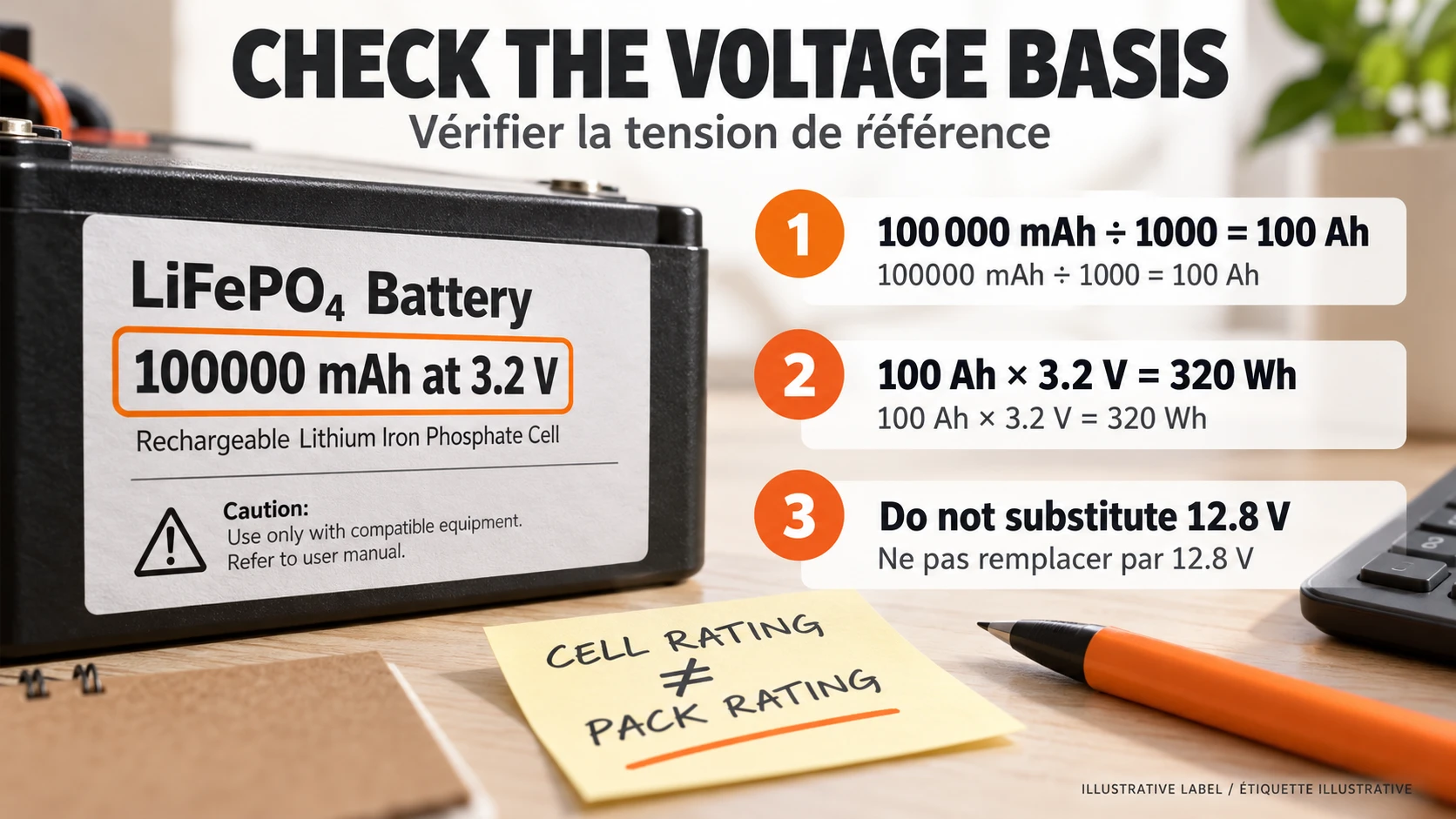
Large mAh numbers deserve a second look, not an automatic rejection. A label of 100000 mAh means 100 Ah, but its energy still depends on the stated voltage. At 3.2 V it represents 320 Wh. Multiplying that same figure by 12.8 V would incorrectly give 1280 Wh if the original rating belonged to a 3.2 V cell or cell-equivalent basis.
For identical cells in an approved series arrangement, voltages add while the string Ah stays the same. Four illustrative 3.2 V, 25 Ah cells in series make a 12.8 V, 25 Ah assembly: 320 Wh, not 1280 Wh. In a compatible parallel arrangement, Ah adds while voltage stays the same. These are accounting examples, not instructions to build or rewire a battery; follow the manufacturer’s BMS and configuration limits.
Nominal Wh is not usable Wh at the luminaire
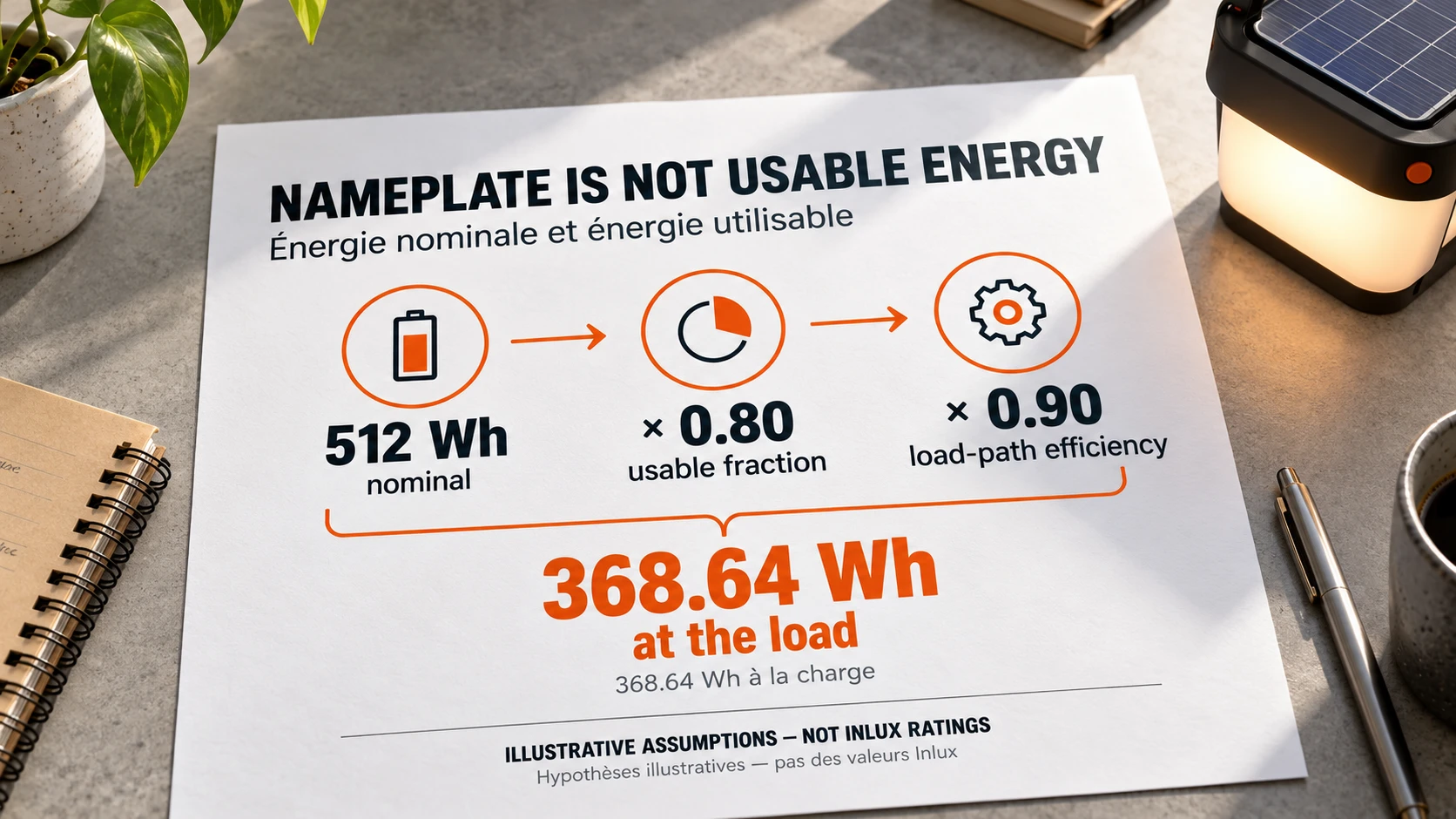
The amp hours to watt hours formula converts a rating; it does not remove discharge limits or losses. For a simple illustrative check, take the 512 Wh battery above, an allowed usable fraction of 0.80 and a battery-to-load efficiency of 0.90. Energy reaching the stated load boundary would be 512 × 0.80 × 0.90 = 368.64 Wh. Those factors are assumptions, not Inlux ratings or universal design values.
Define the boundary before using an efficiency factor. Battery-terminal energy, energy at the luminaire input and energy at the LED module are different quantities. Do not multiply by a round-trip charging efficiency when you only mean discharge-path loss, or count the same loss twice. A quotation should show what each allowance covers and the operating conditions behind it.
A constant 30 W load would use 360 Wh over 12 hours. The illustrative 368.64 Wh result is not enough evidence to specify that installation: reserve, temperature, ageing, control consumption and charging conditions have not been established. For the whole design, use the separate solar street-light battery sizing guide. This conversion page stops at making the energy figures comparable.
Five checks before you accept the battery line in a quote
| Quotation check | What to verify | Reason to pause |
|---|---|---|
| 1. Same assembly | Ah and nominal V refer to the complete proposed pack | Cell mAh multiplied by unrelated pack voltage |
| 2. Reproducible Wh | Ah × V agrees with stated nominal energy | Unexplained energy discrepancy |
| 3. Usable-energy basis | Discharge limits and operating conditions are stated | Nameplate Wh described as guaranteed output |
| 4. System compatibility | Battery, BMS, controller and charging settings match | Same Wh treated as proof of interchangeability |
| 5. Lighting brief | Operating profile and site conditions accompany the offer | A battery label alone used to promise nights of autonomy |
Use this conversion when reviewing the Inlux All-in-One range; the same arithmetic applies to the Inlux All-in-Two range. The product architecture does not change the unit conversion. It does change the physical package, service access and component matching that the project team must review.
Inlux Solar’s standard warranty is five years. That verified company policy is not a substitute for a configuration-specific capacity or retention statement. For a solar parking-lot lighting project, record the agreed battery basis alongside the actual night-time lighting brief rather than copying a generic battery number into every location.
FAQ: battery conversion questions
How do you convert 200 amp hours to watt hours?
Multiply 200 Ah by the nominal battery voltage. At 12 V the result is 2400 Wh; at 12.8 V it is 2560 Wh; at 25.6 V it is 5120 Wh. There is no single correct Wh answer for “200 Ah” without a voltage.
How many watt-hours is a 300 Ah battery?
A 300 Ah battery contains 3600 Wh nominally at 12 V, 3840 Wh at 12.8 V or 7680 Wh at 25.6 V. Use the voltage on the relevant pack data sheet, not the charger voltage. Actual usable energy can be lower.
How do I convert 1000 Wh back to Ah?
Divide watt-hours by nominal volts: Ah = Wh ÷ V. For 1000 Wh, that is about 83.33 Ah at 12 V, 78.125 Ah at 12.8 V or 39.0625 Ah at 25.6 V. Keep the voltage with the result so another buyer can reproduce it.
Why do suppliers use Ah instead of Wh?
Ah is useful for describing battery charge capacity and relating it to current over time. Wh is more convenient for comparing energy across different voltages. Request both, together with nominal voltage; neither number alone establishes discharge capability, safe compatibility or service life.
Does the same Wh mean two batteries are interchangeable?
No. They can have different voltages, chemistry, BMS limits, current ratings, connectors, dimensions and charging requirements. Equal nominal energy is only one comparison. A replacement needs approval for the complete lighting system; do not rewire or substitute packs from a conversion chart.
Can Wh tell me how many nights a solar street light will run?
Not by themselves. You need usable energy, the actual load profile, system losses, control rules and site-dependent recharge conditions. Amp hours to watt hours is a conversion step, not a complete autonomy calculation. Have the lighting and energy assumptions reviewed together.
Take a comparable battery brief into the project discussion
For a project using commercial solar street lighting, send the pack voltage, Ah, declared Wh, operating profile, installation location and quantity with your solar lighting enquiry to Inlux Solar. Include the source label when the numbers disagree. That gives the team a concrete discrepancy to resolve, instead of asking whether the largest Ah number must be the best offer.