







Intersection & Roundabout Lighting
Design safer, clearer decision zones at intersections and roundabouts—using the standard and edition adopted by the responsible road authority. We apply luminance-based design on approaches and the illuminance method within conflict areas, adding vertical or semicylindrical illuminance at pedestrian and bicycle crossings for face recognition. Lighting is transitioned along each approach to support eye adaptation, while optics, mounting height and spacing are optimized from photometric files to achieve uniformity and low glare. Choose grid-powered LED or solar options, and receive a preliminary layout for project-specific compliance review, calculation report and bill of materials ready for procurement.
Design Principles for Intersection & Roundabout Lighting

Standards-led classes
M-class luminance on approaches; illuminance-based criteria (incl. vertical/semicylindrical) inside conflict areas and at crossings; control uniformity and disability glare (TI/veiling).

Pedestrian visibility
Specify crossing vertical illuminance, measurement height and driver-view directions from the adopted local criteria; a research example is not a universal design target.

Roundabout lighting
Assess circulating lanes and conflict areas with the road authority; select maintained levels and uniformity for the site rather than applying one illuminance value to every roundabout.

Transition zones
Define the illuminated approach transition from the adopted design guide, approach speed, geometry and surrounding lighting; do not treat one distance as universal.
Solutions by Scenario
Signalized Intersections
Luminance-based approaches, added vertical illuminance at crosswalks, strict glare control for turning movements.
Unsignalized / Stop-Controlled
Boost recognition at yield/stop lines; illuminate splitter/median islands and near-side/ far-side crosswalks.
Roundabouts
Uniform lighting over the circulatory roadway, transitioned approaches, and vertical components where pedestrians/bikes are present.
Mid-Block Crossings
Check vertical illuminance across the crossing from the relevant driver-view directions, using the measurement height and maintained target specified for the project.
Interchanges / Toll Plazas (High-Mast)
Wide-area coverage with high-mast where appropriate; fewer poles, simplified maintenance.
What You Get
- Layout and calculation report identifying the adopted standard, edition, methods and project-specific acceptance criteria
- Photometric files (IES/LDT) + calculation reports
- Pole/foundation drawings + wiring single-line
- BOM with options (LED vs Solar, pole heights, optics)
- O&M, warranty and acceptance checklist
Recommended Solar Street Light Products

JAGUAR (INL-AIT5)
High-output all-in-two with 5050 LEDs, large LiFePO4, advanced optics—built for highways and major roads.

SIRIUS (INL-AIO9)
High-output AIO with adjustable head, Type II/III optics, 5050 LEDs and LiFePO4—built for two-way roads and highways.

APOLLO Lithium Battery
Modular performance with long-life batteries; reliable output under varied urban conditions.
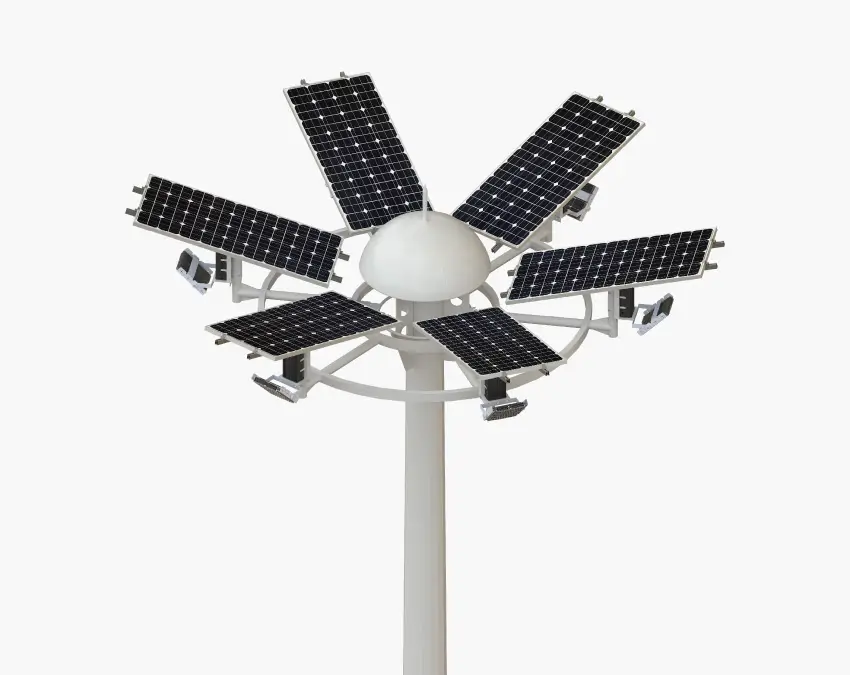
Solar Mast Light
Split-type solar high mast for large areas. 15–30 m poles, ring or directional carriages, high-efficacy flood arrays, PV + LiFePO4 sized to latitude and nights-of-backup.

Integrated Solar Mast Light
All-in-one solar luminaires paired with high masts for simplified wiring. 15–30 m pole options, engineered optics and autonomy, with wind-load checks and optional lowering system.
Recommended LED Street Light Products

INL-LED25 — LED Street Light
100–200 W packages, roadway optics and controls-ready drivers for main and collector roads.

INL-LED24 — LED Street Light
50–200 W with precise Type II/III/V optics; tool-less service and SPD options for municipalities.

INL-LED22 — LED Street Light
60–200 W versatile platform with roadway distributions and controls options.

INL-LED13 — LED Street Light
60–200 W with durable die-cast housing and IP/IK ratings for urban streets and lots.

Mini Mast Light
Mid-height masts for lots and campuses with multiple luminaires and tailored optics; engineered AC controls and easy maintenance.

High Mast Lamp
Modular flood arrays for ring or directional mounting; 200–1200W per lamp, >125/175 lm/W packages, 90–305V AC, 30°/60°/90°/120° beam options.