







Road & Street Lighting
Design safe, efficient illumination for urban roads and streets—in full compliance with EN 13201 and IES RP-8. We prioritize luminance-based design for motorized traffic lanes and apply the illuminance method for pedestrian and conflict areas such as crossings and intersections. Mounting geometry, optics and spacing are optimized from photometric files to achieve uniformity and low glare. Whether grid-powered LED or solar street lights, we deliver layouts, reports and a bill of materials tailored to your road class and local code—ready for procurement and installation.
Design Principles for Road & Street Lighting

Standards-led classes
Use M-classes (luminance) for main carriageways; P/C-classes (illuminance) for pedestrian and conflict areas. Control uniformity and disability glare (TI/veiling).

Optics & mounting
Select Type II/III distributions, arm length and height to match lane count, medians and sidewalks; spacing is a calculation outcome based on targets and photometry.

Crossings & intersections
Provide vertical/semi-cylindrical illuminance for face recognition and safety where required by the chosen P/C class.

Energy & controls
Dimming profiles, SPD choice, surge protection, and (when solar) battery autonomy sized for worst-case nights.
Solutions by Scenario
Urban Arterials & Collectors
Luminance-based layouts for consistent visibility at speed, low glare and long spacing ratios.
Residential & Local Streets
P-class illuminance with comfortable brightness, good U₀, and pedestrian-friendly vertical/semi-cylindrical metrics.
Intersections & Roundabouts
Conflict-area treatment with added vertical illuminance and glare control; optional high-mast for large junctions.
Crosswalks & School Zones
Enhanced vertical/semicylindrical illuminance and uniformity for driver recognition of pedestrians.
Solar Street Lighting Options
Off-grid systems with LiFePO₄, MPPT and adaptive dimming—ideal where trenching or grid tap-offs are constrained.
Municipal Solar Street Lights: Compare System Architectures
For a municipal road project, compare installation constraints, solar-panel orientation, energy storage, and maintenance access before selecting a model. Different streets within the same municipality may need different system architectures.
- All-in-One: consider an integrated fixture when compact construction and faster installation are priorities. Check that the available panel and battery capacity match the operating schedule and local solar conditions.
- All-in-Two: compare this architecture when the solar panel needs to be oriented separately from the luminaire. Review the panel mounting arrangement, pole loading, battery capacity, and lighting layout together.
- Split Type: review separated components when panel and battery sizing require more flexibility. Confirm the battery-box location, cable protection, installation scope, and maintenance access.
An international municipal reference is the Bamako road lighting project, which used 3,162 JAGUAR INL-AIT5-150W All-in-Two lights. The case describes sample testing before the full rollout; another location still needs its own lighting and system design. For integrated-system specification steps and illustrative layouts, use our All-in-One municipal design guide.
What You Get
- EN 13201 / IES RP-8 compliant layout (luminance or illuminance method)
- Photometric files (IES/LDT) + calculation reports
- Pole/foundation drawings + wiring single-line
- BOM with options (LED vs Solar, pole heights, optics)
- O&M, warranty and acceptance checklist
Recommended Solar Street Light Products

JAGUAR (INL-AIT5)
Off-grid street lighting with LiFePO₄, MPPT and adaptive dimming for urban corridors.
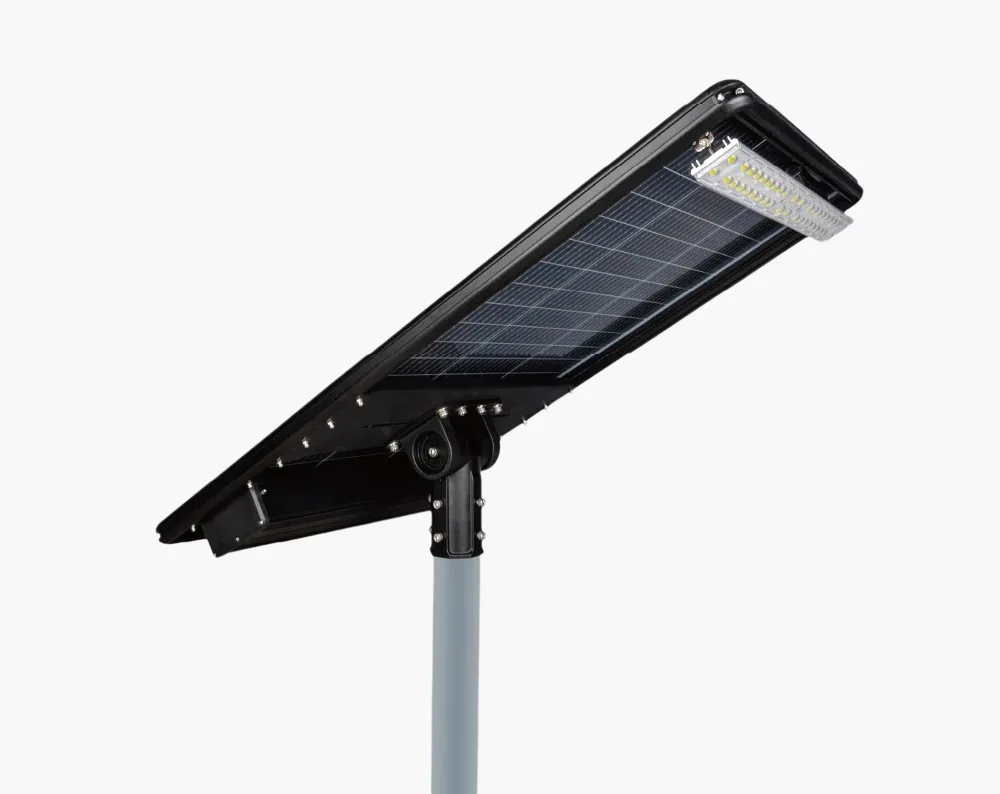
SIRIUS (INL-AIO9)
Integrated design, fast deployment and smart control for local streets and collectors.

APOLLO Lithium Battery
Modular performance with long-life batteries; reliable output under varied urban conditions.

Solar AC Hybrid
Hybrid supply for critical nodes and cloudy seasons; maintain illuminance and uniformity.

INL-SPL01 — Solar Pole Street Light
Sleek pole-integrated solar solution for avenues and promenades.
Recommended Solar Street Light Products

INL-LED25 — LED Street Light
100–200 W packages, roadway optics and controls-ready drivers for main and collector roads.

INL-LED24 — LED Street Light
50–200 W with precise Type II/III/V optics; tool-less service and SPD options for municipalities.

INL-LED23 — LED Street Light
50–240 W high-output range for wider spacings; multiple arm/slip-fitter mounts.

INL-LED22 — LED Street Light
60–200 W versatile platform with roadway distributions and controls options.

INL-LED13 — LED Street Light
60–200 W with durable die-cast housing and IP/IK ratings for urban streets and lots.