Most solar lights last 4–12 hours at night depending on the light type, battery size, and brightness mode. Decorative/path lights often hit 6–10 hours on low/medium, while constant “security-flood bright” output commonly lasts 2–6 hours. If you only get 1–2 hours, the fastest fixes are low/dimming or motion-only mode, panel cleaning, and checking for battery wear.
Note: This article focuses on night runtime (how many hours the light stays on after sunset). If you mean how many years solar lights last (overall lifespan), see: How Long Do Solar Lights Last? (Lifespan Guide).
Typical Runtime by Type (What’s Normal?)
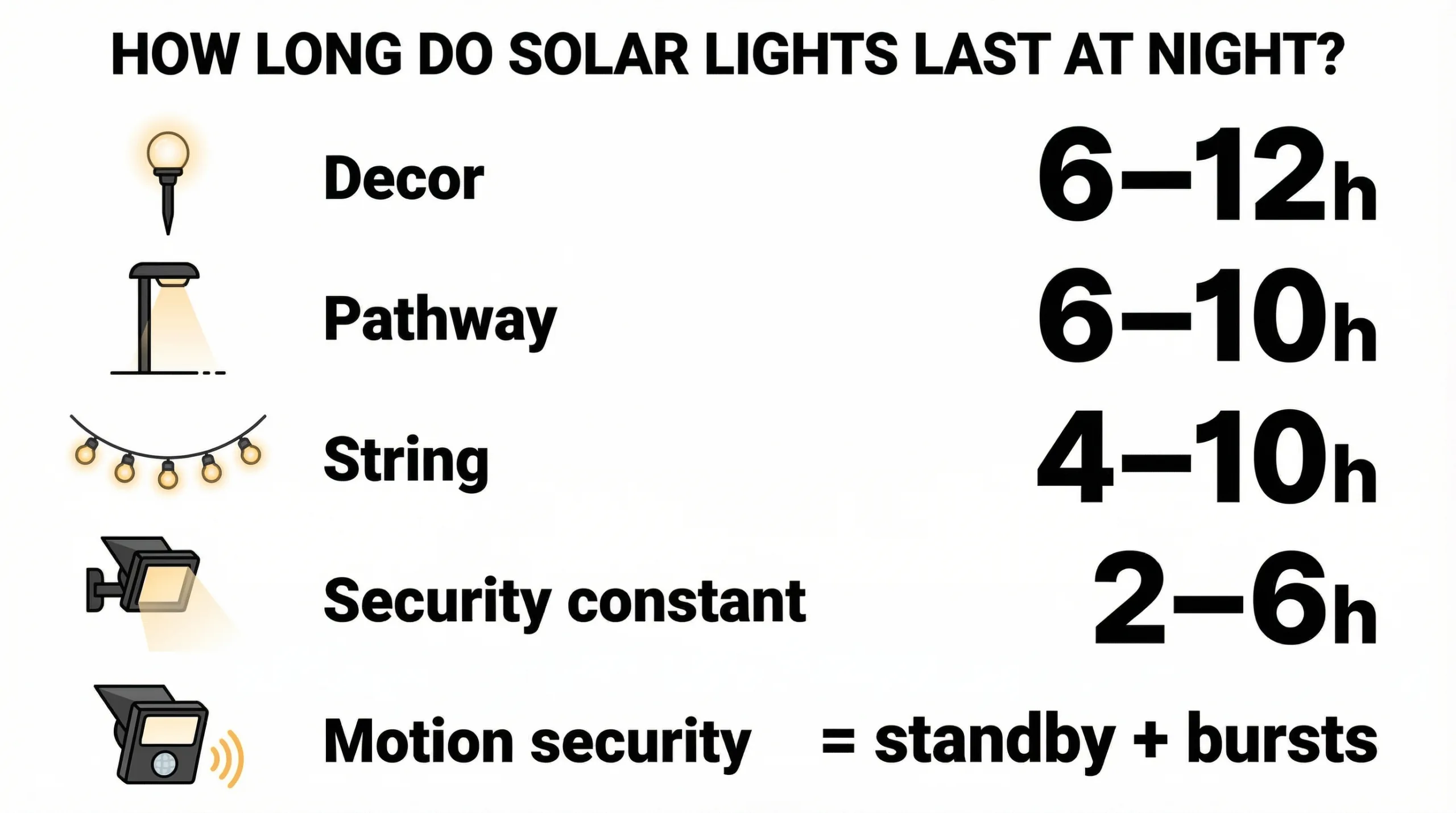
“Solar lights” covers everything from tiny garden stakes to high-output security fixtures. Here are realistic consumer ranges (assuming normal use and a decent charge day):
Decor / small garden stake
Typical: 6–12 hours (often dim)
Normal behavior: steady glow, not “headlight bright”
Pathway (medium brightness)
Typical: 6–10 hours
Normal behavior: visible late night on low/medium
String / fairy lights
Typical: 4–10 hours
Normal behavior: flashing modes shorten runtime
Security / flood (constant high)
Typical: 2–6 hours (often shorter)
Normal behavior: “all-night bright” is uncommon unless oversized
Security (motion-activated)
Typical: long standby + bursts
Normal behavior: runtime depends on trigger frequency
One-line truth: The brighter the light, the faster it drains the battery—runtime is an energy budget, not a promise.
What “All Night” Usually Means
Snippet answer: Yes, but “all night” usually means low mode, an auto-dimming profile, or motion-only—not maximum brightness from dusk to dawn.
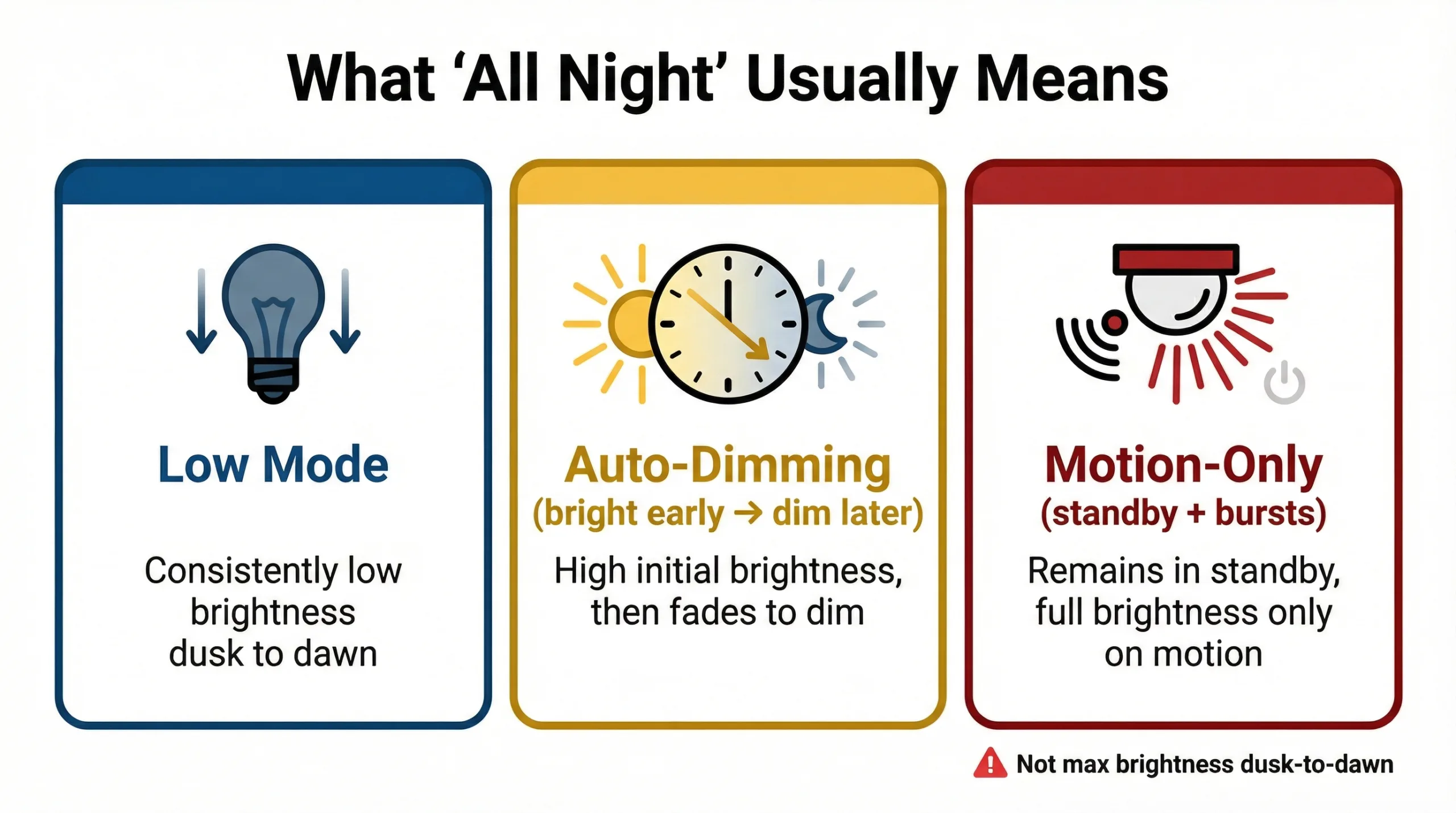
If you’re comparing products, ignore one headline runtime number. Look for runtime by mode (High / Low / Dimming / Motion) and whether the light uses a dimming schedule to stretch energy.
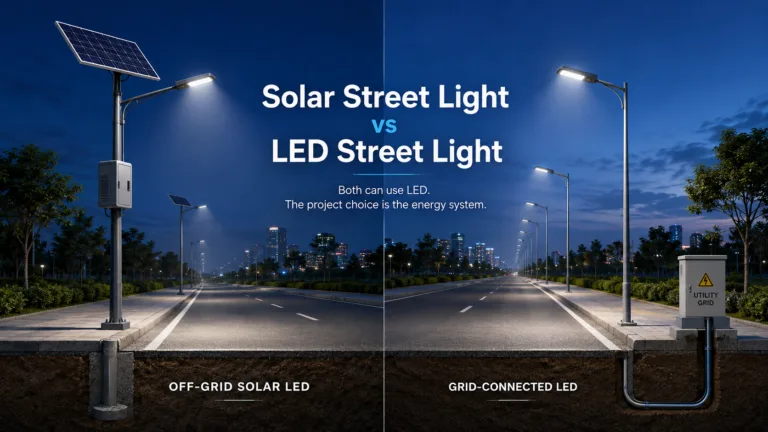
Where all-night runtime is contractually required, a solar AC hybrid street light removes the risk entirely by adding a grid backup to the battery system.
Mode Cheat Sheet (Biggest Runtime Lever)
Snippet answer: Switching from High to Low (or enabling dimming/motion-only) is usually the fastest way to extend night runtime—often more effective than moving or replacing the light.
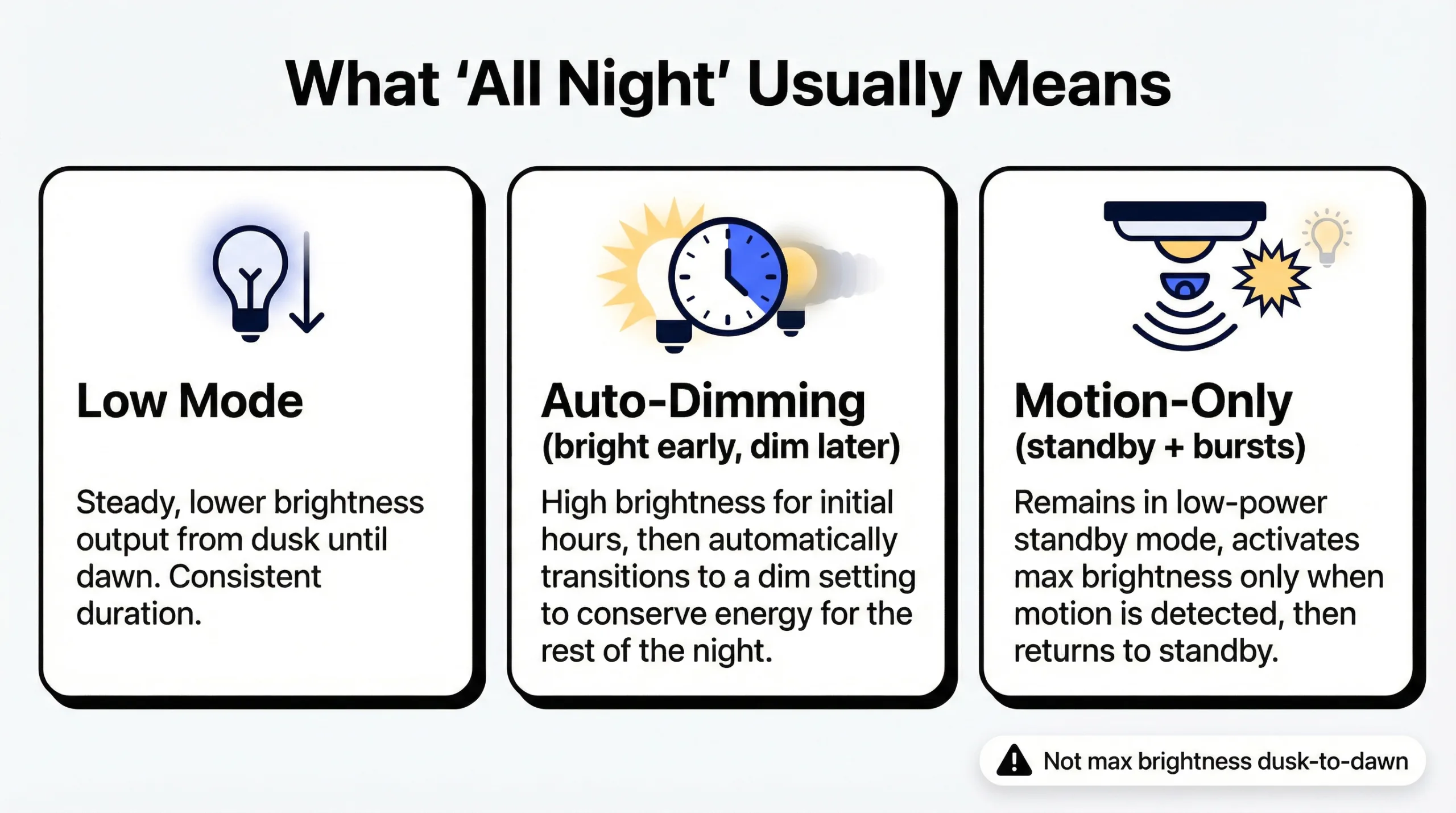
- High (constant): brightest, shortest runtime
- Low (constant): longest steady runtime
- Auto-dimming: bright early evening, dim later (best balance)
- Motion-only: best for security + low-charge conditions
60-Second Runtime Calculator (with examples)
If your product lists battery capacity, you can estimate runtime and spot impossible claims.

Estimator: Runtime (hours) ≈ Battery Wh × 0.75 ÷ Average LED W
0.75 is a practical “real-world” factor for losses + battery behavior.
Example A: Why low mode can feel “all night”
- Battery: 10 Wh
- Average LED power (low): 1.0 W
- Estimated runtime: 10 × 0.75 ÷ 1.0 ≈ 7.5 hours
Example B: Why high mode dies fast
- Battery: 10 Wh
- Average LED power (high): 5 W
- Estimated runtime: 10 × 0.75 ÷ 5 ≈ 1.5 hours
Quick cheat table (typical feel)
If you want ~8 hours…
You typically need Battery Wh to be roughly LED W × 10 (rule-of-thumb with losses).
If you want “bright all night”…
Look for dimming schedules or motion-only. Constant high output is the hardest scenario.
Why Solar Lights Die Early (1–2 Hours)
Snippet answer: Solar lights “fail quickly” at night when they’re spending energy faster than they stored—usually due to High mode, battery aging, cold weather, or not reaching full charge in recent days.
- High mode drain: the #1 cause of “only 2 hours”
- Battery wear: capacity drops over months/years
- Cold nights: less usable battery energy
- Never fully charged lately: several weak-charge days in a row
- Dirty panel: slow decline most people miss
- Motion trigger overload: for sensor lights (roads, pets, swaying branches)
Make Them Last Longer: Fix Order (Guaranteed Wins)
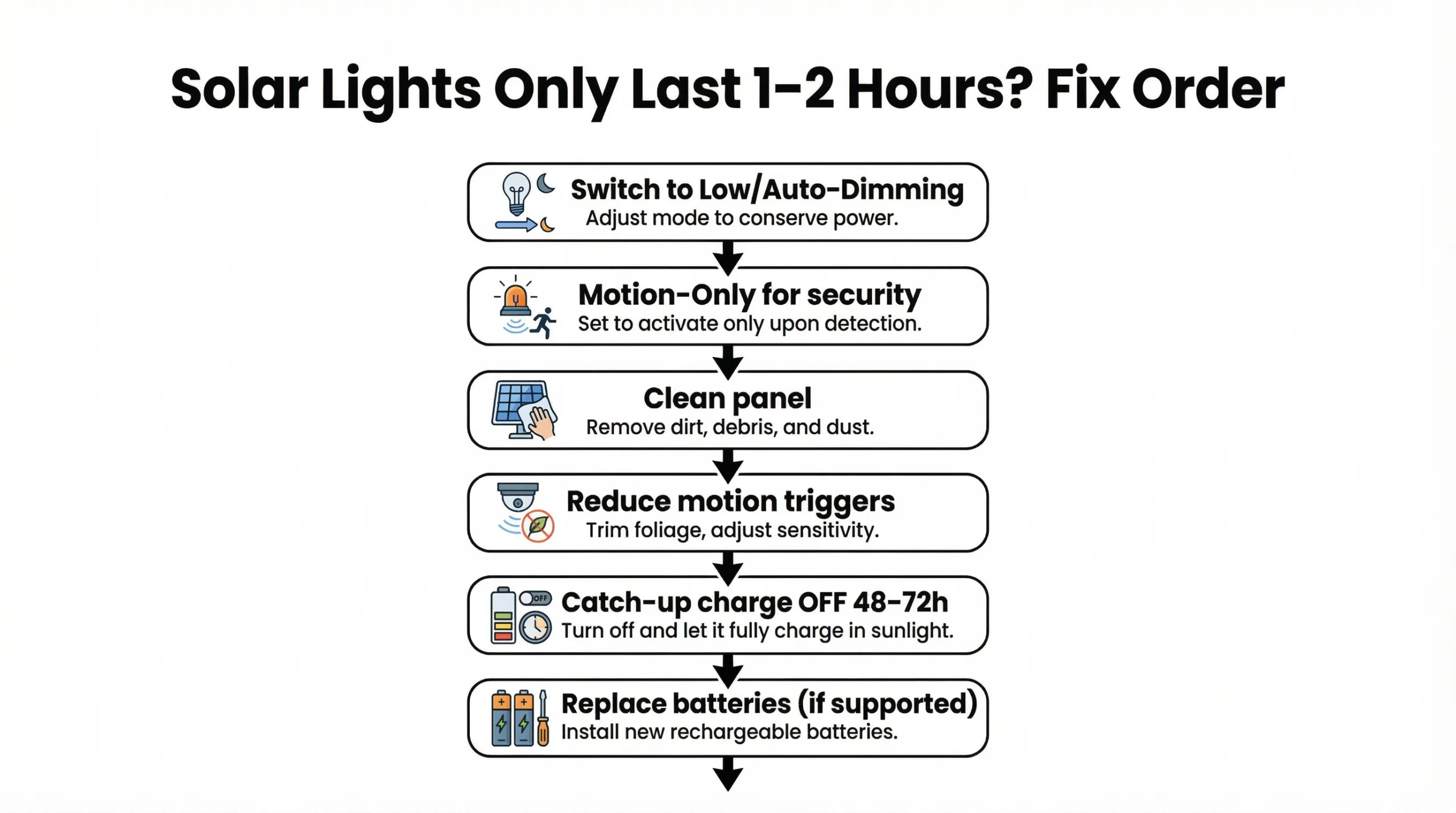
- Switch to Low or enable auto-dimming.
- For security: use motion-only instead of constant high brightness.
- Clean the solar panel (dust/pollen film matters).
- Reduce motion triggers (aim away from roads/pets/branches).
- Catch-up charge: turn the light OFF for 48–72 hours to recharge without nightly drain.
- Replace rechargeable batteries if supported (best fix when runtime used to be longer).
How Long to Charge for a Full Night?
Snippet answer: Many consumer solar lights need a full day of decent charging for their best runtime, and multiple weak days can reduce runtime sharply.
If your actual problem is charging conditions / panel exposure (not modes/battery), use this guide (separate topic, avoids keyword overlap):
Do Solar Lights Need Direct Sunlight? (Placement & Charging Guide)
Buying Checklist (Avoid Marketing Traps)
- Runtime by mode (High/Low/Dimming/Motion), not one headline number
- Dimming schedule (bright early evening → dim later) for “all-night feel”
- Meaningful battery capacity (Wh is more useful than mAh alone)
- Motion-only option for security use
- Replaceable batteries (extends product life)
Sanity rule: If a tiny panel + tiny battery claims “super bright all night,” the math usually doesn’t work out.
For project & street lighting buyers (optional, professional specs)
For roads/campuses/industrial sites, runtime should be specified as autonomy + dimming schedule, not a single marketing number.
- Autonomy days: e.g., 2–3 nights without new charging
- Dimming profile: e.g., 100% for 3 hours → 50% → 30% till dawn
- Battery chemistry: LiFePO4 is common for durability and safety in professional systems
- Controller strategy: charging efficiency + protections + low-voltage management
At Inlux Solar, we size panel + battery + dimming to hit the autonomy target, so “all night” is engineered—never assumed.
FAQ
How long do solar lights usually last at night?
Most run about 4–12 hours depending on type, battery size, and brightness mode.
How long do solar pathway lights last at night?
Pathway lights commonly last 6–10 hours on low or medium settings.
How long do solar string lights last at night?
Many solar string lights last 4–10 hours, and flashing modes typically shorten runtime.
Is it normal for solar lights to only last 2 hours?
It can be normal on high mode, but it often points to high power draw, battery wear, cold weather, or weak recent charging.
Do solar lights stay on all night?
Often yes—if they run in low mode, follow an auto-dimming schedule, or use motion-only. Constant maximum brightness all night is less common.
Which mode makes solar lights last the longest?
Low mode and auto-dimming profiles usually provide the longest usable runtime.
Why do solar lights get dimmer after midnight?
Many lights dim intentionally to save energy and extend runtime.
Why do solar lights shut off around midnight?
The battery often reaches a low-voltage cutoff, especially in high mode or with aging batteries.
Are motion-activated solar lights better for runtime?
Yes, motion-only operation saves energy by using bright output only when needed.
How can I make my solar lights stay on longer?
Switch to low/dimming or motion-only, clean the panel, and reduce unnecessary motion triggers.
What is a catch-up charge for solar lights?
Turning lights OFF for 48–72 hours lets them recharge without nightly drain, improving runtime after several weak-charge days.
Do solar light batteries wear out over time?
Yes, battery capacity declines with age, which commonly reduces night runtime.
When should I replace solar light batteries?
If runtime is much shorter than when new and the panel is clean, battery replacement is often the next step (if supported).
Does cold weather reduce solar light runtime?
Yes, cold can reduce usable battery energy, so runtime may drop even with similar charging.
Does higher brightness mean shorter runtime?
Generally yes, higher brightness usually means higher power draw and faster battery drain.
How long does it take solar lights to charge for a full night?
Many need a full day of decent charging for best runtime, and multiple weak days can reduce runtime sharply.
How can I estimate runtime from battery specs?
A quick estimate is Battery Wh × 0.75 ÷ Average LED W to account for real-world losses.
What specs should I look for if I want longer runtime?
Look for runtime listed by mode, auto-dimming, motion-only options, and meaningful battery capacity (Wh).