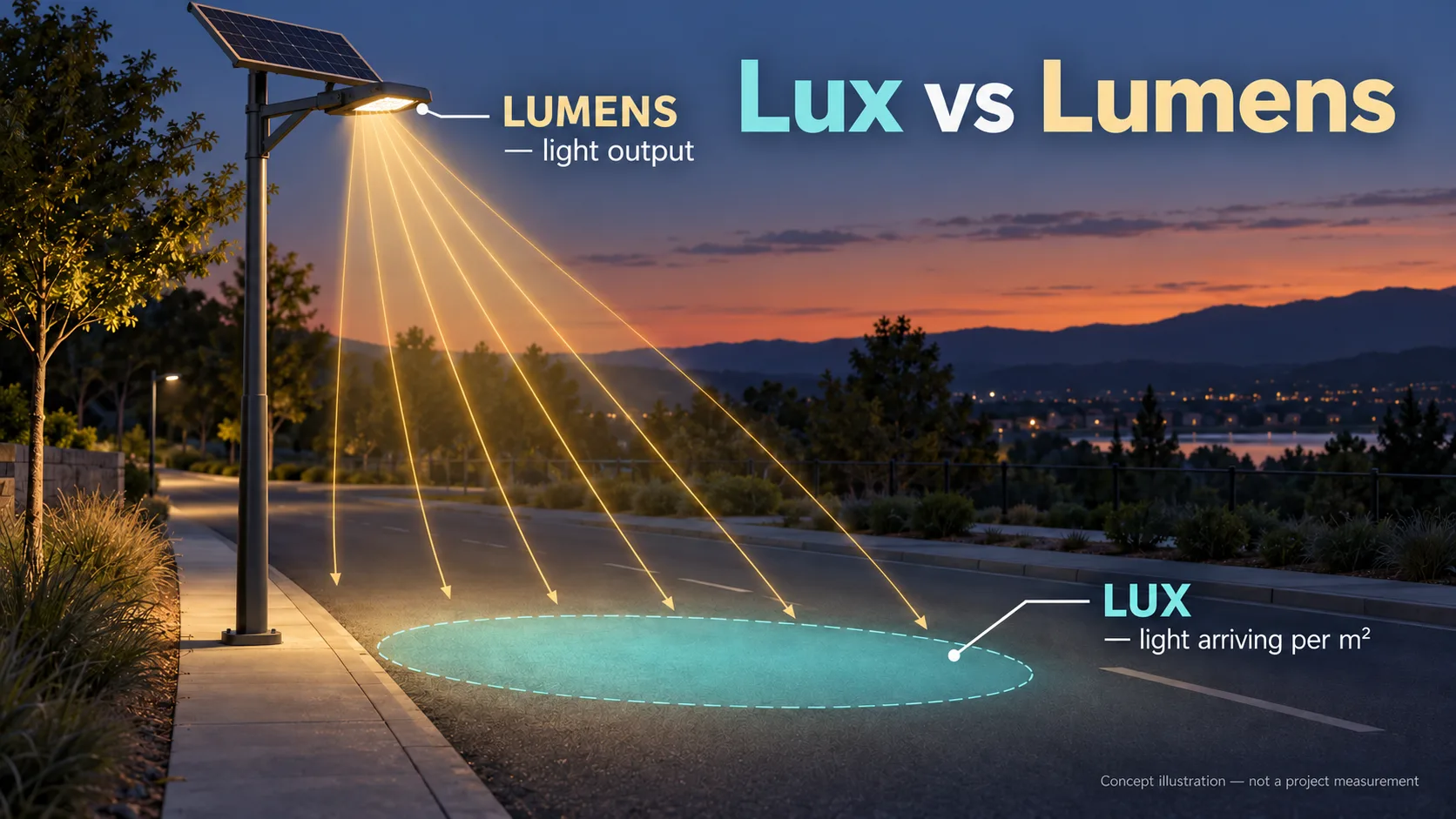
Lux vs lumens compares two different measurements: lumens describe luminous flux—the quantity of visible light—while lux describes how much of that light arrives per unit area of a surface. A lamp’s lumen rating tells you about its output. A lux reading tells you about the illumination at the place where you measure it.
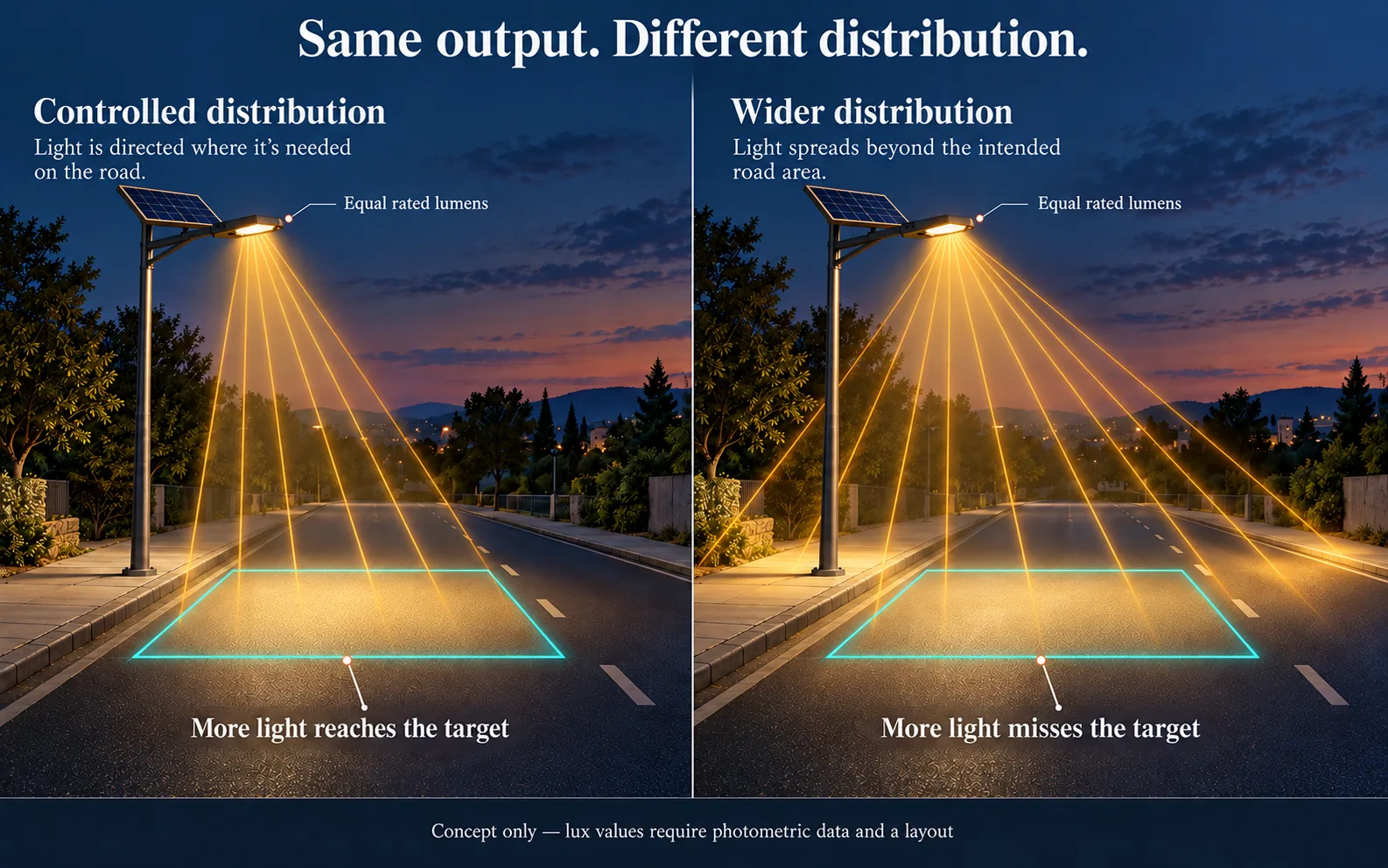
That distinction matters when two street lights advertise the same output. One may put more light on the road, while the other sends more beyond the kerb. The lumen figure can be identical even though the road looks different.
The useful question is not which unit is better. It is whether the number in front of you describes the lamp, the receiving surface or a particular test setup.
In this guide
- Lux vs Lumens at a Glance
- Why a Lumen Rating Is Not a Ground-Level Lux Guarantee
- Lux vs Lumens: The Conversion Formula and Its Limit
- Example 1: The Same Incident Light over Different Areas
- Example 2: Equal Lumens, Different Useful Light
- Example 3: The Square-Foot Trap
- What One Lux-Meter Reading Leaves Out
- Distance Changes the Result, but Height Alone Is Not a Calculator
- Applying Lux vs Lumens to Solar Street-Light Quotes
- What to Ask for Next
Lux vs Lumens at a Glance
| Quantity | Unit | What it describes | What it cannot tell you alone |
|---|---|---|---|
| Luminous flux | Lumen, lm | Visible-light flux; a luminaire rating normally describes emitted output | How that output is distributed across a road or path |
| Illuminance | Lux, lx | Incident luminous flux per square metre at a surface | Total luminaire output from one spot reading |
| Luminous intensity | Candela, cd | Output in a particular direction per unit solid angle | The total output in all directions |
| Electrical power | Watt, W | The rate of electrical energy use | Useful illumination without efficacy and optical information |
The NIST definition of lux gives the unit relationship: one lux is one lumen per square metre. The square metre is part of the definition, not an optional detail. Mixing square feet with lux produces a different answer unless you convert the area first.
In a lighting specification, “lumens” also needs a scope. Is it LED-package output before optical losses, or output from the complete luminaire? At what operating power and temperature was it measured? Comparisons become unreliable when one supplier quotes the LED chips and another quotes the finished fitting.
Why a Lumen Rating Is Not a Ground-Level Lux Guarantee
Imagine holding a torch over a table. Concentrating its beam on a small patch can produce a high reading there, but that says little about the dim corners. A wider beam may reduce the peak reading while spreading useful light over more of the table.
Street lighting adds more variables: mounting height, pole spacing, bracket reach, tilt, road width and the direction of the optical distribution. Light from adjacent luminaires can overlap. Buildings or vegetation can block part of it. A measurement at one location does not describe all of those conditions.
This is the practical meaning of lux vs lumens: a source rating and a receiving-surface result answer different questions. You need both when evaluating an installed lighting system.
For a real example of optical choice, Inlux’s INL-LED22 street-light page lists several beam options and makes IES photometric data available on request. That supports a model-and-optic-specific comparison. It does not establish one universal lux value for every installation of that product.
Lux vs Lumens: The Conversion Formula and Its Limit
For a defined surface, average illuminance can be written as:
Average lux = lumens arriving on that surface ÷ area in m².
Rearranging the same relationship:
Lumens arriving on the surface = average lux × area in m².
The important words are “arriving on that surface.” A luminaire’s rated output includes light that may miss the area you care about. Dividing that nameplate output by your site area assumes all of it reaches the site area—an assumption that often does not hold.
Uniformity is another separate issue. Dividing total incident flux by area gives an average; it does not mean every point has that value. A single lux reading can stand in for the average only when that substitution is justified, not simply because it is the only reading available.
There is consequently no fixed conversion such as “1,000 lumens equals 100 lux.” You must specify the receiving area and the light reaching it. A conversion tool that accepts only a lamp’s lumen number cannot determine the installed ground illumination.
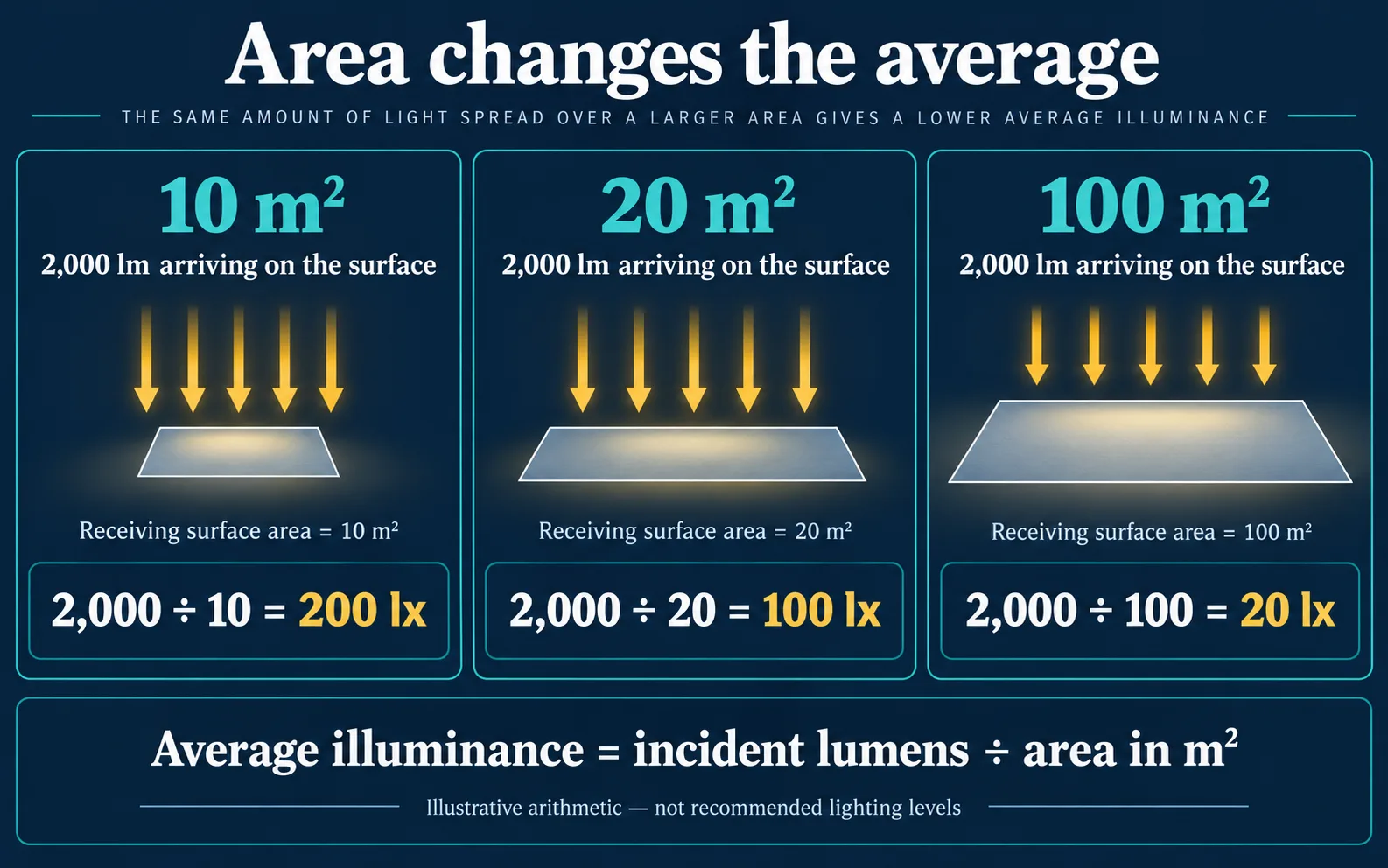
Example 1: The Same Incident Light over Different Areas
Suppose 2,000 lumens actually reach the chosen surface. These are hypothetical input values, not a product test.
| Receiving area | Calculation | Average illuminance |
|---|---|---|
| 10 m² | 2,000 ÷ 10 | 200 lx |
| 20 m² | 2,000 ÷ 20 | 100 lx |
| 100 m² | 2,000 ÷ 100 | 20 lx |
The arithmetic is straightforward because the input already states how much light reaches each surface. If 2,000 lm were only the lamp rating, those results would not follow without additional information.
This example explains the units. It is not a recommendation to install 200 lx, 100 lx or 20 lx on a road, car park or pedestrian route. The required criteria depend on the application and the applicable project requirements.
Example 2: Equal Lumens, Different Useful Light
Consider two hypothetical 10,000 lm luminaires serving the same 100 m² target area. Suppose a photometric calculation shows that 40% of the first luminaire’s output and 20% of the second luminaire’s output reach that area.
| Input or result | Layout A | Layout B |
|---|---|---|
| Luminaire output | 10,000 lm | 10,000 lm |
| Assumed share reaching the target | 40% | 20% |
| Flux arriving on the target | 4,000 lm | 2,000 lm |
| Target area | 100 m² | 100 m² |
| Calculated average | 40 lx | 20 lx |
The percentages are invented for this worked example. They are not Inlux efficiency claims, standard utilisation factors or recommended design assumptions.
The lesson is that selecting the fitting with the largest lumen number is not enough. Optics and layout decide where the output goes. Even Layout A is not automatically the better design: minimum illumination, glare, light outside the boundary and the required operating conditions still need review.
For a real comparison, request the photometric file for the exact configuration. Our guide to reading an IES file explains how to check whether the file and quoted luminaire belong together.
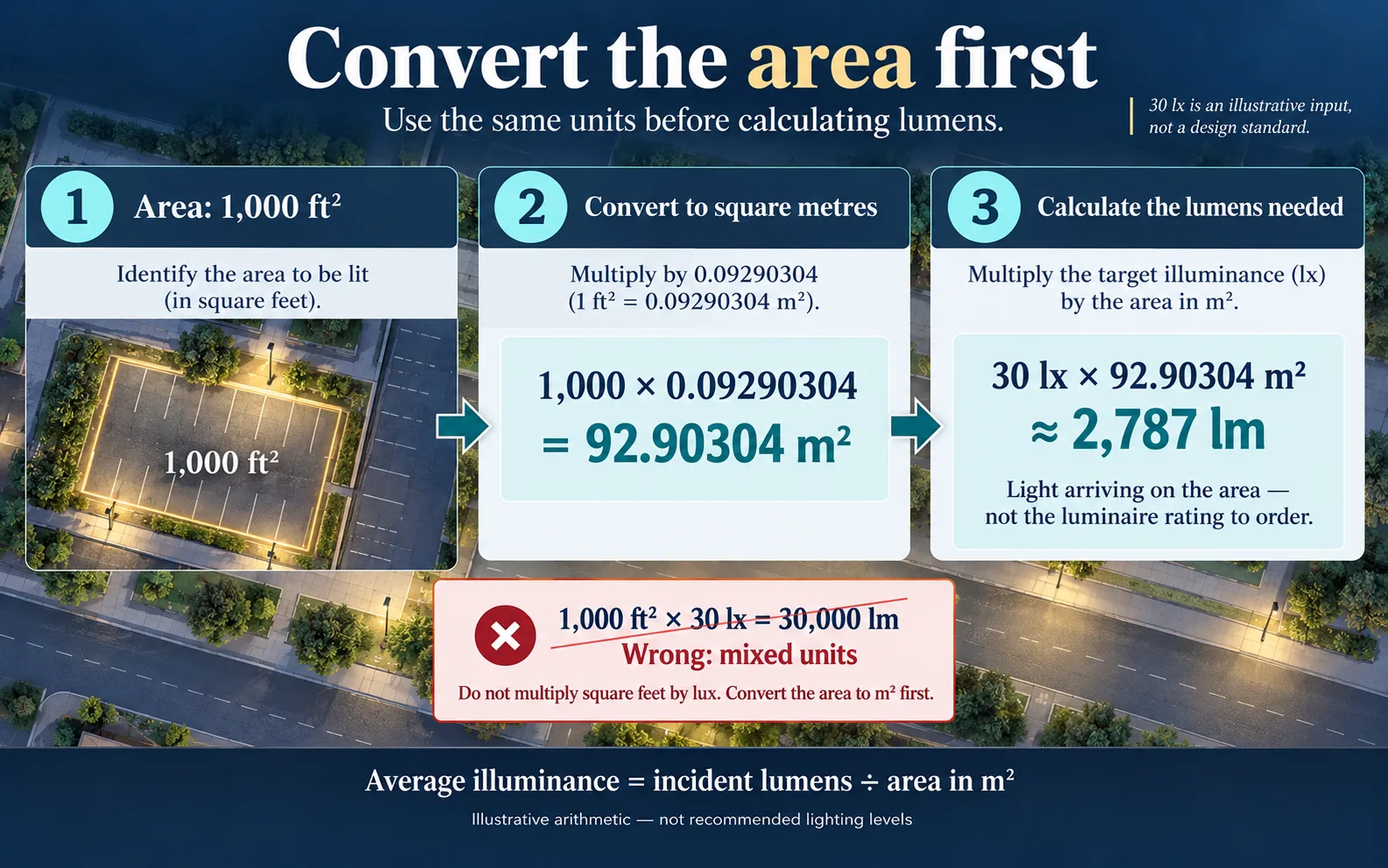
Example 3: The Square-Foot Trap
Suppose a calculation brief specifies an area of 1,000 ft² and a hypothetical average illuminance of 30 lx. First convert the area:
1,000 ft² × 0.09290304 = 92.90304 m².
Then calculate the incident flux corresponding to that average:
30 lx × 92.90304 m² = 2,787.0912 lm, or approximately 2,787 lm arriving on the area.
Multiplying 1,000 directly by 30 would give 30,000, but the mixed units would make that result wrong. Nor is 2,787 lm automatically the luminaire rating to order. You still need to account for how much emitted light reaches the target and the project’s design conditions.
The 30 lx input is only an arithmetic example. It is not a universal parking-lot or street-lighting requirement. This is where a useful lux vs lumens explanation should stop short of pretending to be a complete lighting design.
What One Lux-Meter Reading Leaves Out
A lux meter samples the illumination at its sensor. Move it, turn it, place it at another height or shade it with your body, and you may be measuring a different condition. Nearby lights and daylight can also contribute to the reading.
For a meaningful site record, identify the measuring plane, positions, instrument, time, weather, active luminaires and control setting. A sensor facing upward on a horizontal plane is not interchangeable with a sensor facing a sign or a vertical surface.
Keep the distinction between lux vs lumens in mind when reviewing a supplier’s photograph of a meter. The display may be genuine, yet the test position could be directly under the brightest part of the beam. Without the setup and other measuring points, it cannot prove complete area coverage or total luminaire output.
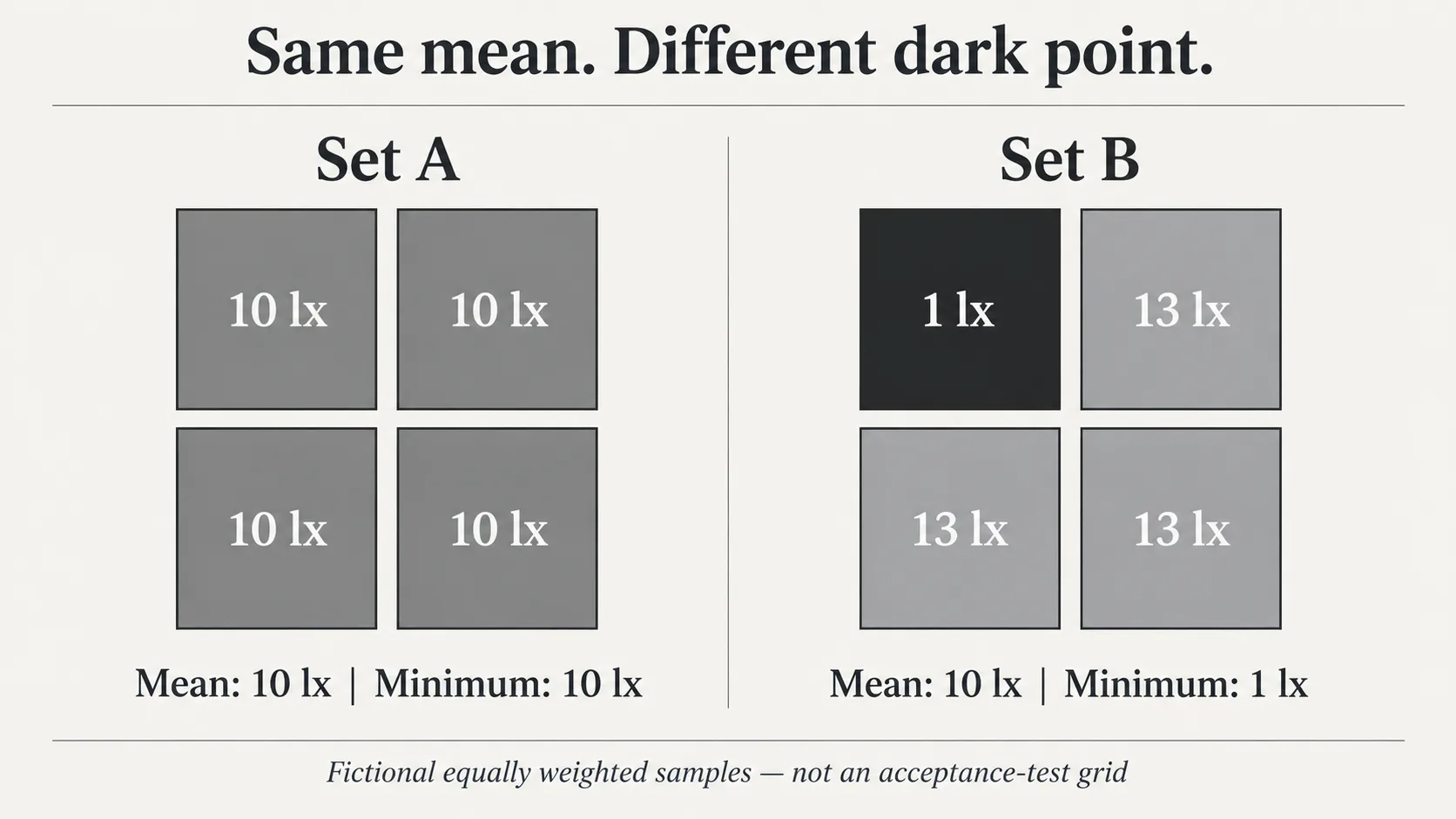
Average illumination also needs context. Consider these four equally weighted, fictional sample points:
| Sample set | Readings in lx | Mean | Minimum |
|---|---|---|---|
| A | 10, 10, 10, 10 | 10 lx | 10 lx |
| B | 1, 13, 13, 13 | 10 lx | 1 lx |
Both sample means are 10 lx. Set B nevertheless contains a much darker point. Four readings are used here to make the arithmetic visible, not to prescribe an acceptance-test grid. A real project needs the specified calculation or measurement grid and the required uniformity definition.
Distance Changes the Result, but Height Alone Is Not a Calculator
Moving a light farther from a surface generally changes both the illuminated footprint and the readings across it. In the ideal point-source case, with the receiving surface normal to the light direction and negligible attenuation, illuminance follows an inverse-square relationship with distance. The CIE’s discussion of source intensity, distance and illuminance explicitly identifies the point-source and surface-orientation conditions in its treatment.
Do not turn that simplified relationship into a rule that doubling every street-light pole height always quarters every road reading. Real comparisons also change the direction from the luminaire to each point, incidence angles and contributions from neighbouring fixtures. Roadway optics are not a uniform sphere of light.
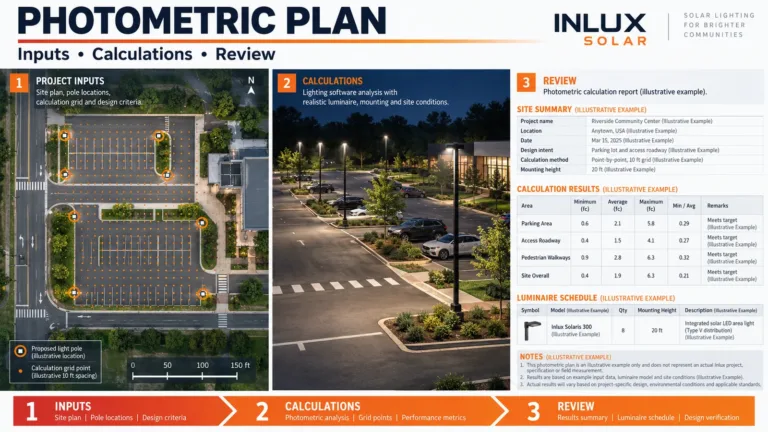
Use a project photometric calculation with matching IES data when the decision concerns pole height, spacing or compliance. The calculation should use the planned geometry, not a convenient generic scene.
Applying Lux vs Lumens to Solar Street-Light Quotes
A solar street light also has an operating profile. If the controller reduces output later in the night, a reading from the initial high-output period does not establish illumination during that later period. Ask which operating mode the reported result represents.
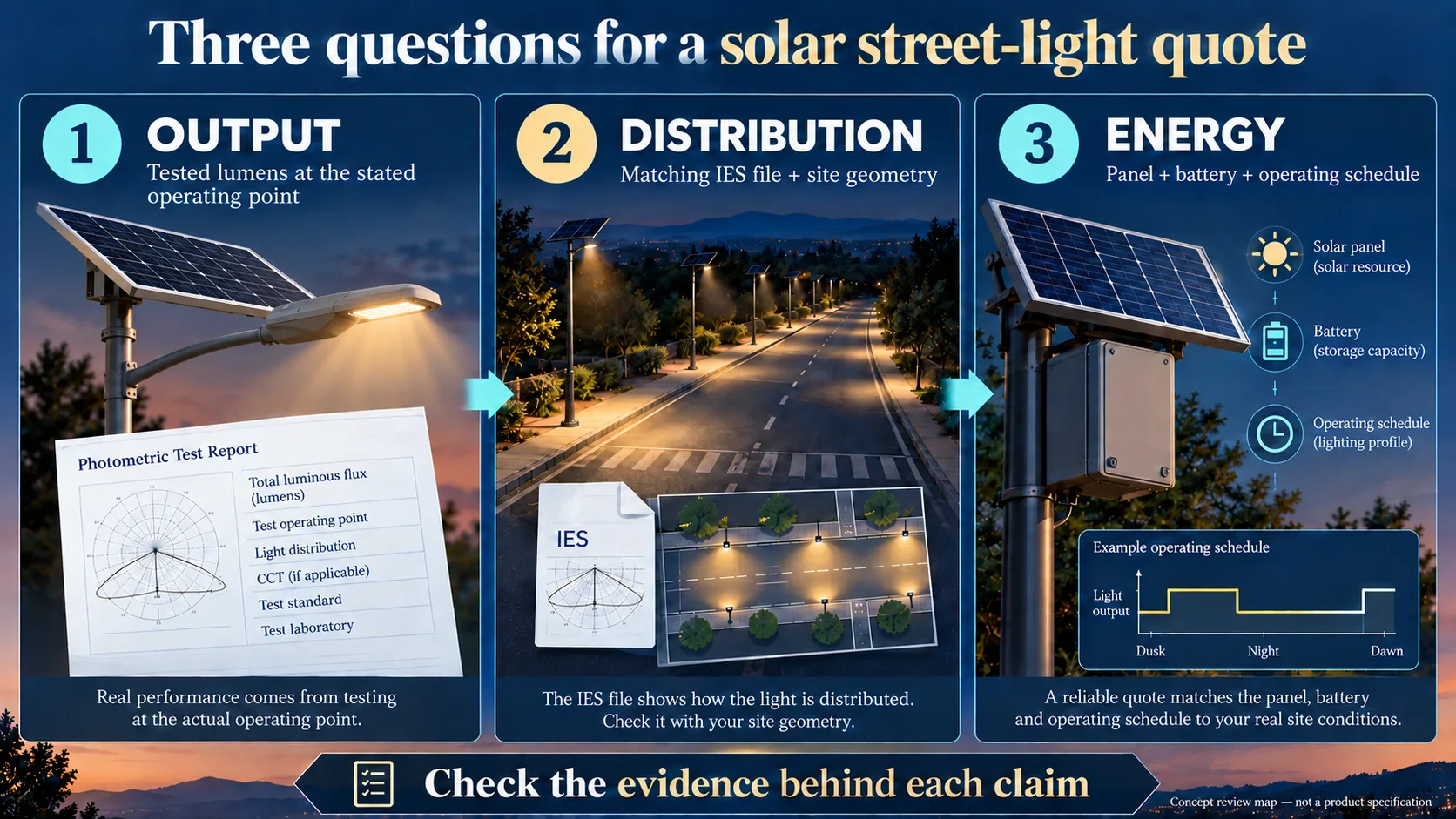
Separate three questions in the quotation:
- Output: What is the tested luminaire output for this configuration and operating point?
- Distribution: What does the matching photometric calculation show on the actual target surfaces?
- Energy: Can the panel, battery and control schedule support the required operation under the agreed design conditions?
This prevents a large lumen claim from substituting for a lighting layout, or a large battery claim from substituting for adequate illumination. It also gives you a useful way to compare quotations with different optics or dimming schedules.
The same reasoning applies to solar street-light systems and grid-connected luminaires. The energy source changes the system design; it does not change what a lux or a lumen means.
What to Ask for Next
The practical takeaway from lux vs lumens is to match each claim to the evidence that can establish it. Use a luminaire report for output, a suitable meter and measurement plan for site readings, and a photometric calculation for the proposed layout.
When requesting a design review, send the location, site dimensions in clearly stated units, proposed mounting positions, operating schedule and required lighting criteria. Ask the supplier to identify the luminaire model, optical option, photometric file, calculation plane and maintained or initial basis of the results.
Inlux Solar can be approached through the project enquiry form with that information. Request the calculation inputs alongside the result, so another reviewer can understand what was modelled. A useful comparison is not just “more lumens”; it is a defensible explanation of where the light will go and whether it meets the project’s needs.
Lux vs Lumens FAQ
Is one lumen equal to one lux?
No. A lumen measures luminous flux, while one lux means one lumen arriving on each square metre of a surface. The two units describe different parts of the lighting problem, so they are not interchangeable.
Can you convert lux to lumens?
You can calculate the luminous flux arriving on a defined area by multiplying average illuminance in lux by area in square metres. That result is incident lumens on the area—not automatically the rated output of the luminaire.
How many lumens are needed for 100 lux?
The area must be known first. An average of 100 lx across 20 m² corresponds to 2,000 lm arriving on that surface. The luminaire may need to emit more because not all output reaches the target.
Does a higher lumen rating always produce more lux on the road?
No. Mounting height, spacing, aiming, optical distribution, obstructions and the receiving plane all affect the result. Compare a matching photometric calculation instead of ranking street lights by lumens alone.
Which matters more for street lighting: lux or lumens?
Both matter, but they answer different questions. Lumens help describe luminaire output; lux helps describe illumination on the road or other target surface. A defensible proposal connects the tested output to the calculated layout.
Are foot-candles and lux the same measurement?
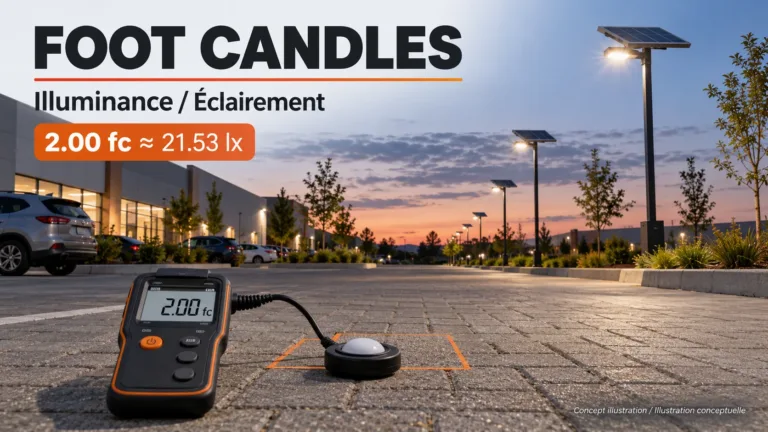
Both measure illuminance, but they use different area units. One foot-candle is approximately 10.7639 lux. Keep the unit consistent throughout a calculation and state the measurement plane.