Quick answer: IP65 vs IP67 answer different water-exposure questions
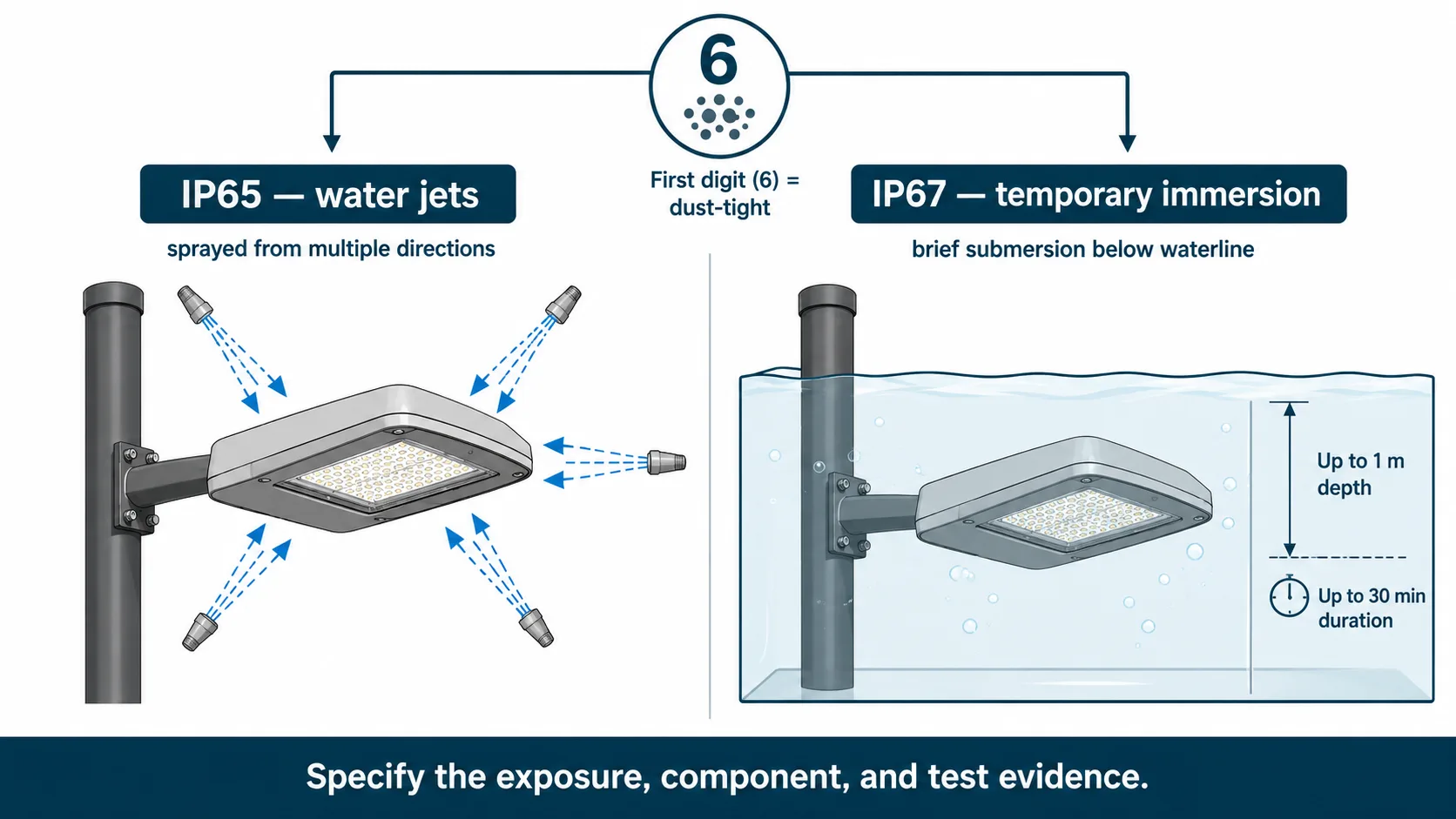
For an outdoor solar street-light project, IP65 versus IP67 is not a simple “higher number wins” choice. Both ratings use 6 for the solid-particle part of the code. The practical difference is the water test named by the second numeral: IEC-based testing summaries describe IPX5 as water-jet protection and IPX7 as temporary-immersion protection. Intertek’s IP testing guide explains the two code positions and their test categories.
Choose the evidence to match the real exposure. A luminaire mounted above a road may need a clear water-jet/rain exposure discussion. A controller compartment, base cabinet, connector, or battery enclosure that could sit in pooled water needs a separately defined immersion scenario. Neither rating, by itself, proves corrosion resistance, cable-entry quality, impact resistance, or the performance of every enclosure in a solar lighting system.
| Project question | Why it matters | What to request in the RFQ |
|---|---|---|
| Will the luminaire face wind-driven rain, washdown, or jet-like cleaning? | This is an exposure question, not a label preference. | Name the water exposure and request the applicable enclosure test evidence. |
| Can any box, connector, or low-mounted component be temporarily submerged? | A pole-mounted head and a ground-level enclosure can face different risks. | Define which component may be immersed, for how long, and at what installed height. |
| Is the site coastal, humid, dusty, or corrosive? | Water ingress is only one reliability variable. | Request corrosion strategy, gasket/connector details, material scope, and maintenance access. |
| Is vandalism or mechanical damage a risk? | An ingress rating and an impact rating address different issues. | State the required impact evidence separately; do not use IP as a substitute for IK. |
This guide compares the terms for a B2B solar street-light specification. For the broader tender process—including IP, IK, corrosion, evidence packages, and bid comparability—use the IP & IK selection guide.
What an IP rating actually describes
The IP code is a classification for the protection provided by an enclosure. IEC 60529 is the international standard for degrees of protection provided by enclosures for electrical equipment. IEC’s publication record describes its scope, while Intertek’s lighting guidance explains that the first numeral concerns solid objects and dust, and the second concerns fluid or water.
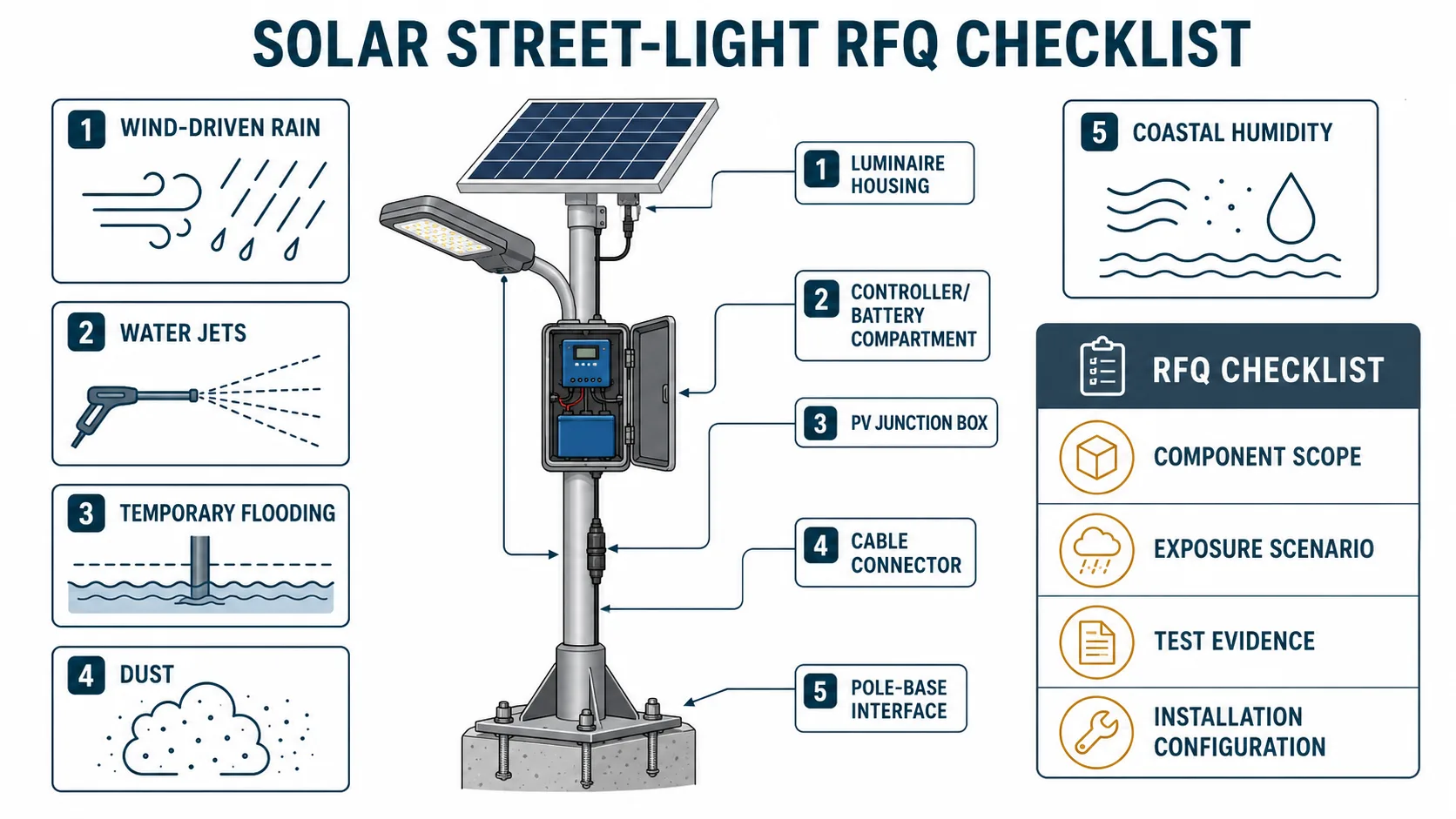
That scope matters on a solar street-light project. A complete system can include a luminaire housing, optical chamber, battery or controller compartment, PV junction box, cable glands, connectors, pole interfaces, and sometimes a ground-level cabinet. A supplier statement that one enclosure has a rating is not automatically evidence for every other component.
The 6 in both IP65 and IP67 refers to the same solid-particle position: IP6X is described as dust-tight in IEC-based lighting test guidance. The difference is the water-related position:
| Rating | Dust position | Water position | What it means for a procurement review |
|---|---|---|---|
| IP65 | 6: dust-tight | 5: water jets | Ask which enclosure was tested and whether the real exposure resembles rain, washdown, or directed water. |
| IP67 | 6: dust-tight | 7: temporary immersion | Ask which enclosure was tested, the immersion conditions, and whether a temporary-submersion scenario is actually present. |
UL’s lighting test reference lists IPX5 as water jets and IPX7 as temporary immersion, and it lists IP and IK as separate enclosure protections. UL’s IP and IK testing sheet is a useful short reference when writing a lighting specification.
Why IP67 is not automatically the better project specification
IP67 can sound more demanding because temporary immersion is a severe-sounding condition. But a tender should not rank ratings as if every water exposure were identical. The relevant question is: what is the actual failure path at this installation?
For example, a solar luminaire fixed high on a pole is normally exposed to weather from above and around it. A component in a low cabinet, a handhole, a flood-prone pedestal, or a connector positioned near standing water may face a different exposure. Those are different engineering questions, even when the bid sheet has one column labeled “IP rating.”
The safe procurement rule is to state the exposure and demand evidence for the specific enclosure. Do not write “IP67 preferred” when the project actually needs a documented response to water jets. Do not write “IP65 is enough” when a controller, cable interface, or base cabinet could be temporarily submerged. A qualified lighting supplier should be able to identify the relevant parts and provide model-specific test or certification documentation.
Compare the whole solar street-light system, not only the lamp head
An IP claim becomes more useful when it is assigned to an exact component. Use a component-by-component review before comparing quotations.
1. Luminaire housing and optical chamber
Ask whether the quoted IP rating applies to the complete luminaire, the optical chamber, or a subassembly. Confirm the intended mounting orientation and whether maintenance access can disturb seals or gaskets. For a road, parking, or municipal project, also connect the enclosure review to the commercial solar street-light system being quoted, rather than treating the rating as a standalone marketing line.
2. Battery and controller compartment
Battery and controller compartments can have a different location and service profile from the light head. A sealed luminaire does not establish the water-exposure performance of a cabinet, battery box, or integrated compartment. Ask for the rated enclosure, the cable-entry arrangement, condensation-management approach, and the maintenance procedure for the exact configuration.
3. PV module junction box, connectors, and cable entries
Cable glands, plugs, connectors, and junction boxes are common specification interfaces. Identify the component, its installation location, and who is responsible for sealing after installation. This is especially important when the design has remote PV hardware, external sensors, or a high-mast solar lighting arrangement with multiple field interfaces.
4. Pole base, foundation interface, and low-mounted equipment
The pole base and any nearby electrical enclosure can see splashing, drainage problems, standing water, or site damage that are unlike the conditions at the luminaire. If the site is flood-prone, define the expected water level and duration instead of relying on a generic IP label. If the project team cannot define those conditions, mark the risk as an engineering clarification before bid comparison.
IP rating does not replace corrosion, IK, thermal, or installation checks
Ingress protection is valuable, but it is not a complete outdoor-reliability specification. The rating concerns the enclosure’s protection against dust and water under the relevant test category. It does not, by itself, establish every issue that affects a solar street-light project.
| Separate question | Why IP alone does not answer it | Evidence to request |
|---|---|---|
| Mechanical impact or vandalism | IP and IK describe different protections. | IK rating/test evidence for the relevant enclosure or lens. |
| Coastal or chemically aggressive air | A water-ingress claim is not a corrosion strategy. | Material, coating, fastener, and salt/corrosion evidence appropriate to the site. |
| Heat and battery service life | A sealed housing can still require thermal design and serviceability review. | Thermal design information, operating limits, and maintenance procedure. |
| Installation quality | A tested product can be compromised by field cable entry or incorrect sealing. | Installation instructions, torque/sealing process, and commissioning checklist. |
| Photometric performance | An IP rating does not establish illuminance, uniformity, glare, or road coverage. | Photometric files and a project-specific lighting calculation where required. |
This is why an outdoor infrastructure RFQ should connect enclosure evidence to the whole project scope. UL notes, in a broader utility-enclosure context, that baseline ingress standards can require additional application-specific verification. UL’s watertightness guidance is a useful reminder that exposure, pressure, duration, and interfaces must be defined for the real installation.
A copy-and-paste RFQ checklist for IP65 vs IP67
Use the questions below in an RFQ or tender clarification. They are designed to make bids comparable; they are not a substitute for the project’s applicable codes, authority requirements, or engineering review.
- Identify the component. State whether the request applies to the luminaire, optical chamber, battery/controller compartment, PV junction box, connector, cabinet, or another enclosure.
- Describe the exposure. State whether the component will face normal weather, water jets, temporary flooding, standing water, coastal humidity, dust, or a combination.
- State the requested rating and test basis. Ask for the IP classification, the applicable test standard, and a model-specific test report or certificate.
- Define the installed configuration. Require the supplier to show that the quoted cable entries, mounting orientation, connectors, and accessories match the tested configuration.
- Separate ingress from impact. If impact risk exists, request IK evidence separately rather than assuming an IP number covers it.
- Request service instructions. Ask how seals, cable glands, and covers are inspected or replaced after commissioning and during maintenance.
RFQ wording template
The supplier shall identify the IP classification applicable to each quoted outdoor enclosure, including the luminaire, controller/battery compartment, PV junction box, and field connectors where applicable. The supplier shall provide model-specific evidence for the stated rating and confirm that the tested configuration matches the proposed installation, including cable entries, mounting orientation, and accessories. Water-jet, temporary-immersion, corrosion, mechanical-impact, and installation requirements shall be stated separately where relevant to the site.
How to compare two supplier quotations fairly
When two quotations use different IP claims, compare the evidence package before comparing labels. A practical review table can include the following columns:
| Bid comparison field | Supplier A | Supplier B | Decision note |
|---|---|---|---|
| Exact enclosure/component | Do not accept a system-wide label without scope. | ||
| Stated IP code | Record both numerals. | ||
| Water exposure addressed | Match it to the installation risk. | ||
| Test report/certificate reference | Check model and configuration. | ||
| Cable entries and connectors covered | Note field-installed interfaces. | ||
| IK/impact evidence, if needed | Keep separate from IP. | ||
| Corrosion and maintenance evidence | Review for coastal, humid, or difficult-access sites. |
This approach reduces a common purchasing error: choosing the most impressive-looking label without checking whether it applies to the part that will actually see the risk.
From an IP question to a project-ready solar street-light specification
IP65 versus IP67 is one input to a wider solar street-light specification. Before requesting a price, organize the road or area layout, pole height, mounting arrangement, target lighting level, local weather and water-exposure risks, autonomy requirement, installation constraints, and preferred system format. The solar street-light installation guide and the technical guide hub can help structure the engineering questions before the RFQ.
Inlux Solar has delivered lighting for more than 1,000 projects; that experience does not replace a model-specific IP report. Use the project portfolio for relevant application references, then send the exact project conditions to the team for an evidence-led comparison. For cost variables and quotation inputs, see the solar street-light price guide.
If you are preparing a road, parking, high-mast, municipal, or industrial lighting RFQ, contact Inlux Solar with the installation environment, water-exposure scenario, required documents, and target system configuration. The request should be evaluated against the quoted model and the project—not answered with a generic “waterproof” promise.
Frequently Asked Questions
Is IP67 better than IP65 for solar street lights?
Not automatically. IP65 and IP67 describe different water-exposure categories. The correct requirement depends on whether the relevant enclosure faces jet-like water exposure, temporary immersion, or another condition. Specify the actual exposure and request evidence for the exact component.
Does IP67 mean a complete solar street-light system can stay underwater?
No. An IP classification applies to the enclosure that was tested and to the stated test category. A solar street-light system may include multiple housings, connectors, cable entries, and installation interfaces. Ask which component is covered and whether the proposed field configuration matches the evidence.
Is IP65 enough for heavy rain?
There is no universal answer without the installation context. Review mounting position, drainage, wind-driven rain, cleaning practice, cable-entry locations, and any low-mounted equipment. Put those conditions into the RFQ instead of relying on a label alone.
Is IP the same as IK?
No. IP addresses enclosure protection against solid objects and water. IK addresses resistance to external mechanical impact. If a road, public-space, or industrial project has vandalism or impact risk, specify and verify the two requirements separately.
What document should a buyer request for an IP claim?
Ask for a model-specific test report or certificate, the standard/test basis, the enclosure and configuration tested, and confirmation that the quoted cable entries, accessories, and mounting arrangement match the proposed installation.