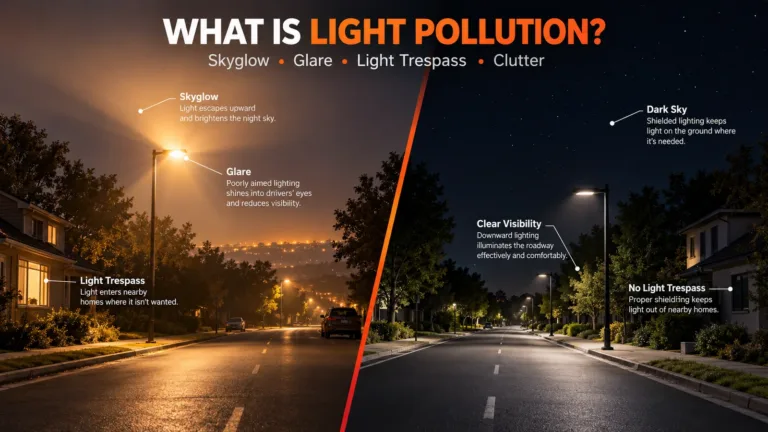
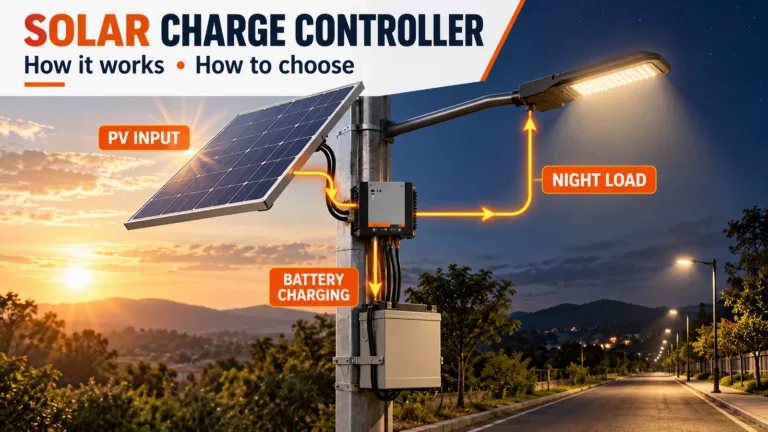
Solar street lighting looks straightforward: a PV panel charges a battery, the battery powers LEDs at night. Simple.
In the field, it’s not simple at all. Reliability depends on a chain of engineering decisions—optics, thermal management, controller firmware, MPPT behavior, LiFePO4 pack build quality, Battery Management System (BMS) logic, sealing integrity, and production discipline. One weak link turns into site revisits, missed handovers, and warranty headaches.
Key takeaway: A reliable manufacturer is the one that can prove performance, repeat quality at scale, and support you after delivery—with traceability and supply chain transparency.
Quick Takeaways (TL;DR)
If you’re sourcing for municipal, EPC, or contractor projects, treat supplier selection as a risk-control task—not a price comparison.
- Require IES files + a short photometric analysis before comparing wattage or “marketing lumens.”
- Vet LiFePO4 cell sourcing, pack build, and BMS protections—battery-related issues dominate early failures.
- Ask for MPPT efficiency curves (not one number) plus surge/ESD protection and firmware fail-safes.
- Verify QC discipline: IQC/IPQC/OQC checkpoints, plus aging/burn-in records tied to serial numbers.
- Demand traceability + a no-silent-substitution policy for LEDs, cells, controllers, optics, and gaskets.
- Make after-sales measurable: response SLA, spares plan, RMA workflow, and CAPA closure.
- Use a scoring matrix to compare vendors objectively across engineering, QC, and support.
Want a procurement-ready version? Jump to the RFQ Checklist Download section below and get the Excel + PDF pack.
Definition (for procurement): A reliable solar street light manufacturer can prove performance with photometry, repeat quality at scale with documented QC, and support field issues with traceable parts and clear warranty execution.
Minimum evidence: IES files + QC records + battery/BMS traceability + after-sales SLA.
1) Define Your Project Requirements First (So Quotes Are Comparable)
Before you evaluate suppliers, lock the operating envelope. Otherwise, vendors will “optimize” their quote by quietly changing the configuration.
Minimum inputs to define
- Application: highway / arterial road / residential street / pathway / industrial park / rural road
- Lighting targets: average illuminance, uniformity, glare control, CCT, beam angle/distribution type
- Mounting conditions: pole height, outreach arm length, tilt, spacing, wind load
- Energy targets: autonomy days, dimming profile, seasonal solar irradiation assumptions
- Environment: ambient temperature range, humidity, coastal corrosion risk, dust, sand, vandal risk
- Project deliverables: IES files, photometric analysis, drawings, manuals, spares plan, warranty terms
Procurement rule: Ask each supplier to quote using a configuration code (panel + battery + LED + optics + controller + pole height). If you only compare “60W vs 100W,” you are not comparing the same product.
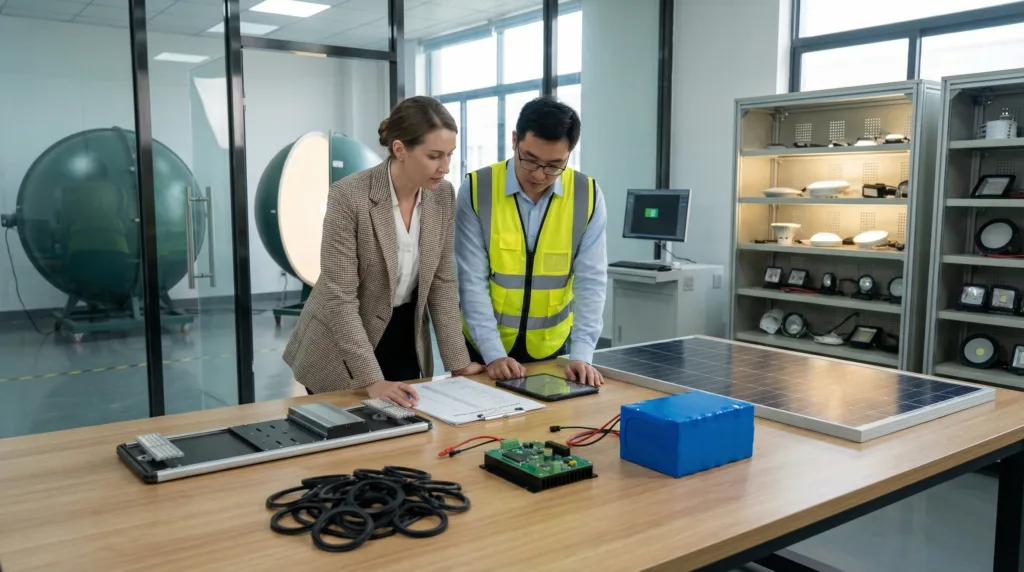
2) Confirm They Are a Real Manufacturer (Not a Catalog Reseller)
Many “manufacturers” are trading companies with a brochure and a WhatsApp group of subcontractors. That can work for low-risk purchases. It usually fails in municipal or contractor-grade projects.
Supply chain transparency (non-negotiable)
Ask for:
- Factory address + legal entity name
- Production line photos/videos with current date
- Audit access (on-site or third-party)
- Clear BOM for critical components (LED chips, controller PCB, LiFePO4 cells, optics)
- Traceability method (serial number → component lots → test records)
Fast red flags
- Refuses to share who makes the controller PCB
- Can’t explain battery cell grade beyond “Grade A LiFePO4”
- Provides generic IES files that don’t match the quoted model
- Dodges questions about IP testing, aging tests, or calibration
- Keeps changing the configuration to hit a target price
Key takeaway: If a supplier won’t be transparent before payment, they will be worse after shipment.
3) Evaluate R&D Capability: Can They Engineer, Or Only Assemble?
Assembly-only suppliers can ship product. They can’t solve root causes. Real reliability requires design control.
What strong R&D looks like
- Optics engineering: lens selection, distribution control, glare mitigation
- Thermal engineering: heat path design, temperature derating strategy, validation testing
- Electronics + firmware: protections, stable dimming logic, fault behavior, data integrity
- Mechanical design: sealing strategy, corrosion protection, structural validation
R&D evidence you should request
- IES files for the exact luminaire configuration
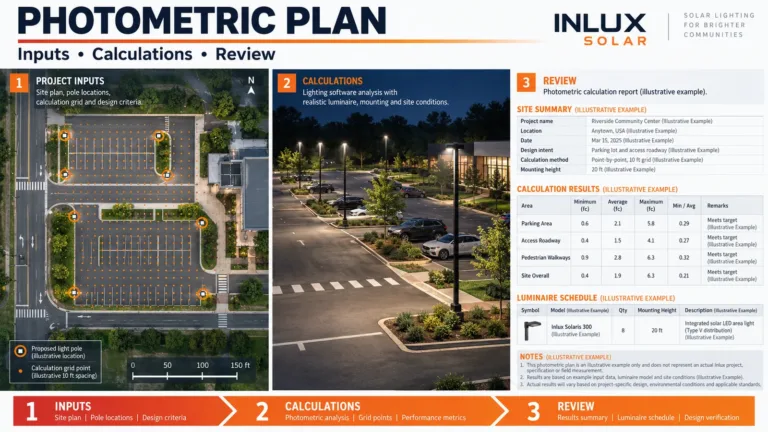
- A concise photometric analysis summary:
- recommended mounting height and spacing
- uniformity sensitivity
- application suitability (roadway vs pathway)
- Design change control:
- ECO (Engineering Change Order) process
- re-validation rules after component substitutions
OEM/ODM services questions that reveal maturity
- What can be customized safely (optics / housing / controller firmware / battery pack)?
- Who owns tooling and design files?
- How do you manage component EOL (end-of-life) and substitutions?
- Do you have version control for firmware and hardware revisions?
Key takeaway: OEM/ODM services are valuable only when design control + validation discipline are real.
4) Demand Real Photometrics: IES Files + Traceable Test Data
Marketing lumens are cheap. Verified roadway performance is not.

Request package (for each quoted configuration)
- IES files matching model, CCT, optics, and drive current
- Photometric test reference (test date, setup, sample identity)
- Simulation output for your pole height + spacing (Dialux/Relux or equivalent)
Quick checks procurement can do
- Does the IES file name/model match the datasheet and quote?
- Is CCT consistent (3000K vs 5700K)?
- Does distribution match the application (roadway needs controlled forward throw)?
- Ask one hard question:
- “If pole spacing increases by 10%, what happens to uniformity and min lux?”
Key takeaway: If they can’t explain their photometric analysis, they don’t control the lighting outcome.
5) Controller & MPPT: Where Field Failures Often Hide
The controller is the brain. It’s also a common failure point when protections and firmware are weak.
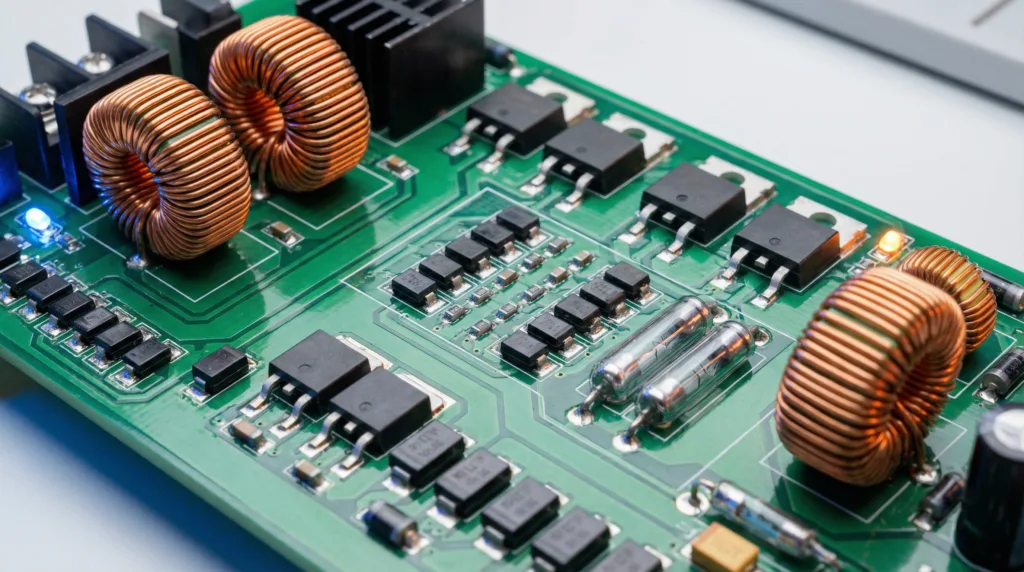
MPPT Efficiency: ask for curves, not slogans
Demand:
- MPPT efficiency curve vs input power and battery voltage
- Low-irradiance behavior (cloudy mornings matter)
- Partial shading behavior
- Temperature impact on charging and cutoffs
Protection design checklist
- Reverse polarity protection
- Short-circuit and over-current protection
- Over-temperature protection with controlled derating
- Surge/ESD robustness (especially lightning-prone regions)
- Moisture ingress mitigation at connectors/cable glands
Firmware questions that predict stability
- Is dimming schedule stored in non-volatile memory with integrity checks?
- What happens after brownout or unexpected shutdown?
- Is there event logging (undervoltage, overtemp, charge faults)?
- Can parameters be locked to prevent unauthorized field changes?
Key takeaway: “High MPPT Efficiency” means nothing if firmware becomes unstable in harsh conditions.
6) Battery Due Diligence: LiFePO4 Grade, Pack Engineering, and BMS Reality
Most “solar street light problems” are battery-system problems.
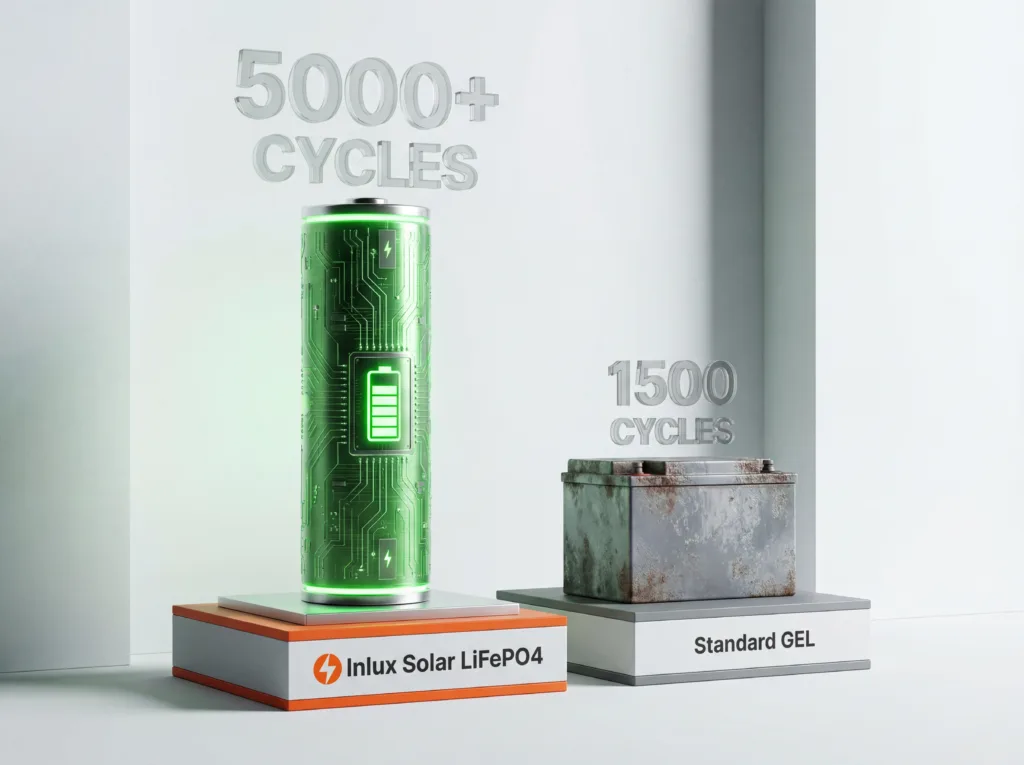
LiFePO4 cell sourcing (verify, don’t trust labels)
Ask for:
- Cell manufacturer identity + datasheet
- Incoming inspection (capacity screening + internal resistance matching)
- Lot traceability (cell lot → pack serial number)
Pack engineering: what to verify
- Welding method (spot vs laser) + workmanship controls
- Mechanical reinforcement and vibration resistance
- Insulation and short-prevention design
- Thermal strategy for hot climates
- Serviceability plan (can the pack be replaced safely in the field?)
Battery Management System (BMS): minimum functions
A serious BMS should include:
- Cell balancing (critical for longevity)
- Over/under-voltage protection
- Over/under-temperature cutoffs
- Over-current/short protection
- Fault handling logic (not just “shut down”)
- SOC logic aligned with dimming and autonomy strategy
Questions that separate professionals from amateurs
- What is the discharge depth policy (DoD) in firmware?
- What is low-voltage cutoff and recovery behavior?
- How do you prevent “sleep death” after long bad-weather periods?
- Can the battery be field-replaced without compromising IP sealing?
Key takeaway: If they can’t explain their BMS strategy clearly, you’re buying warranty risk.
7) LED & Driver Sourcing: Brands, Binning, and Thermal Discipline
Names like Philips/Lumileds or Bridgelux are helpful signals—only if sourcing is controlled and documented.
LED quality controls to request
- Chip/LED package brand and binning strategy (flux + chromaticity)
- Anti-counterfeit measures (sealed packaging, lot/QR verification)
- LED board build quality (MCPCB thickness, thermal conductivity)
Driver and system efficiency checks
- Driver efficiency and thermal derating behavior
- Power regulation stability under battery voltage variation
- Heat path design from LED → housing → ambient
Short sentence. Important:
LED lifetime is mostly thermal lifetime.
8) Mechanical Reliability: IP65/IP66 Ratings, Corrosion, and Impact Resistance
A strong electrical design still fails if sealing and mechanics are weak.
Sealing and ingress protection
Ask how they prove IP65/IP66 ratings:
- Test method and sample policy (not a one-time test from years ago)
- Gasket material specification and compression control
- Venting strategy (breathable membrane vs fully sealed—each has tradeoffs)
- Connector selection and cable gland quality
Corrosion and harsh environment readiness
- Coating system (powder coating thickness control, anodizing where applicable)
- Fastener materials (stainless grades, anti-galling practice)
- Salt spray validation for coastal projects
- UV resistance for lens and housing materials
Structural and impact considerations
- Wind load considerations for pole height and luminaire weight
- Anti-theft fasteners and tamper-resistant design
- Optional impact resistance strategy (where vandal risk exists)
Key takeaway: Reliability is not only electronics. Mechanical discipline is the difference between “works in the lab” and “survives outdoors.”
9) Quality Control (QC): ISO Systems, Aging Tests, and Traceability
Certificates don’t run production. Process control does.
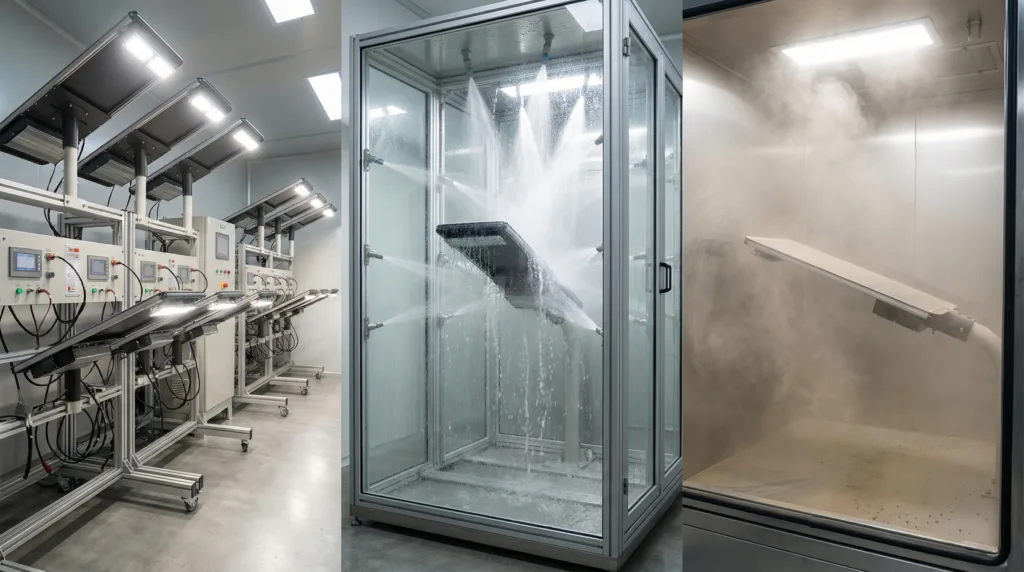
ISO and management system expectations
- ISO 9001 as a baseline quality management system
- ISO 14001 / ISO 45001 if your project requires EHS maturity
QC structure you should see
- IQC (Incoming QC): batteries, LEDs, PCBs, gaskets, housings
- IPQC (In-process QC): solder quality, torque control, sealing steps, programming verification
- FQC/OQC (Final/Outgoing QC): functional test, burn-in, visual inspection, packaging controls
Critical tests that matter for solar street lights
- Aging / burn-in: controller + LED operation for defined time/temp
- Charging/discharging validation under controlled conditions
- Ingress protection verification for IP65/IP66
- Thermal cycling (sealing movement, condensation risk, solder fatigue)
- Salt spray (coastal), vibration, and drop tests where relevant
Traceability: your warranty survival tool
Demand:
- Serial number per unit
- Serial-to-lot mapping (battery pack lot → controller PCB lot → LED module lot)
- NCR/CAPA workflow (Nonconformance + Corrective/Preventive Action)
- Change control discipline (ECO records, version control)
Key takeaway: If failures cannot be traced and corrected at the batch level, the same failure will repeat.
10) Supply Chain Transparency: Control Over Sub-suppliers
A supplier can only be as reliable as their weakest sub-supplier.
What transparent suppliers can show
- AVL (Approved Vendor List) for key components
- COA / incoming test records for critical batches
- Anti-substitution policy (“no silent changes”)
- Evidence that substitutions trigger re-validation (not just a new label)
Key takeaway: Supply chain transparency is not paperwork. It is proof of control.
11) After-Sales Support: How They Handle Real Field Issues
This is where many suppliers disappear.
After-sales support checklist
- Response SLA (e.g., 24–48 hours for technical response)
- Spare parts availability (controller, battery pack, optics) + lead time
- Remote troubleshooting process (photos, logs, parameter checks)
- Clear RMA workflow and failure analysis template
- Field-replacement guidance (step-by-step service manual)
Warranty terms that actually protect you
- Clear scope: parts only vs parts + performance degradation
- Defined exclusions (specific, not vague)
- Failure validation process
- Replacement/credit rules and shipping responsibility
- Commitment to firmware support and component continuity planning
Key takeaway: A “5-year warranty” without a service process is just a marketing sentence.
12) A Practical Sourcing Process (Step-by-Step)
Step 1: Paper qualification (fast elimination)
Request:
- Configuration-coded quote + datasheet
- IES files + photometric analysis summary
- Controller spec: MPPT behavior, protections, firmware features
- Battery pack details: cell maker, screening method, BMS functions
- QC plan overview + traceability approach
- Warranty + spares list + support SLA
Step 2: Factory audit (on-site or third-party)
Audit agenda:
- Production flow and work instructions
- Test equipment list + calibration records
- Warehouse controls (incoming/quarantine/approved)
- ESD controls for electronics
- Training records and rework controls
- Sample traceability demonstration (pick one unit, trace all critical lots)
Step 3: Sample validation
- Lock a golden sample (label + photos + configuration record)
- Validate photometrics, charging behavior, and dimming profile
- Confirm sealing integrity and assembly consistency
Step 4: Pilot batch and pre-shipment inspection
- Pilot batch with enhanced QC sampling
- Pre-shipment inspection using a written checklist
- Confirm packaging, labeling, and spare parts inclusion
Key takeaway: The best suppliers don’t fear audits. They use them to prove control.
13) Total Cost of Ownership (TCO): The Pricing Reality
A cheaper unit cost can be a more expensive project.
Consider:
- Failure rate risk and site-revisit cost
- Replacement logistics cost (especially cross-border)
- Downtime penalties or reputation impact
- Spare parts availability and lead time
- Warranty execution speed
Short. Direct:
Price is what you pay. Reliability is what you live with.
14) Red Flags: Cut These Suppliers Early
- Avoids sharing test methods or hides model identity on reports
- IES files don’t match quoted configurations
- Unrealistic lumen/autonomy claims without an energy budget explanation
- No traceability and no ECO/change control
- Battery details are vague and non-verifiable
- Warranty is long but vague, exclusion-heavy, and process-free
15) The Ultimate RFQ Sourcing Checklist (Copy/Paste)
A) Company & factory verification
- Factory address + legal entity name
- Audit access (on-site or third-party)
- Production capacity + key processes
- Calibration records for critical test equipment
- Supply chain transparency statement (who makes what)
B) Technical deliverables (must match quoted configuration)
- Configuration-coded datasheet + BOM highlights
- IES files + photometric analysis summary
- Controller spec: MPPT Efficiency curve + protections + firmware features
- Battery pack details: cell maker, screening method, pack structure, Battery Management System (BMS) functions
- Sealing evidence for IP65/IP66 ratings + test method + sampling plan
C) Quality control & testing
- IQC/IPQC/FQC/OQC checklists
- Burn-in/aging SOP and sample records
- Traceability sample (serial → component lots → test records)
- NCR/CAPA example (sanitized)
- ECO/change control policy (no silent substitutions)
D) Commercial & after-sales
- Warranty document + RMA workflow
- Spare parts list + pricing + lead times
- Support SLA and escalation path
- Component continuity plan (EOL handling)
16) Quick Vendor Scoring Matrix (Use This to Compare)
Score each supplier 1–5:
| Category | What “5” Looks Like |
|---|---|
| R&D capability | Clear ownership of optics/thermal/electronics/firmware + documented validation |
| Photometrics | IES files match configuration + can explain photometric analysis and simulation |
| Controller robustness | Proven protections + stable firmware behavior under real conditions |
| Battery system quality | Traceable LiFePO4 cells + strong pack build + credible BMS strategy |
| QC discipline | Structured IQC/IPQC/OQC + aging tests + calibrated equipment |
| Traceability | Serial-to-lot mapping + CAPA closes defects systematically |
| Supply chain transparency | AVL/COA + no silent substitutions + re-validation after changes |
| After-sales support | SLA + spares plan + documented troubleshooting and RMA workflow |
Final takeaway: The best manufacturer makes your project boring—in the best way. Predictable performance. Repeatable quality. Dependable support.
Completed the checklist? Send your shortlist to a qualified solar street light manufacturer directly — Inlux Solar: 300,000+ units deployed across 60+ countries, UNHCR Syria Refugee Programme reference, and MOQ from 10 units.