Engineer’s Note: For decades, the lighting industry used “watts” to measure brightness. In modern solar street lighting, this is a dangerous and expensive mistake. At Inlux Solar, we size our systems based on “lumens per watt” (efficacy) to maximize battery life while meeting strict municipal brightness codes.
Quick Answer: Lumens vs. Watts in Solar Lighting
- Watts (W) measure electrical input power. Energy use also depends on operating hours and the dimming schedule.
- Lumens (lm) measure luminous flux emitted by a light source or luminaire. Illuminance on the road is measured in lux and depends on the optical distribution and layout.
For solar lighting, compare the electrical input needed to meet the project’s maintained lighting target. More lumens alone do not establish a better road layout.👇 Scroll down to see our Street Light Replacement Chart (Traditional vs. LED).
Commercial Street Light Conversion: Traditional vs. LED
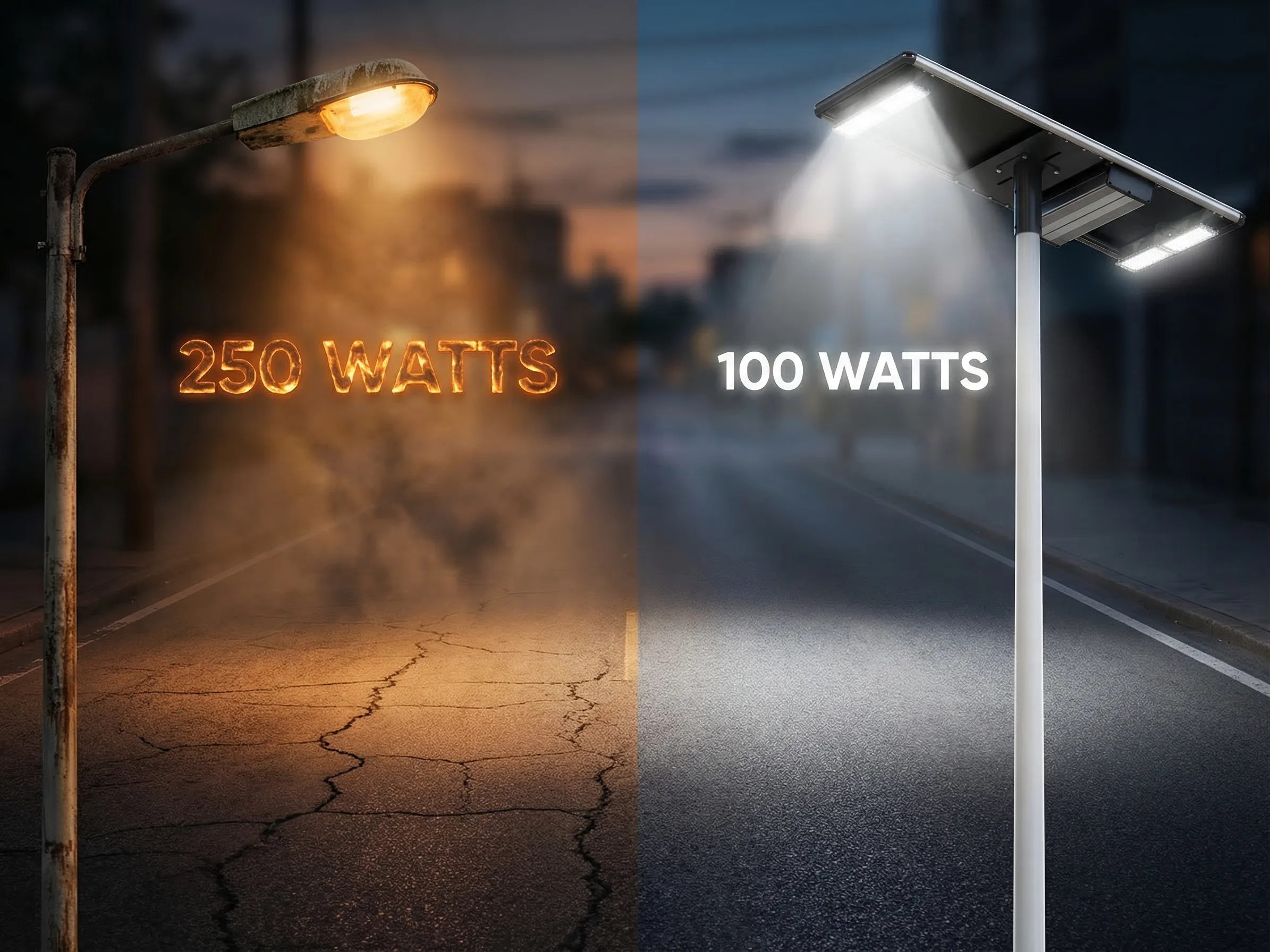
If you are retrofitting an old city street or parking lot, do not buy a “100W solar light” just because you had a 100W traditional light. Modern commercial LEDs produce significantly more light using a fraction of the power.
| Desired Brightness (Lumens) | Old Technology (HPS / Metal Halide) | Inlux Solar Commercial LED (High Efficacy) |
|---|---|---|
| 3,000 – 4,000 lm (Parks / Walkways) | ~ 70 Watts | 20 – 25 Watts |
| 8,000 – 10,000 lm (Residential Streets) | ~ 150 Watts | 50 – 60 Watts |
| 10,735 – 18,000 lm (Highways / Main Roads) | ~ 250 Watts | 100 – 120 Watts |
Wattage vs Lumens: What’s the Difference?
What is Wattage?
Wattage refers to the power consumption of a light source, indicating how much energy it uses to operate. Traditionally, wattage was used to gauge how bright a light source might be. However, in modern lighting technologies like LEDs, wattage is no longer a reliable indicator of brightness.
- Example: An old 60W incandescent bulb might only produce about 800 lumens, while a 20W LED bulb can generate the same 800 lumens but use much less energy. This makes LEDs far more energy-efficient.
In solar lighting, wattage determines how much energy is required to power the light source, but to understand how much light will actually be emitted, you need to focus on lumens.

What Are Lumens?
Lumens measure the total light emitted by a source. The higher the lumens, the brighter the light. When purchasing solar street lights or other outdoor lighting, the number of lumens tells you how bright the light will be.
- Example: A 15W solar light might generate 2,000 lumens, ideal for small street paths, while a 100W solar light could produce up to 12,000 lumens, suitable for larger areas like highways or parking lots.
Lumens = Brightness
Wattage = Energy Consumption
Why Wattage Alone Isn’t Enough
Many people still mistakenly equate wattage with brightness. While wattage indicates energy usage, lumens provide the actual brightness produced. This is why LEDs are preferred in solar lighting systems: they use less wattage to produce more lumens, offering both energy savings and increased brightness.
- Traditional Incandescent: 10–15 lumens per watt.
- Fluorescent Lights: 35–75 lumens per watt.
- LED Lights: 80–150 lumens per watt (depending on quality).
This efficiency makes LED solar lights the ideal choice for both residential and commercial outdoor lighting solutions.
How to Choose the Right Wattage and Lumens for Your Project
Selecting the appropriate wattage and lumens for your solar lighting system depends on several factors: the size of the area, the desired brightness level, and the lighting application. Here’s a guide to help you choose:
Lighting Needs by Area Type
- Residential Streets or Paths
- Wattage Range: 15W – 30W
- Lumens: 1,500 – 3,000
- Ideal for walkways, small pathways, and residential streets.
- Parking Lots and Roadways
- Wattage Range: 40W – 100W
- Lumens: 4,000 – 10,000
- Provides high brightness for safety and visibility in parking areas.
- Large Highways and High-Mast Areas
- Wattage Range: 100W – 300W
- Lumens: 10,000 – 30,000
- Suitable for larger areas requiring bright, consistent lighting, like highways.
How to Calculate Wattage and Lumens for Your Solar Lighting Needs
Keep area units and the measurement boundary consistent. One lux equals one lumen per square metre. Multiplying average illuminance by area gives the luminous flux incident on that calculation plane; it does not directly give the luminaire output or electrical input required.
- Area (m²) = Area (sq. ft.) × 0.09290304
- Flux incident on the plane (lm) = Average illuminance (lux) × Area (m²)
Unit-conversion example: 1,000 sq. ft. equals 92.90304 m². An illustrative average of 30 lux across that plane corresponds to approximately 2,787 lumens incident on the plane. The 30-lux value is an example, not a universal parking-lot requirement.
Do not divide that incident flux by luminaire efficacy and treat the result as a specified solar-light wattage. The selected IES/LDT file, mounting height, spacing, aiming, light falling outside the area and maintenance assumptions affect the luminaire output needed. A preliminary lumen method must state its utilization and maintenance factors; the project layout must also check the required minimum levels, uniformity and glare.
Once a suitable luminaire and operating point are identified, compare its reported output and complete-luminaire input power on the same test basis: luminaire input watts = luminaire lumens ÷ luminaire efficacy (lm/W). Then calculate nightly energy from the actual input at each operating stage and size the solar and battery system separately. LED-chip efficacy is not a substitute for complete-luminaire data.
Efficiency: Lumens per Watt (lm/W)
When selecting solar lights, efficiency matters. This refers to how many lumens a fixture can produce for every watt of power consumed. The higher the lumens per watt, the more efficient the light.
Comparison of Efficiency by Lighting Type
| Type | Wattage | Lumens | Efficiency (lm/W) |
|---|---|---|---|
| Incandescent | 60W | 800 lm | 13.33 |
| LED (Low) | 15W | 1,500 lm | 100 |
| LED (High) | 100W | 10,000 lm | 100 |
LEDs have a high efficiency, producing more light per watt of energy, making them the best choice for solar street lighting systems.
Choosing the Right Solar Lighting System for Your Project
When it comes to solar street lighting, there’s no one-size-fits-all solution. Different areas and applications require different brightness levels and energy consumption. Here’s a guide to help you choose the right light for your specific needs:
- Total wattage needed based on the area size and required lumens.
- Lumens per watt efficiency of the light source (LED is the most efficient).
- Environmental conditions such as solar exposure (affects the charging of the battery).
- Budget for installation and long-term energy savings.
The key to a successful solar lighting system is balancing the wattage and lumens to provide the right amount of brightness while ensuring energy efficiency.
Convert Lumens into a Tender-Ready Specification
Lumens are only one input. A project specification should also define beam angle, CCT, CRI, road geometry, uniformity, glare, and the matching photometric file. Review our CCT, CRI, and beam angle guide, use the IES and DIALux checklist, or send your target road class and lighting requirements for an RFQ review.
Conclusion
Understanding the relationship between wattage and lumens is essential for selecting the right solar lighting system. While wattage measures energy consumption, lumens measure light output. By understanding these two concepts and applying them to your lighting project, you can make more informed decisions, ensuring energy-efficient and bright lighting for your street, parking lot, or pathway.
Visual Aids (Charts & Diagrams)
Chart 1: Wattage vs Lumens (LED vs Incandescent)
| Type | Wattage | Lumens | Efficiency (lm/W) |
|---|---|---|---|
| Incandescent | 60W | 800 lm | 13.33 |
| LED (Low) | 15W | 1,500 lm | 100 |
| LED (High) | 100W | 10,000 lm | 100 |
Chart 2: How to Calculate Required Lumens and Wattage for Your Area
- Plane-flux relationship:
Incident lumens = Area (m²) × Average lux. Convert square feet to square metres first; luminaire selection requires photometric and maintenance assumptions. - Illustration: 1,000 sq. ft. × 0.09290304 = 92.90304 m²; 92.90304 m² × 30 lux ≈ 2,787 incident lumens. This does not specify a lamp wattage or a universal parking-lot target.