A cable gland secures a cable where it enters an enclosure and, when correctly specified and assembled, helps seal that entry. Choosing one for a solar street light means matching two different interfaces: the cable passing through the gland and the enclosure receiving it. An M20 label describes a connection thread, not a universal cable diameter or a complete replacement specification.
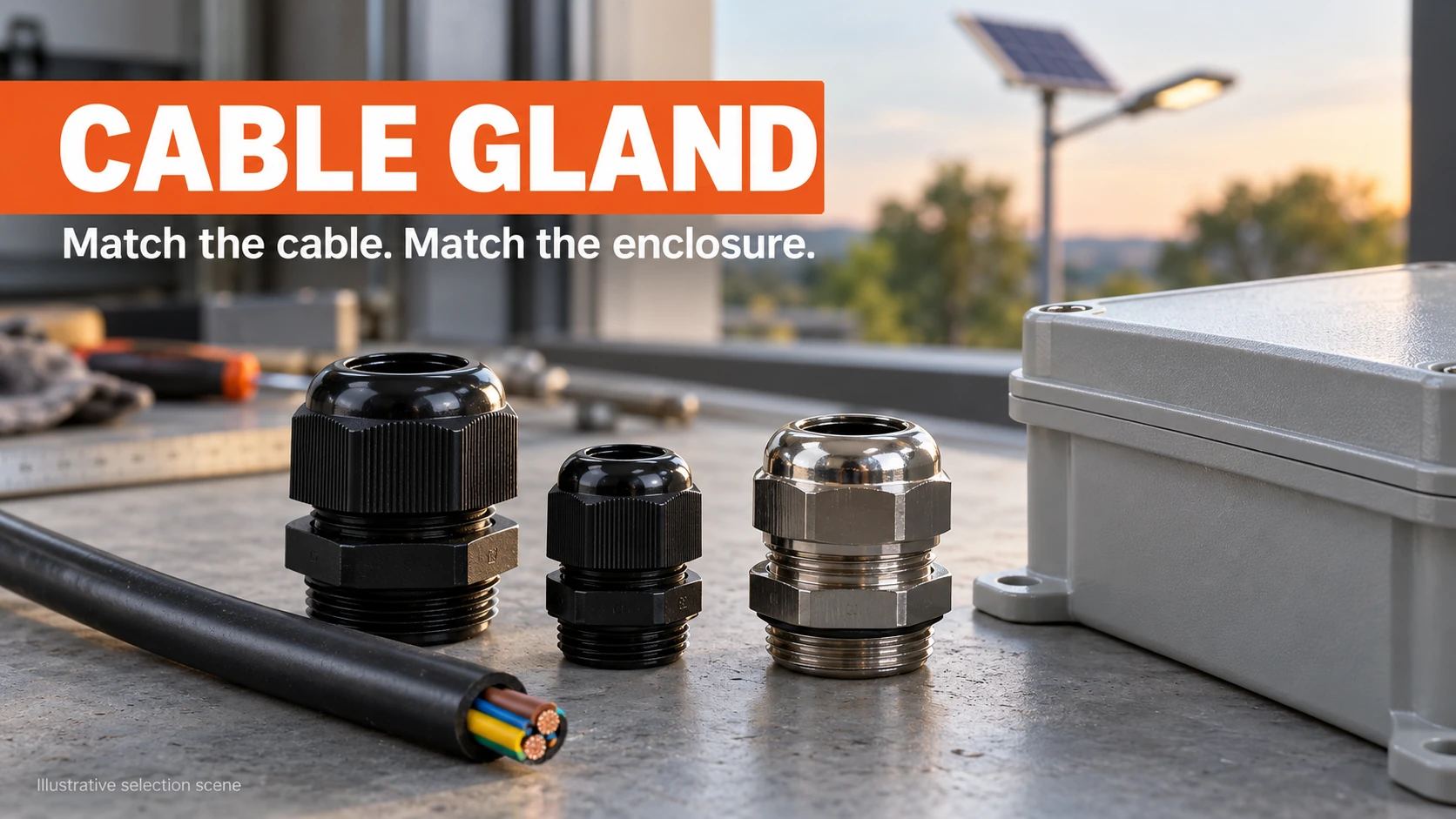
The buying mistake is easy to make. A maintenance list says “M20 cable gland,” a replacement arrives, and its thread appears to match. Yet the cable is too small for the insert, the mounting length is unsuitable, or the required sealing accessory is missing. Resolve those details on the purchase record before the parts reach the pole. This guide is for procurement and component identification, not instructions to open or modify energized equipment.
Start with the cable entry you are actually buying
Name the enclosure and cable endpoints first. Is the entry on the luminaire, a separate battery/controller box, or another part of the approved assembly? A specification for one opening does not identify the parts at every other opening. Ask the lighting supplier for the relevant assembly revision and the gland part number, rather than ordering by a photograph of a similar nut.
For projects using All-in-One solar lighting, a serviceable cable entry must still be identified for the particular model. Integration does not authorize a universal replacement. For a commercial parking-lot project, include the lighting-system identity in the spare-parts schedule so a contractor does not substitute a locally available fitting solely because it screws in.
Check 1: cable outside diameter, not conductor size
The number on a conductor specification is not necessarily the dimension a gland seals around. AWG and mm² describe conductor size; the finished cable also has insulation and, where applicable, an outer sheath. Our wire gauge chart explains that distinction. For gland selection, obtain the cable manufacturer’s stated outside diameter and tolerance, together with the permitted cable geometry.

A cable gland may be designed for one round cable, a particular flat profile or a specified multi-hole insert. Do not treat these arrangements as interchangeable. A procurement record should identify the cable part number and construction, not just say “two wires.” If a connector is already fitted to the cable, also ask how the approved assembly passes through the entry; do not remove a factory termination to make a replacement fit.
Check 2: the exact gland range, not just M20
A useful documented example appears in LAPP’s SKINDICHT SHV-M catalogue. Part 52105300 has an M20 × 1.5 connection and a 6–6.8 mm cable clamping range. Part 52105330 has the same connection designation but a 9–10.8 mm range. These are manufacturer-specific examples, not Inlux-approved accessories or a universal M20 chart.
| Documented catalogue entry | Connection designation | Cable clamping range |
|---|---|---|
| LAPP 52105300 | M20 × 1.5 | 6–6.8 mm |
| LAPP 52105330 | M20 × 1.5 | 9–10.8 mm |

Consider a hypothetical cable with a confirmed 10 mm outside diameter. It is outside the first stated range and within the second. That comparison rejects the first option on diameter alone; it does not approve the second for the lighting assembly. The enclosure interface, material, exposure, accessories and installation instructions still need to match. This is why a buyer should retain the whole part number instead of reducing it to M20.
Check 3: connection thread and mounting arrangement
LAPP’s single-entry selection guidance distinguishes metric, NPT and PG connection threads. Its metric reference identifies M20 × 1.5 as a 20 mm nominal thread diameter with a 1.5 mm pitch. Neither value states the cable clamping diameter. Do not treat a nearby PG or NPT designation as a direct substitute.
For a replacement enquiry, include the enclosure drawing or approved part reference, the specified thread designation and the mounting arrangement. A threaded entry and a clearance opening secured with a locknut are different arrangements. The available thread length, wall thickness, sealing surface and required accessories must be reviewed together. A label that says “fits 20 mm” leaves too much unresolved.
If the existing thread is damaged or its identity is uncertain, stop the substitution decision and request the manufacturer’s repair route. Do not force a fitting, enlarge the opening or add an unapproved adapter to make the order work. Such changes alter the assembly being assessed; this article does not provide drilling dimensions, tightening torques or a field modification procedure.
Check 4: sealing and exposure belong to the assembly
A cable gland has a cable-side interface and a housing-side interface. Identify the required seals and accessories for both. The IP66 procurement guide covers why an individual component rating does not establish the protection of an unspecified installed enclosure. Here, the purchasing task is narrower: ensure that the actual gland, cable and enclosure combination is the one being approved.
Keep environmental selection explicit. State sunlight, temperature, corrosion or cleaning exposure that matters at the entry, then ask which proposed materials and conditions are supported. The solar cable guide addresses cable construction and route exposure separately. A suitable sheath does not by itself establish a suitable gland, just as a metal gland is not automatically the right choice for every coastal installation.
Special applications need their own evidence. Eaton’s cable-gland range distinguishes industrial, commercial and hazardous-environment requirements. Do not infer hazardous-area suitability from an outdoor-lighting label or a generic waterproof claim. If such a location is in scope, specify its classification and require the equipment supplier to address it explicitly.
Check 5: order a repeatable spare, not a look-alike

A useful spare-parts line ties together the lighting model and revision, enclosure entry reference, complete gland part number, cable part number, and required insert, seal or locknut. Keep an approved drawing or supplier reference with that line. A bag labelled only “M20 black” may help a storekeeper sort stock, but it does not provide enough information to authorize a replacement.
At receipt, compare the supplied identification with the approved purchase record. If the supplier proposes another brand, a different insert or a changed cable, request a documented substitution review before acceptance. Record who approved the alternative and which assembly it applies to. That avoids treating a cheaper component as equivalent before anyone has checked what changed.
Keep installation and inspection with qualified personnel following the equipment instructions and site safety procedures. Tightening harder is not a remedy for a wrong clamping range, and tape or sealant is not evidence of a compatible replacement. Retain the specified assembly and acceptance records after the work; a close-up photograph can support identification but does not certify an ingress test.
FAQs about cable gland selection
What is another name for a cable gland?
Terms such as cord grip, cable connector and strain-relief fitting appear in supplier catalogues. They do not guarantee identical construction or sealing performance. Search by the required function, then confirm the exact product and its documented application.
How do I choose the right cable gland size?
Match the specified cable outside diameter and geometry to the exact part’s permitted range, then verify the enclosure connection and mounting arrangement. Keep environmental requirements and required accessories in the same approval. Neither conductor area nor thread size alone completes the selection.
Does M20 mean a 20 mm cable?
No. In a designation such as M20 × 1.5, M20 refers to the nominal metric connection thread diameter, and 1.5 specifies its pitch. The cable clamping range is a separate product value and can differ between M20 glands.
What is the difference between a cable gland and a grommet?
A basic grommet protects a cable at an opening; a specified gland can also provide cable retention and sealing. Some specialized entry systems combine functions, so compare documented performance rather than relying on the name. Do not replace an approved gland with a plain grommet without review.
Can two cables go through one cable gland?
Only when the selected product and insert are intended for that cable arrangement. Two loose cables in a single round sealing opening are not automatically an approved assembly. Request the correct multi-entry solution or the manufacturer’s specified alternative.
Can I replace a solar light’s gland with any waterproof one?
No. Identify the exact lighting model, enclosure, cable and approved accessories. A waterproof label does not establish dimensional compatibility or preserve the original assembly rating. Ask the equipment supplier to confirm the replacement before it is fitted.
Put the entry specification into the lighting order
Inlux Solar has a 5-year standard warranty; confirm the agreed configuration and applicable terms in the quotation. This does not extend approval to an unspecified field modification or a look-alike accessory. Keeping the original assembly identity is useful both for the first delivery and for later maintenance.
When requesting a solar lighting project quotation, include the project location, selected system, quantity and any separately supplied cables or enclosures. For a replacement, include the equipment label, approved drawing reference and clear identification photographs taken under safe conditions. Ask for the correct assembly or a documented alternative—not simply the closest available cable gland.