Solar cable is cable specified for photovoltaic service, but the name alone does not approve it for every outdoor route. For a solar street-light project, identify the exact cable, its electrical ratings and its permitted exposure before accepting a substitution. A larger conductor does not solve an unsuitable sheath, and an outdoor claim does not automatically permit standing water or direct burial.
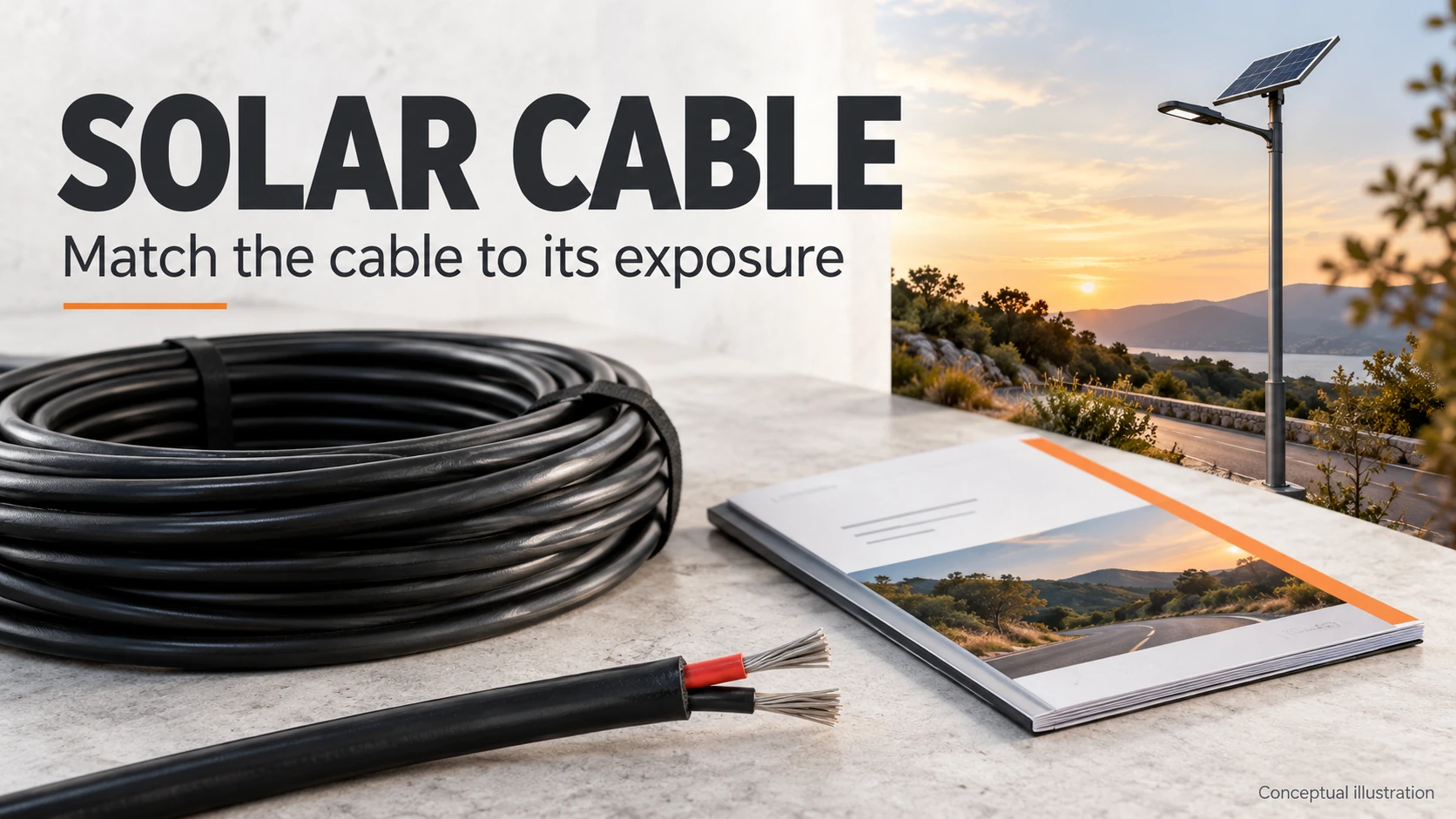
The useful purchasing question is not simply “Is this solar cable?” It is “Does this identified product suit this part of the lighting system, in these conditions?” The five checks below separate those decisions. This is a procurement reference, not a wiring or testing procedure; installation and inspection require qualified personnel, the equipment instructions and applicable local rules.
1. Identify what the solar cable is made of
Conductor, insulation and outer sheath are different parts of the specification. The conductor carries current; its material and cross-sectional area matter. Insulation provides electrical separation. The outer sheath is part of the cable’s protection against its environment. Looking at a thick black jacket does not establish the metal area inside or the conditions for which the complete cable is approved.
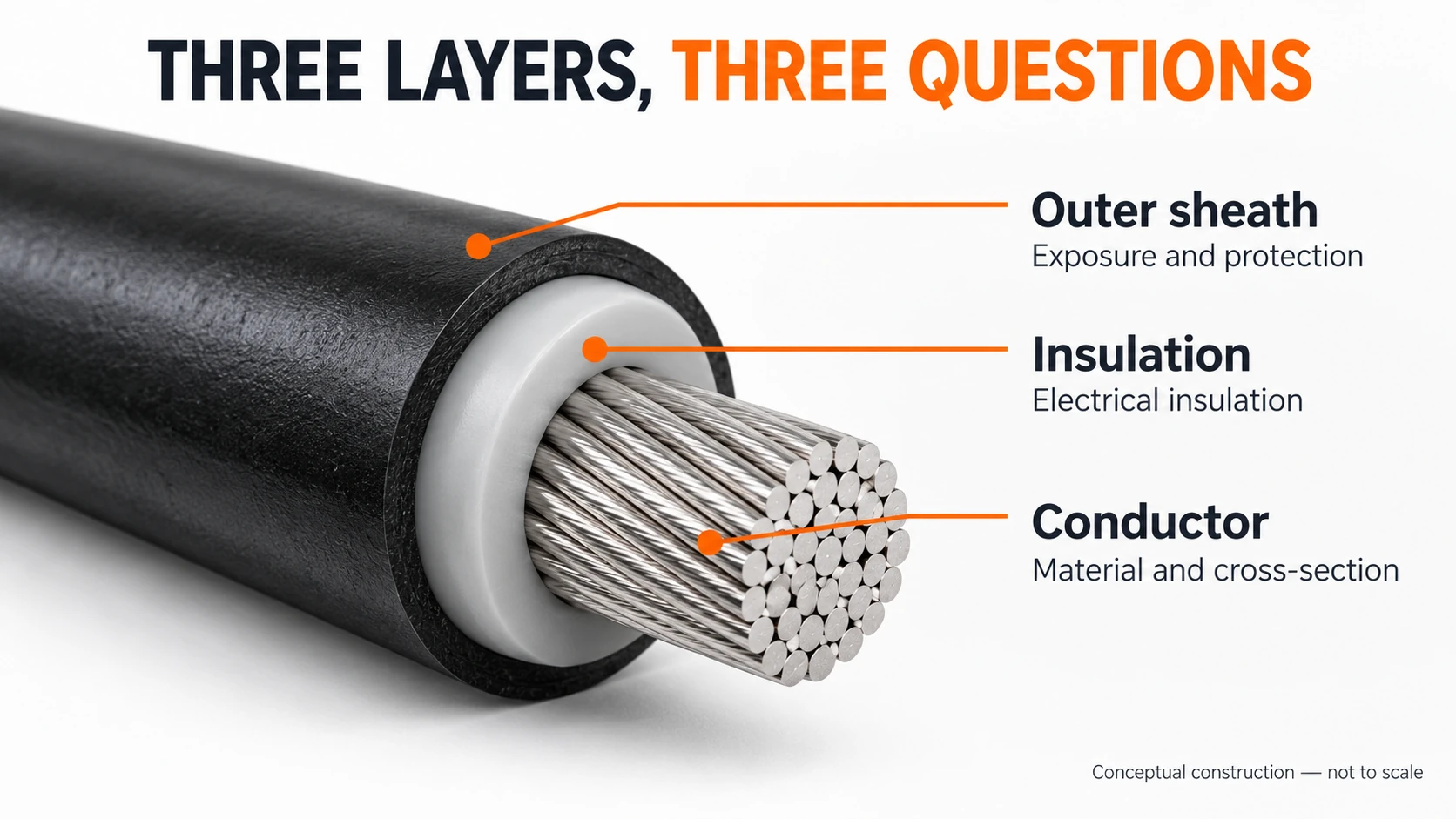
For a concrete manufacturer example, the LAPP ÖLFLEX SOLAR XLWP data sheet specifies a fine-stranded, tinned-copper conductor with crosslinked polyolefin insulation and sheath. That describes this product; it is not a definition of every cable advertised online as solar cable. The coating on tinned copper also does not make the conductor aluminium.
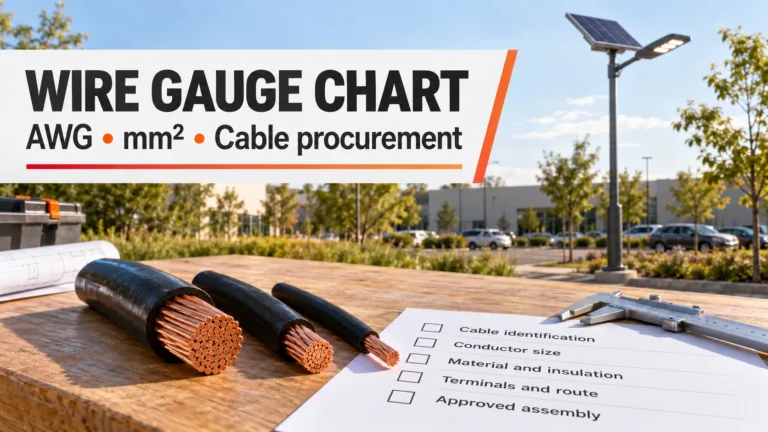
Keep cable construction separate from size conversion. Our AWG and metric conductor reference explains why metal area and insulated outside diameter cannot be substituted for each other. Here, the decision is whether the named material and construction match the equipment and exposure requirements, not which generic gauge to buy.
2. Match the marking to an identifiable product
A type designation is useful, but a quotation still needs the manufacturer, exact part number and current data sheet. Ask for a legible sample of the cable marking and the reel or assembly identification. Those records should describe the same product as the offer. A certificate for a different size, manufacturer or construction does not settle the proposed cable’s suitability.
| Specification entry | What the cable entry establishes | What the cable entry does not establish |
|---|---|---|
| Conductor size and material | The stated conducting element | An approved current for every installation |
| AC or DC voltage rating | The declared insulation rating for the stated duty | The operating voltage of the light |
| Temperature information | Limits under the manufacturer’s stated conditions | One temperature usable for storage, installation and operation |
| Product standard or type code | A reference for the stated cable construction | Unrestricted permission for every outdoor route |
For example, a cable marked for a high DC voltage does not force the lighting system to operate at that voltage. Equally, a low-voltage lighting system does not make every insulation or exposure issue irrelevant. Keep the equipment operating limits, cable ratings and installation conditions in separate fields so that one impressive number does not hide an unanswered question.
Temperature needs the same care: a conductor-temperature limit is not necessarily the permitted ambient temperature during installation. Do not lift the largest temperature printed in a brochure and use it for all conditions. If the data sheet distinguishes fixed installation, handling and short-duration operation, preserve those distinctions in the review.
3. Separate sunlight, water and burial suitability
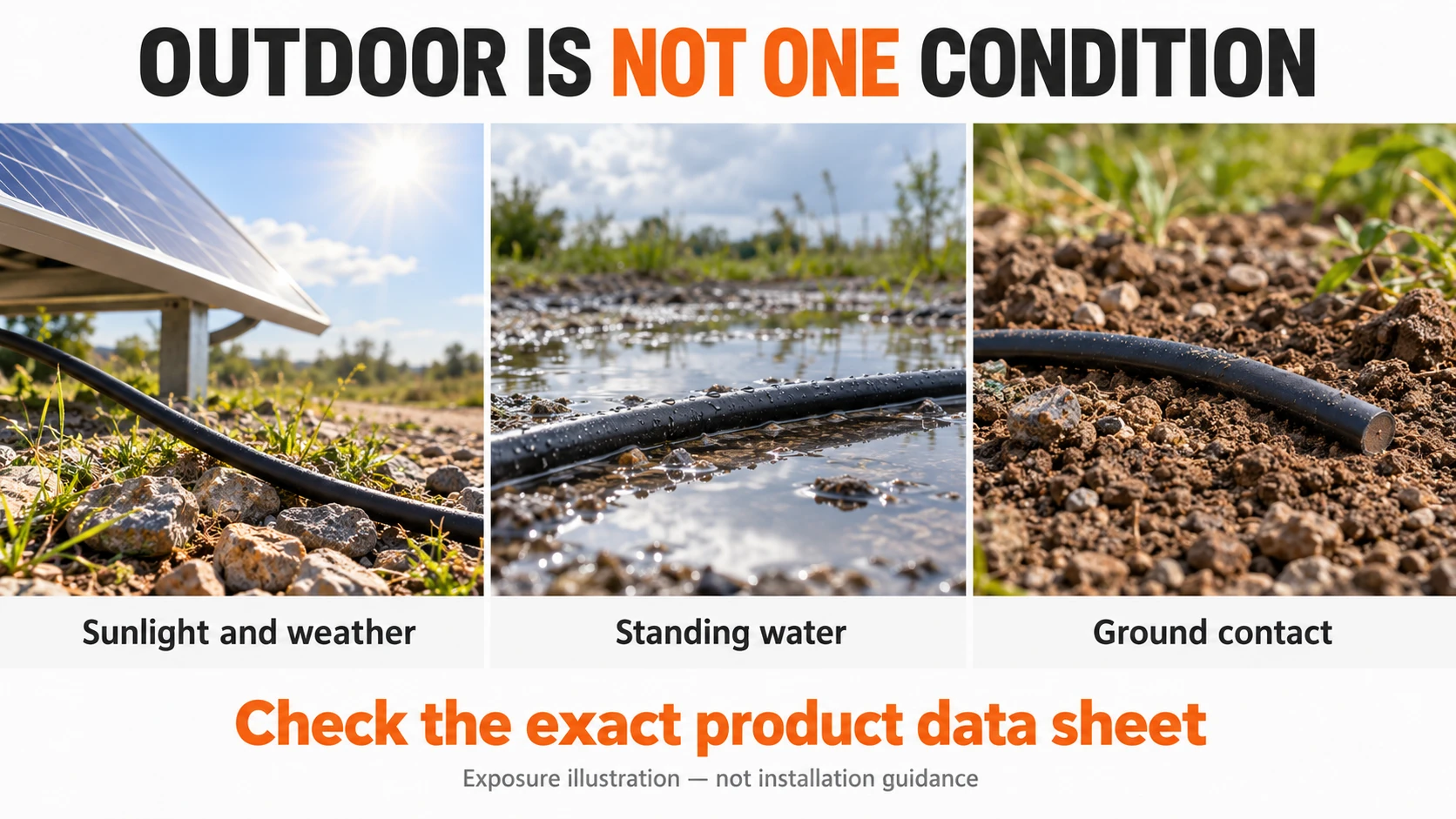
“Outdoor” covers several different exposures. A lead above ground may face sunlight and rain. A section in a low point may remain wet. A ground route introduces a different set of mechanical and moisture conditions. Describe the actual exposure instead of asking the supplier to approve an undefined outdoor installation.
The XLWP sheet cited above is a useful counterexample to a blanket burial claim. It describes permanent outdoor use, allows water exposure only under stated conditions, and explicitly excludes direct burial. Its immersion conditions include a maximum depth of 1 m and water temperatures of 5–40 °C. Water suitability therefore does not erase the separate burial restriction. These are manufacturer-specific limits, not Inlux installation recommendations.
Another product, LAPP ÖLFLEX SOLAR H1 BUR, data sheet version 04, also lists H1Z2Z2-K but describes underground cable-trench use subject to stated installation requirements and limits on mechanical stress. Its document is valid from 7 August 2026. The comparison shows why the full product document matters even when a familiar type designation appears on both offers.
Neither example is a recommendation to substitute these brands into an Inlux light. The practical outcome is simpler: if the proposed route and the permitted use do not match, hold the substitution. Obtain an approved cable or a revised routing design. A generic “solar rated” description is not the missing approval.
4. Keep the cable inside its approved system boundary
The PV lead, battery connection and luminaire connection are not automatically the same cable duty. Identify both endpoints before comparing offers. An assembly approved between a particular panel and controller is not automatically approved as a battery lead, an extension or an AC supply cable. The PV configuration guide explains the electrical arrangement; this material review does not replace it.
For the integrated solar-light range, service procurement should follow the specified assembly for the exact model and revision. Do not open a sealed unit or replace its internal harness using a generic cable article. For the separate-panel solar-light range, confirm the supplied panel-to-light arrangement and whether the proposed mounting changes its exposure or approved lead length.
In a commercial solar parking-light project, the distance between poles is not necessarily a cable route: independently powered lights may not have an inter-pole power connection. Describe the actual system rather than ordering cable from the site’s total perimeter. Any shared-power arrangement needs its own engineered scope.
5. Approve the complete assembly, not the loose cable
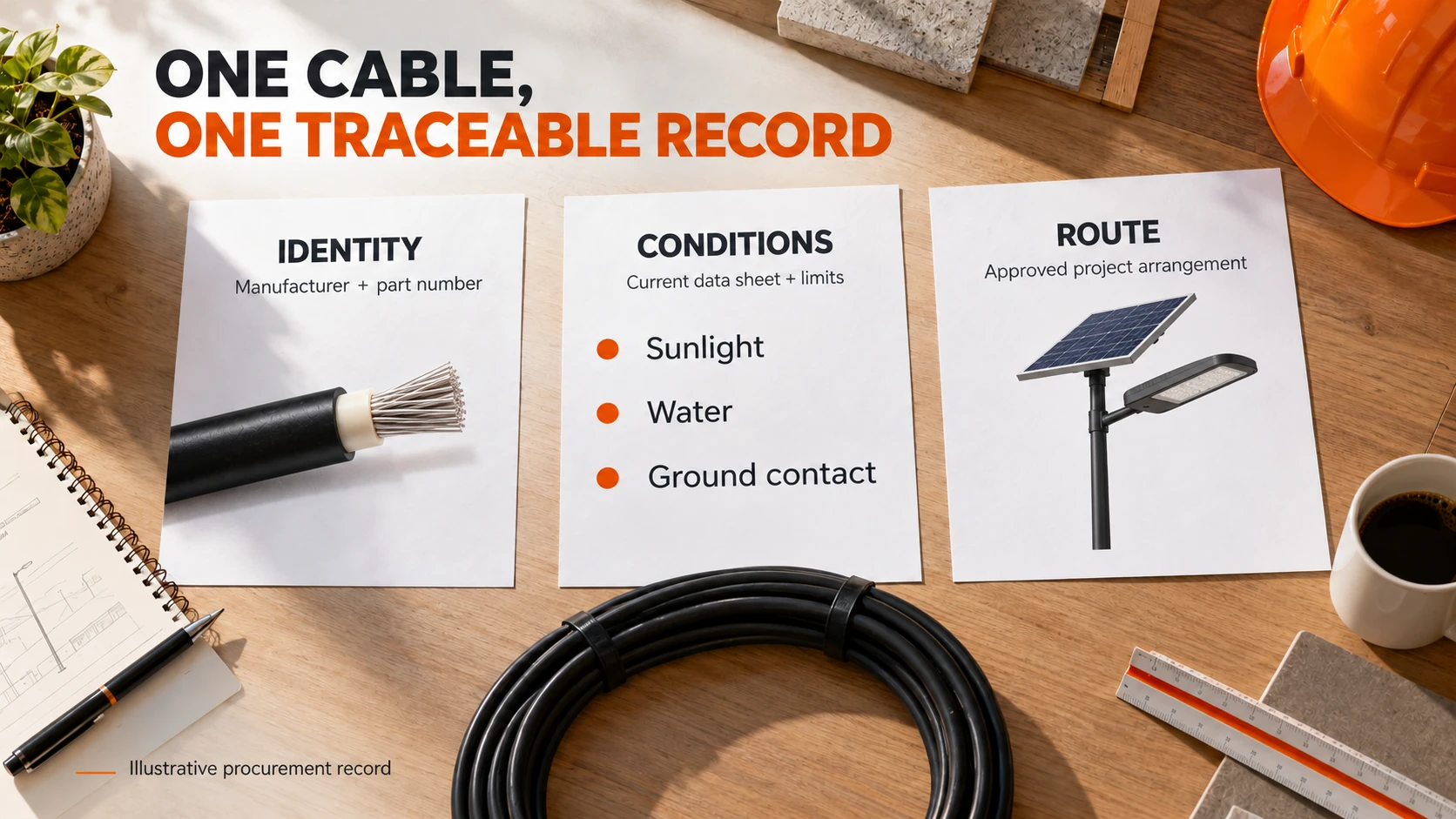
Cable documentation is only one part of acceptance. Terminations, sealing, strain relief and routing must also suit the selected assembly. A suitable bulk cable can still be paired with the wrong contact or seal. Use the PV connector compatibility guide for that separate check; a matching-looking connector is not proof of an approved combination.
Consider two hypothetical offers. Offer A states a conductor area and “UV resistant” but provides no traceable part number. Offer B identifies its cable and the conditions under which it may be used. B is easier to evaluate, but it is not automatically acceptable: its documented limitations must still match the actual route. The decision should be based on that match, not the length of the supplier’s feature list.
Keep one approved record connecting the cable part number, document revision and assembly drawing. If a later shipment has a different marking or the supplier proposes an alternative, resolve that difference before accepting it as equivalent. Do not identify an installed cable by cutting, stripping or disconnecting it; any physical examination must be part of a qualified, safely isolated inspection.
Solar cable questions buyers ask
Which cable is used for solar panels?
Use the cable specified for the selected PV equipment and installation. A photovoltaic cable designation helps identify the intended service, but the exact product’s ratings, exposure conditions and approved terminations still matter. The word “solar” on a listing is not a complete specification.
Is solar cable different from normal cable?
The meaningful difference is the documented construction and permitted use, not the marketing name. Do not assume all ordinary cable is PVC or all solar cable has identical materials. Compare the actual products’ electrical, environmental and assembly requirements before approving an alternative.
Can solar cable be buried directly?
Only where the exact cable and installation design permit it. Do not infer direct-burial suitability from UV resistance, a solar designation or a water rating. The product examples above show why burial conditions must be checked separately.
Does a black or red sheath prove polarity?
No. Colour may support the specified identification system, but it does not prove the polarity of an undocumented or altered circuit. Use the approved drawings and equipment identification. Verification belongs to qualified personnel following the site safety procedure, not guesswork based on colour.
Should I choose 10 or 12 AWG solar cable?
There is no universal choice. Current, route, voltage drop, installation conditions and terminals must be assessed together. The conductor-size reference explains the dimensions; the DC cable-loss guide covers the separate length calculation. Neither approves an undocumented substitution.
How far can I extend a solar-panel cable?
There is no fixed distance that is safe for every system. An extension changes the circuit and may alter voltage drop, connections and exposure. Request approval for the exact model, route and assembly instead of adding cable solely because the connectors fit.
Put the cable question into the lighting quotation
Inlux offers a 5-year standard warranty on its solar street-light systems, subject to the agreed configuration and terms. That is not a claim that every loose cable has a five-year life or that an unapproved field modification is covered. Start with the solar street-light product collection and specify the lighting system before sourcing replacement parts.
When requesting a project-specific lighting quotation, include the site, selected model or arrangement, quantity and the cable issue you need resolved. Attach the proposed cable part number and identify any sunlight, standing-water or ground exposure on the route. Ask for the approved assembly for that configuration, not a general assurance that “solar cable will do.”