Traffic signals use a controller, signal heads, and detectors to safely assign right-of-way to vehicles, cyclists, and pedestrians. Timing is organized into phases within a cycle and coordinated along corridors using cycle length, splits, and offsets. Modern systems add adaptive control, transit priority, emergency/rail preemption, and pedestrian safety tools like Leading Pedestrian Intervals (LPIs). Designs should comply with current standards (e.g., MUTCD 11th Edition in the U.S.; EN 12368 for signal heads in Europe).
What exactly is a traffic signal?
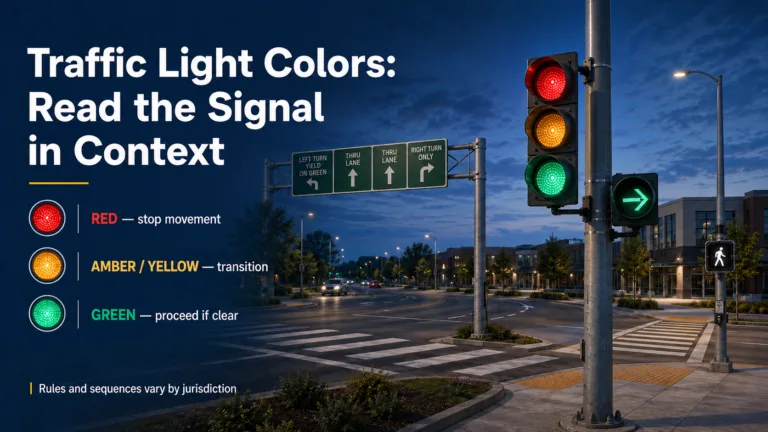
A traffic signal is an active, power-driven device that displays red/amber/yellow/green indications to allocate right-of-way at intersections, mid-block crossings, and special locations (e.g., rail crossings). Its job is safety first, efficiency second.
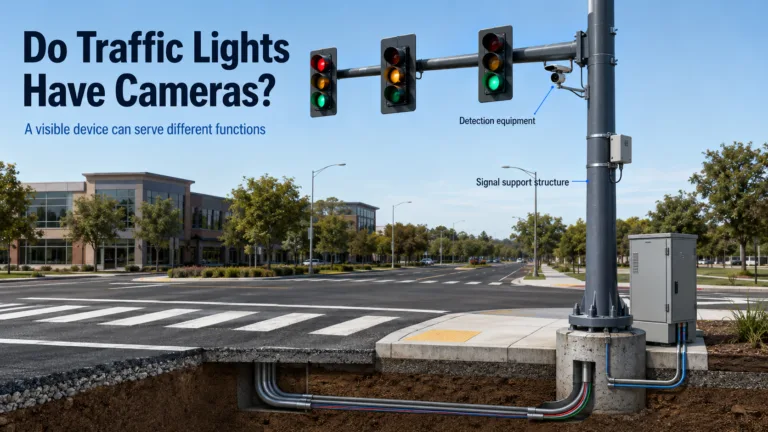
Recommended figure: “Anatomy of a Signalized Intersection” (label controller cabinet, poles/mast arms, signal heads, detectors, pushbuttons, communications, UPS).
The core hardware
- Controller cabinet: The computer that sequences phases and logs events. In North America, NEMA TS2 and ATC platforms are common; a Malfunction Management Unit (MMU)/conflict monitor continuously watches for unsafe indications.
- Signal heads: Lenses/optics and LED modules (200/300 mm) that meet EN 12368 visual, structural, and environmental performance where EU standards apply.
- Detectors: Inductive loop, magnetometer, video, microwave/radar, infrared, ultrasonic—and hybrid sensors. They tell the controller who is waiting and when to end or extend green.
- Communications & power: Fiber/copper/cellular backhaul to the traffic management system; UPS to ride through outages.
From green to red: phases, cycles, and barriers
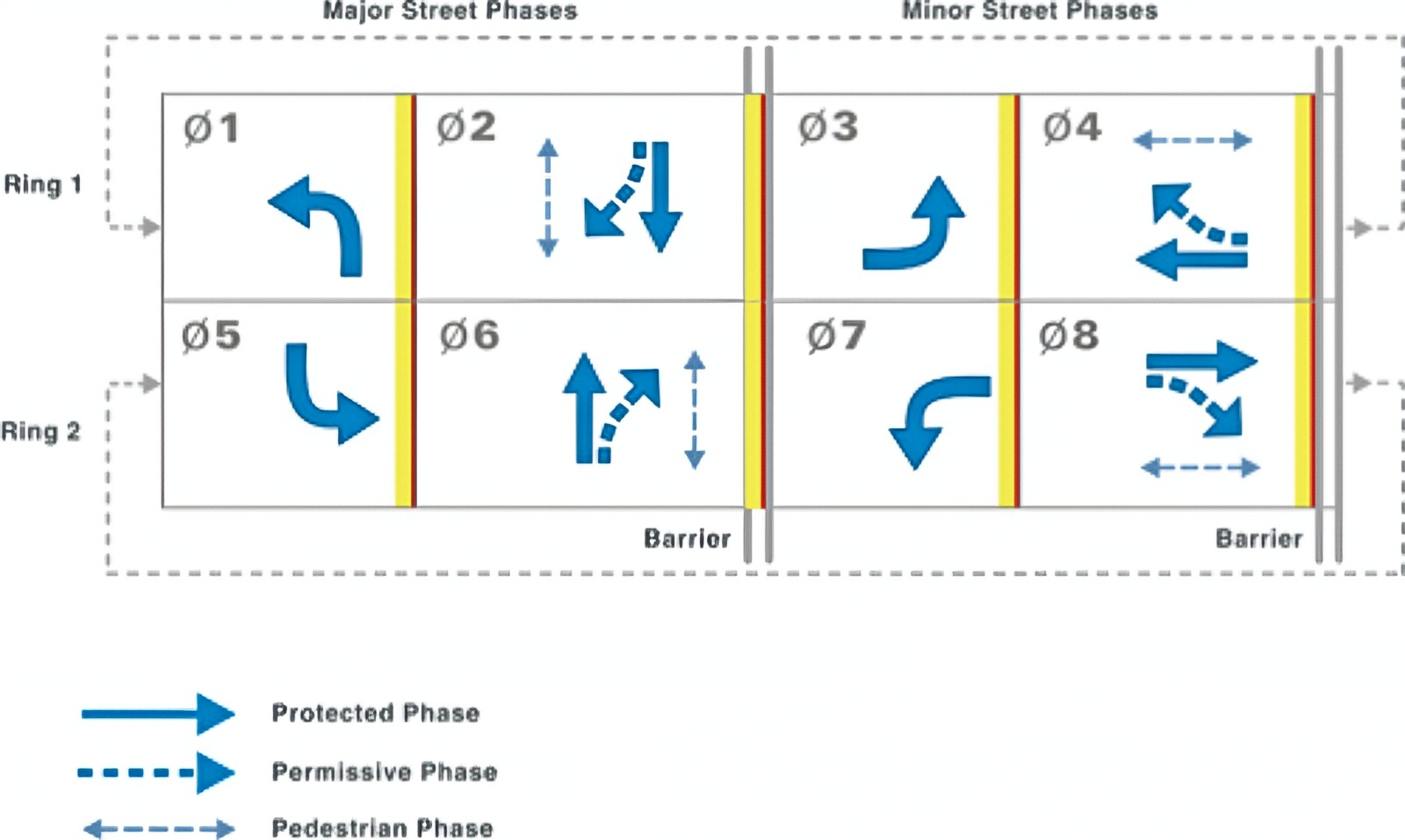
Signals operate in phases (each movement’s green–yellow–red), grouped into a cycle. Dual-ring, barrier-separated operation lets non-conflicting phases in different rings run independently—but both rings must cross the barrier together before serving the other street.
Recommended figure: A clean dual-ring & barrier diagram with an eight-phase example.
Timing building blocks (the “why did I wait?” section)
- Cycle length: Time to serve all phases once.
- Splits: How each phase divides the cycle.
- Offset: The time relationship between neighboring signals for progression (“green waves”).
These three are the heart of corridor coordination and should change by time-of-day or traffic conditions.
Safety-critical intervals
- Yellow (amber) change: Warns drivers their permission to proceed is ending; duration must be engineered, not guessed.
- Red clearance: Brief all-red to clear the intersection.
- Pedestrian timing: MUTCD 11th Edition bases pedestrian clearance on a ≤ 3.5 ft/s walking speed, with slower speeds considered where appropriate. LPIs typically give pedestrians a 3–7 s head start to reduce turning-vehicle conflicts.
Detection strategies (when and how the green ends)
- Stop-bar presence detects demand; advance detection handles dilemma zone protection and gap-out decisions.
- Above-ground radar/video avoids pavement cuts and often reduces maintenance; loops still excel at stop-bar presence with low cost. Choice depends on climate, pavement condition, lanes, and budget.
Control modes you’ll actually encounter
- Pretimed (fixed-time): Simple, predictable, best for steady patterns.
- Actuated: Uses detectors to extend or gap out phases.
- Coordinated-actuated: Local actuation within a corridor plan—today’s urban workhorse.
- Adaptive control: Systems such as SCOOT/SCATS adjust splits/offsets/cycles in near-real-time, cutting delay on variable corridors.
Priority and preemption (special users and special risks)
- Transit Signal Priority (TSP): Small timing favors like green extension or early green to help buses without breaking coordination.
- Emergency Vehicle Preemption (EVP): Immediately modifies timing to provide a safe path for responders.
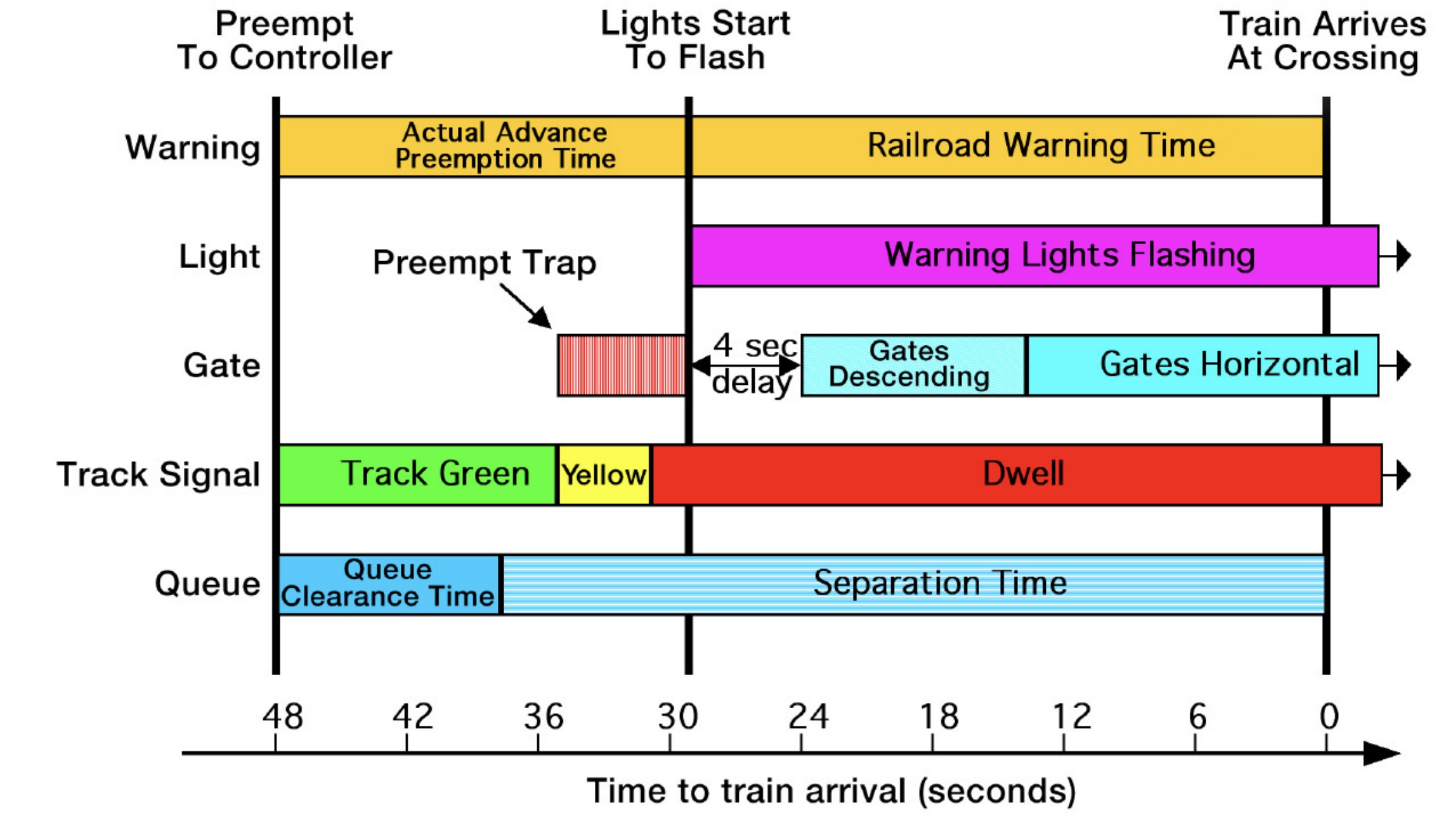
- Railroad preemption: At grade crossings, signals must clear queues away from tracks and lock out movements toward the tracks—now more explicitly covered in MUTCD 11th (Part 8) with compliance deadlines for agencies.
Pedestrians, cyclists, and complete streets
- LPIs (3–7 s), pedestrian recall at downtown cores, accessible pushbuttons, passive detection for slower walkers, and bicycle phases/detectors all improve safety and equity when correctly timed and signed.
Hardware and reliability in the real world
- MMU/Conflict Monitor hardware trips the signal to safe flash if an unsafe combination occurs; modern MMUs exceed TS2 requirements and log rich diagnostics.
- UPS keeps signals running during short outages; remote monitoring flags dark signals or detector failures early.
Design-to-operations workflow
- Data & counts → 2) Safety audit → 3) Select phasing (protected/permissive turns, pedestrian strategy) → 4) Pick detectors → 5) Time the plan (cycle/split/offset + walk/clearances) → 6) Field implement → 7) Fine-tune using performance measures (delay, split failures, v/c, arrivals on green) → 8) Retiming cycle (e.g., every 2–3 years or after land-use changes).
Standards and compliance: what you should cite
- MUTCD 11th Edition (Dec 2023) is the current U.S. national standard; always reference Part 4 (Signals) and Part 8 (Rail crossings) as applicable.
- EN 12368 governs traffic signal heads in Europe (200/300 mm roundels; visual/structural/environmental testing).
- NEMA TS2 defines controller cabinet interfaces, MMU communications, and logging.

Traffic Light Pole
3–7.5 m pole for intersections and gantries; galvanized steel, anti-corrosion for 30 years.

Multi-Function Pole
10–12 m city pole supporting lighting, CCTV, banners, sensors—compact for smart-city streetscapes.