Public outdoor lighting is essential to urban safety, mobility, and economic activity after dark—especially where road infrastructure is still maturing. Well-designed lighting improves residents’ perceived safety, supports policing and public transport, and measurably enhances night-time quality of life.
The baseline: high consumption from legacy street lights
Across Africa, grid stability varies by region. Many corridors still operate high-pressure sodium and mercury fixtures with low efficacy and rapid lumen depreciation—driving high electricity and maintenance costs for municipalities. In South Africa, street lighting can account for ~16% of a municipality’s annual energy use, underscoring the savings potential of upgrades.
Why LED and solar are now the default choices
- High-efficiency LED: 30–50% energy savings versus legacy lamps, 50,000–100,000 h lifetime, and far lower maintenance truck rolls.
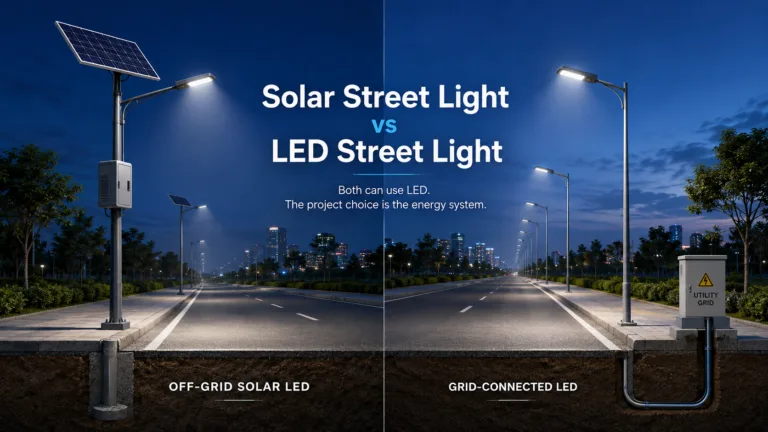
- Solar street lighting systems (PV + lithium storage + LED): independent of the grid, resilient to outages, and ideal where electrification is patchy—often with smart controls for dusk-to-dawn, dimming, and telemetry.
A three-step playbook for municipalities
Step 1 — Diagnose precisely. Inventory quantity, lamp types, failure rates, and current kWh/maintenance spend; prioritize corridors (arterials, business districts, high-incident areas).
Step 2 — Procure at scale. Coordinate joint bids across neighboring cities to unlock volume pricing on LED/solar luminaires and poles.
Step 3 — Finance to fit. Match technology and funding to local realities:
- Grid-stable cores → LED retrofits: 30–50% savings, fastest payback where power is reliable.
- Power-scarce suburbs/villages → Solar: zero electricity bills, off-grid reliability, low OPEX.
- Mixed-reliability hubs → Hybrid: solar for primaries, grid LED for secondaries—balancing CAPEX and service continuity.
- Funding options: PPP for city-wide programs; ESPC for savings-backed repayment without upfront CAPEX; microfinance for community-scale pilots.
Field evidence: Senegal case highlights
A 415-unit solar street-lighting project achieved ~175 kWh annual savings per light (assumes 80 W saved, 6 h/night), translating to roughly US$56 electricity savings per unit per year and ~US$23,000 annual savings across the portfolio—supported by PPP structuring and international lending to de-risk delivery.
Controls and operations that unlock extra savings
- Adaptive dimming (late-night power reduction)
- Photocell + time profiles (seasonal schedules)
- Remote monitoring (battery SOC, fault alerts) — reduces truck-roll diagnostics and accelerates MTTR.
What a city-wide retrofit can save
Replacing 10,000 legacy 250 W HPS luminaires with 100 W LED equivalents operating 10 h/night can save about 5,475 MWh/year—often cutting utility spend by US$1M+/year, depending on tariffs. Scale the same logic with solar to remove grid electricity costs entirely on selected corridors.
Implementation checklist
- Data & GIS audit → build an asset register with GPS, wattage, failure history.
- Photometric design → EN-style illuminance/uniformity on-road and pedestrian areas.
- Lifecycle costing → compare 10-year NPV across LED, solar, and hybrid options.
- Financing model → PPP/ESPC/microfinance aligned with budget cadence.
- Pilot, then scale → prove performance, then roll out by zones.
- O&M plan → spares, batteries (for solar), remote monitoring SLAs.
Conclusion
For West and North African cities, LED and solar street lighting are no longer “nice to have” upgrades—they are pragmatic levers for energy security, budget relief, and safer, more inclusive night-time economies. With the right audit, procurement, and financing, projects demonstrate short paybacks and durable social benefits.
FAQ