As we step into 2026, the demand for sustainable infrastructure has never been higher. Whether for a private backyard or a municipal highway, solar pole lights have become the gold standard for off-grid illumination.
However, if you type “solar pole lights” into a search engine, you are likely bombarded with results ranging from $20 garden stakes to $2,000 industrial systems. This creates confusion. How do you distinguish between a decorative toy and a critical infrastructure asset?
This guide By 2026. We will break down the technology, explain the shift toward vertical solar, and help you decide which lighting solution fits your project—whether it’s a home garden or a city plaza.
1. Residential vs. Commercial Solar Pole Lights: The Great Divide
The most common mistake buyers make is assuming all solar lights are created equal. They are not. The industry is split into two distinct categories: Consumer Grade (B2C) and Commercial/Industrial Grade (B2B).
Understanding this difference is crucial for project managers, city planners, and contractors.
The Comparison: Garden Lights vs. Infrastructure Lights
| Feature | Residential / Garden Solar Lights | Commercial Solar Pole Lights (Inlux Grade) |
| Primary Use | Decoration, pathway accents, ambiance. | Safety, security, highways, public spaces. |
| Luminous Flux | 100 – 800 Lumens (Low brightness) | 3,000 – 12,000+ Lumens (High intensity) |
| Material | Plastic or thin aluminum. | Die-cast Aluminum / Hot-dip Galvanized Steel. |
| Battery Tech | Standard NiMH or low-end Lithium. | LiFePO4 (Lithium Iron Phosphate). |
| Lifespan | 1 – 2 Years. | 10+ Years (Maintenance-free). |
| Autonomy | Fades after a few cloudy days. | 3-5 Rainy Days Backup (Intelligent Dimming). |
The Verdict: If you are looking to light up a flower bed, buy the residential version. But if you are responsible for lighting a parking lot, a university campus, or a street, relying on consumer-grade products will result in failure within 12 months.
2. The Evolution of Technology: Why Vertical Solar is the Future
For decades, commercial solar lights looked the same: a pole with a massive, flat solar panel perched on top like a “hat.” While functional, this traditional design has major flaws:
- Wind Resistance: The flat panel acts as a sail, requiring massive, expensive poles to withstand wind loads.
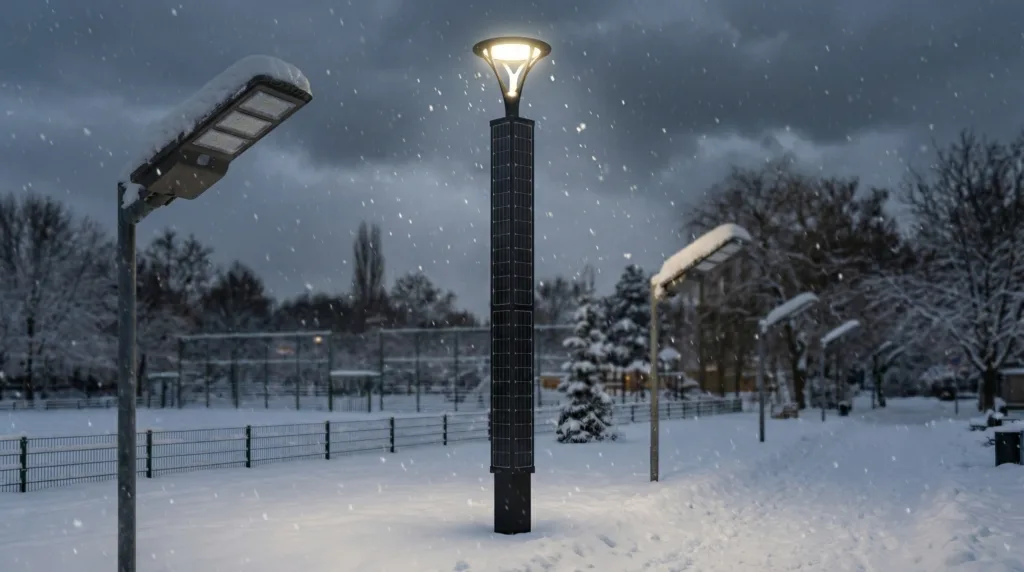
- Maintenance: Flat panels accumulate dust, sand, bird droppings, and snow, which kills efficiency.
- Aesthetics: They often look bulky and industrial.

Enter the Era of Vertical Solar (Cylindrical Solar)
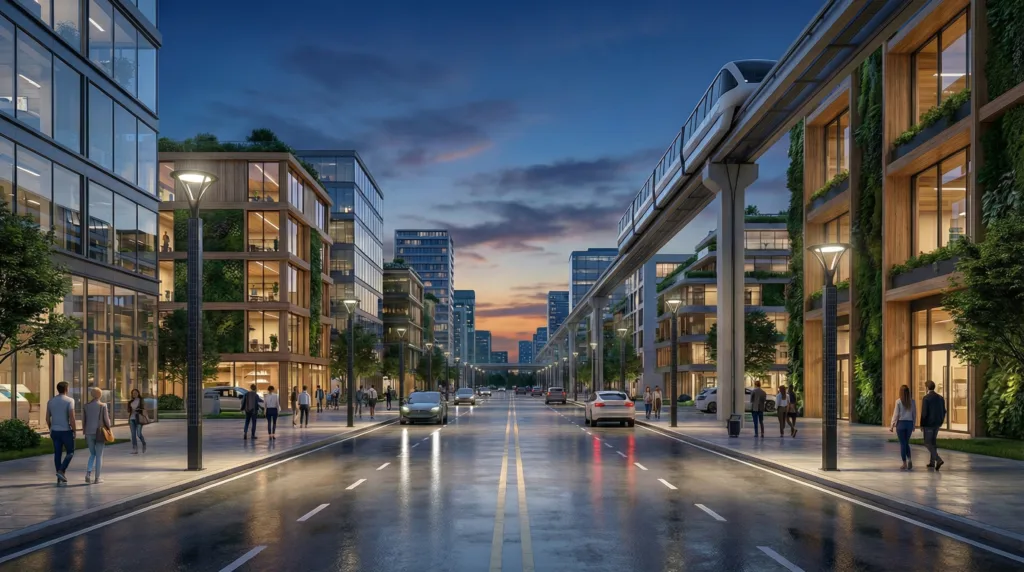
In 2025, the market leader is the Vertical Solar Pole Light. Companies like Inlux Solar have pioneered the integration of solar modules directly onto the pole itself.
Why Vertical is Superior:
- 360° Charging: By wrapping the solar modules around the pole (cylindrical design), the light captures sunlight from all angles throughout the day. It is never fully shaded.
- Self-Cleaning Design: Because the panels are vertical, dust and snow cannot settle. Rain naturally washes the surface clean, maintaining 98% efficiency year-round.
- Hurricane Resistant: The cylindrical shape dramatically reduces wind drag. This is safer for coastal areas and reduces the cost of the foundation.
- Architectural Beauty: It looks like a standard high-end street light. The technology is hidden, making it perfect for plazas, hotels, and modern cities.
Pro Tip: When sourcing for high-profile projects, specify “Vertical Solar PV” in your tender documents to ensure you get modern, wind-resistant designs.
3. Key Components: What Makes a “Pro” Solar Light?
If you are evaluating suppliers for a commercial project, ask about these three internal components. This is where quality is defined.
A. The Battery: LiFePO4 is King
In the past, lead-acid batteries were heavy and died quickly. Today, LiFePO4 (Lithium Iron Phosphate) is the industry standard.
- Safety: It does not overheat or explode.
- Cycle Life: It handles 2,000 to 6,000 charging cycles (roughly 5-8 years) before needing replacement.
- Temperature: High-quality commercial lights incorporate battery heating systems to ensure operation even in -40°C weather.
B. The Controller: MPPT Technology
The “brain” of the solar pole light. You must insist on an MPPT (Maximum Power Point Tracking) controller.
- PWM Controllers are cheap but lose 30-40% of energy.
- MPPT Controllers adjust the voltage in real-time to squeeze every drop of energy from the sun, increasing charging efficiency by 30%.
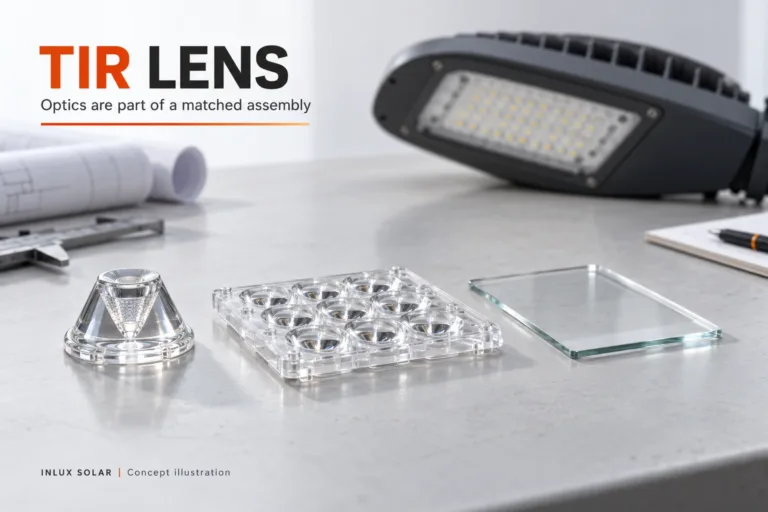
C. The LED Module
It’s not just about Watts; it’s about Efficacy (Lumens per Watt).
- Cheap lights: 100 lm/w.
- Inlux Commercial Lights: 180+ lm/w. This means we can produce brighter light using less battery power, extending the autonomy of the system.
4. Top Applications for Commercial Solar Pole Lights
Where should you install these systems? Here are the most effective use cases we have seen in 2025:
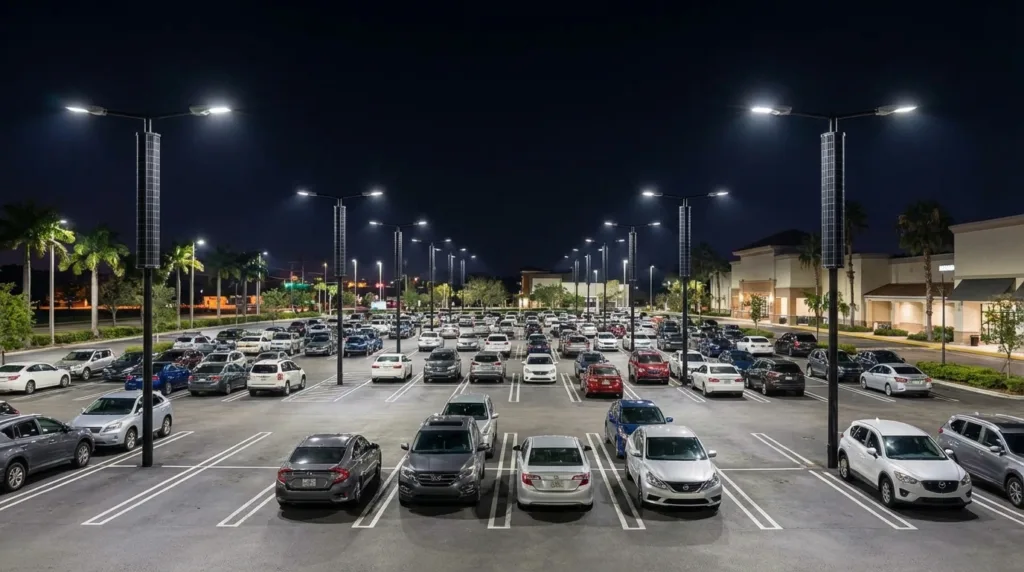
1. Parking Lots & Perimeters
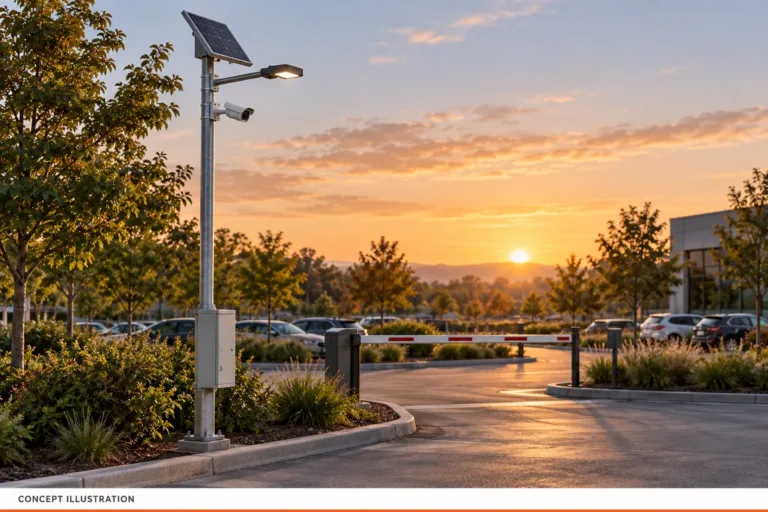
Security is paramount here. Trenching cables across an existing asphalt parking lot is incredibly expensive and disruptive. Solar pole lights can be “dropped and bolted” in a single day with zero surface damage.
2. Municipal Streets & Highways
With the rise of “Smart City” projects, vertical solar lights can now integrate CCTV cameras, Wi-Fi hotspots, and IoT sensors. They serve as independent power stations for city data.
3. Parks, Campuses, and Plazas
Aesthetics matter. A bulky flat panel ruins the landscape design. Vertical solar poles blend seamlessly into the environment, providing soft, reliable light for pedestrians without the visual clutter.
5. Installation & Cost Analysis: Solar vs. Grid
The biggest objection to solar is often the upfront cost. Let’s break down the Return on Investment (ROI).
- Grid-Tied Lights (Traditional): Low hardware cost ($), but HUGE installation cost ($$$$). You must pay for cabling, trenching, transformers, and labor. Plus, you pay a monthly electricity bill forever.
- Solar Pole Lights: Higher hardware cost ($$), but minimal installation cost ($). No trenching, no cabling.
- Electricity Bill: $0.
- Maintenance: Minimal (especially with vertical self-cleaning poles).
The Math: For most new projects, commercial solar pole lights reach the break-even point in 2-3 years. After that, you are essentially lighting your facility for free.
Conclusion: Making the Right Choice
In 2025, the term “Solar Pole Light” encompasses everything from a $20 garden toy to a critical piece of urban infrastructure.
If you are a homeowner, the garden lights on Amazon are fantastic. But if you are a contractor, city planner, or business owner, you need reliability. You need a system that withstands hurricanes, cleans itself, and stays lit through a week of rain.
Vertical Solar Pole Lights are not just an alternative to grid lighting; in many cases, they are the superior choice.
Ready to Upgrade Your Infrastructure?
At Inlux Solar, we specialize in commercial-grade, vertical solar lighting solutions designed for the toughest environments.
- Looking for specs? Check out our SPL Series Solar Pole Lights.
- Need a lighting simulation? Contact our engineering team for a free DIALux simulation today.
- Need 24/7 uptime? See our solar street light with pole and battery complete kit — integrated LiFePO4 battery, galvanized pole, and automatic AC-grid backup for cloudy spells.
Frequently Asked Questions (FAQ) about Solar Pole Lights
Q: How long do commercial solar pole lights last?
A: Unlike residential garden lights that typically last 1-2 years, commercial solar pole lights are engineered for long-term infrastructure use. High-quality systems (like Inlux Solar’s SPL series) generally have a system lifespan of 10-15 years. Specifically, the LiFePO4 battery is designed to last 5-8 years before needing a simple replacement, while the LED modules can maintain brightness for over 50,000 hours.
Q: Do vertical solar pole lights work in winter or cloudy days?
A: Yes. This is a key advantage of Vertical Solar technology. The vertical orientation prevents snow accumulation, which is the #1 cause of failure for traditional flat-panel solar lights in winter. Additionally, commercial systems use intelligent MPPT controllers and oversized battery capacity to provide 3-5 days of backup power (autonomy), ensuring the lights stay on even during extended rainy or cloudy periods.
Q: Are solar pole lights expensive to install compared to grid lights?
A: While the upfront hardware cost of a solar pole light is higher, the total project cost is often lower. This is because solar lights require zero trenching, no underground cabling, and no transformers. For parking lots and highways, eliminating these labor-intensive steps can reduce total installation costs by 20-40% compared to grid-tied lighting.
Q: What is the recommended lumen output for a parking lot solar light?
A: For safety and security in commercial parking lots, decorative lighting is not enough. You typically need a luminous flux between 3,000 to 8,000 lumens per pole, depending on the pole height (usually 6m to 8m). We recommend consulting with a manufacturer to perform a DIALux simulation to ensure the light levels meet local municipal standards.