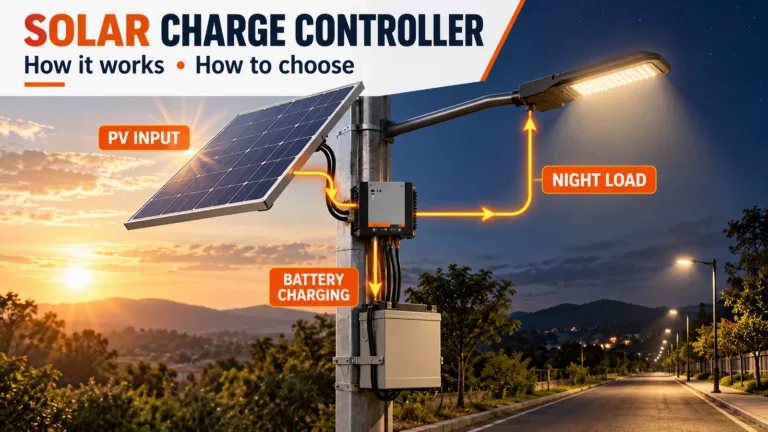
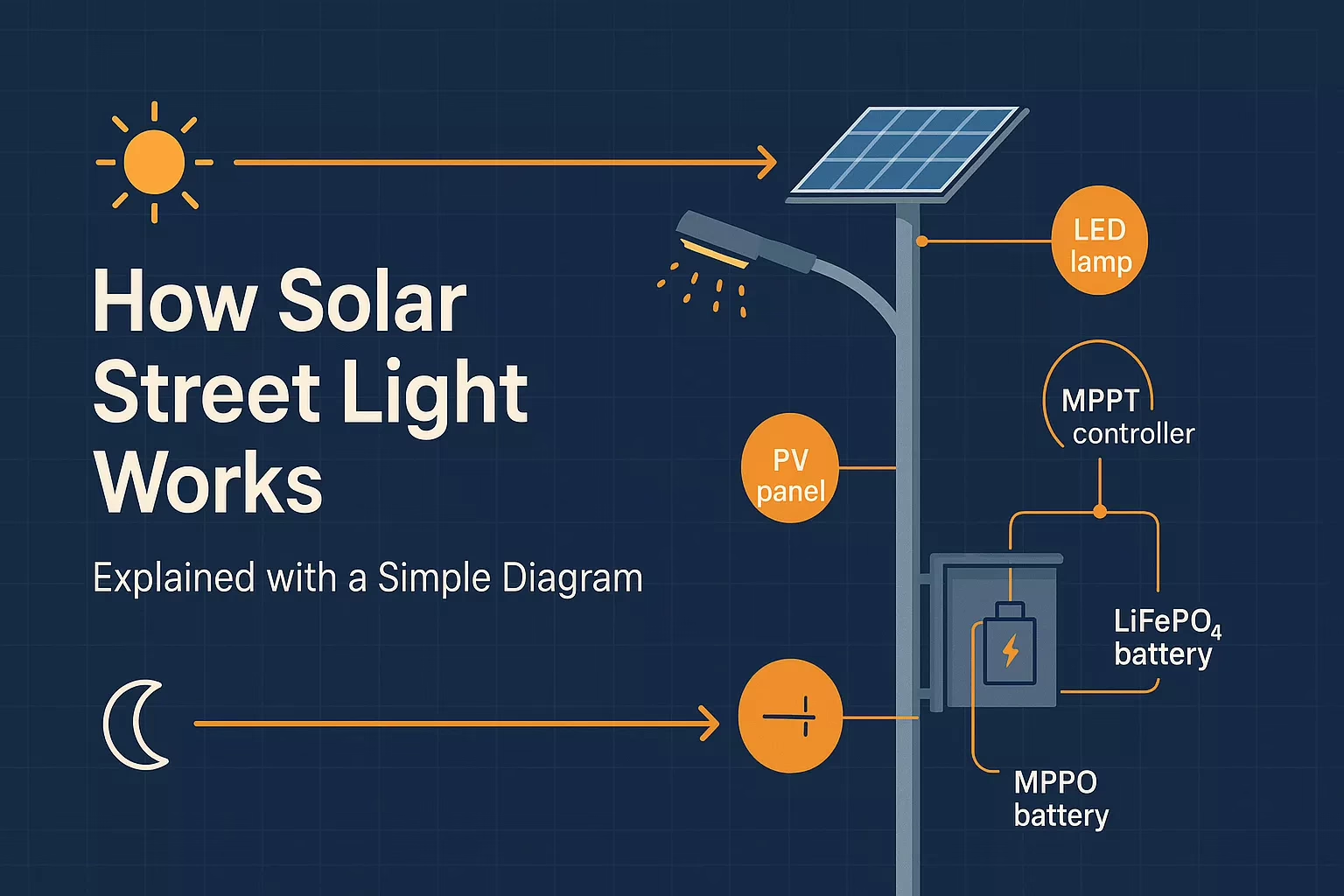
In this comprehensive guide, we will dive deep into how solar street light works, from the core components to professional sizing. A solar street light converts sunlight into electricity during the day and uses this stored energy to power LED luminaires at night. The solar panel charges the battery through a controller, which also manages when the light turns on and off and how bright it is. Modern systems use high-efficiency LED chips, long-life LiFePO4 batteries and smart controls to deliver reliable lighting for roads, streets and public areas without any grid connection.
Every solar street light, regardless of its exact design, consists of a few core components:
- A solar panel to harvest sunlight
- A battery to store energy
- A charge controller to manage charging and discharging
- One or more LED luminaires
- A pole and mounting structure
Inlux Solar designs and manufactures all core components in-house. As a vertically integrated solar street light manufacturer, we offer full OEM/ODM customization from panel wattage to battery chemistry.
How It Works: The Commercial-Grade Process
While basic retail solar lights use simple circuits, commercial solar street lights (like those manufactured by Inlux Solar) rely on intelligent energy management to guarantee 365 days of illumination. Here is the exact 4-step process:
- Daytime (Energy Harvesting): High-efficiency monocrystalline solar panels convert sunlight (and even ambient UV rays on cloudy days) into DC electricity.
- Smart Charging (MPPT Technology): Instead of basic PWM, our Maximum Power Point Tracking (MPPT) controllers safely regulate voltage to charge the LiFePO4 battery up to 30% faster while preventing overcharging.
- Dusk (Auto-Activation): As natural lux levels drop below a specific threshold, the built-in photocell sensor automatically triggers the LED fixture.
- Nighttime (Adaptive Dimming & PIR): To maximize battery autonomy, the light runs at 100% brightness during peak evening hours, then dims to 30% after midnight. If the PIR motion sensor detects a vehicle or pedestrian, it instantly jumps back to 100%.
How Solar Street Light Works: From Sunbeam to Safe Streets
A solar street light is a self-contained micro-power plant on a pole. Sunlight is converted to electricity via the Photovoltaic effect, stored with care, and dispensed at night through a precisely controlled LED engine. When orchestrated correctly, the result is dependable illumination with zero grid dependency and minimal maintenance.
System Architectures: All-in-One (Integrated), All-in-Two, and Split-Type
- Integrated (All-in-One): PV module, battery, controller, and LED luminaire housed in a single compact assembly. Rapid installation, low wiring complexity, excellent for residential streets and campuses.
- All-in-Two: Battery and controller integrated with the luminaire; panel mounted separately. Offers better PV orientation freedom and thermal separation for the battery.
- Split-Type: PV, battery box, and luminaire all separate. Highest configurability and serviceability; favored for large highways or harsh climates.
All-in-Two Solar Street Light Types

JAGUAR (INL-AIT5)
High-output all-in-two with 5050 LEDs, large LiFePO4, advanced optics—built for highways and major roads.

FALCON (INL-AIT6)
Mid-output, versatile optics, fast installation—ideal for streets, pathways, and lots.

BISON (INL-AIT7)
Compact, efficient, >180 lm/W class—community and industrial yards ready.
All-in-One Solar Street Light Types

SIRIUS (INL-AIO9)
High-output AIO with adjustable head, Type II/III optics, 5050 LEDs and LiFePO4—built for two-way roads and highways.

GALAXY (INL-AIO6)
Modular AIO for small-to-medium outputs; 5050 LEDs, LiFePO4 and optional motion/IoT—easy maintenance for streets, pathways, parking.

ALIEN (INL-AIO5)
Double-arm AIO with vertical/horizontal adjustment and precision optics—ideal for complex roads, campuses, and industrial zones.

POLARIS (INL-AIO2)
Compact, cost-effective AIO using high-efficiency panel, 5050 LEDs and LiFePO4—reliable for residential streets, parks and walkways.
Photovoltaic Fundamentals: Harvesting Insolation
Cell Technologies and Module Anatomy
Monocrystalline cells (often PERC or TOPCon) deliver superior efficiency and low-light response. Backsheet and glass encapsulate cells; EVA layers bond the stack; an aluminum frame provides rigidity. Bypass diodes within the junction box mitigate mismatch and partial shading losses.
Tilt, Azimuth, and Shading Dynamics
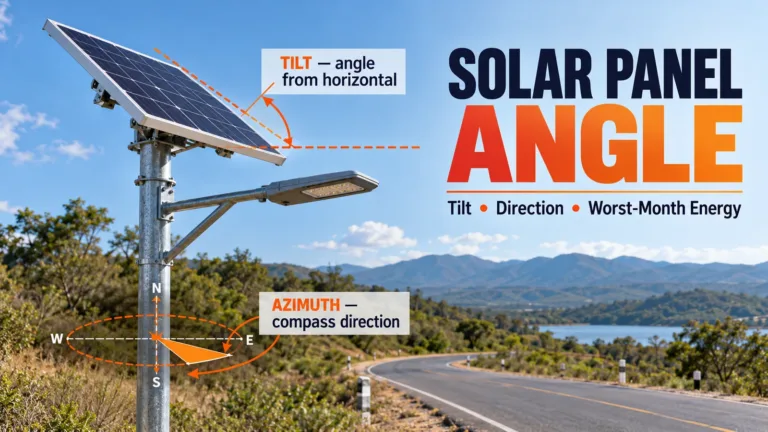
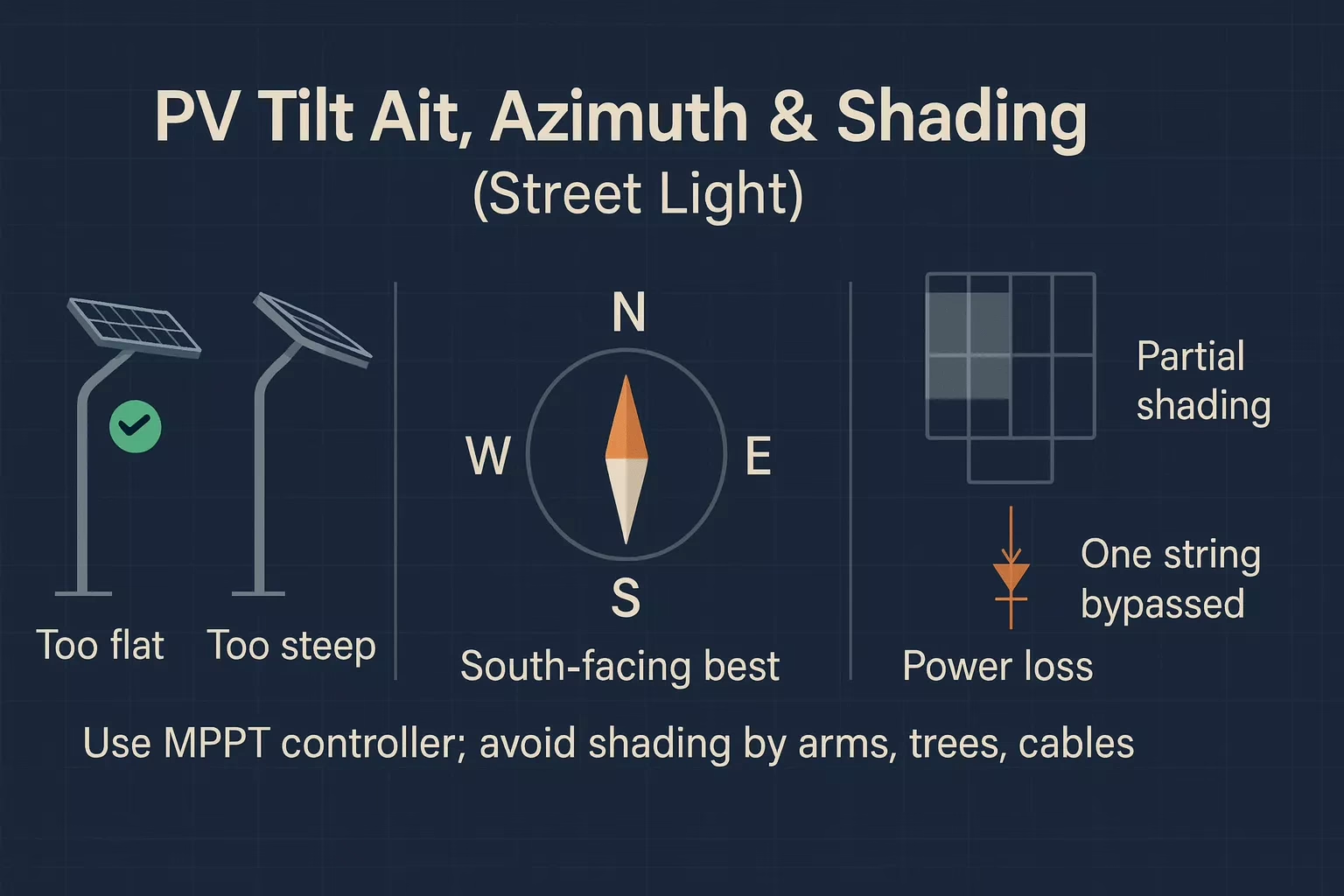
Module tilt approximates site latitude for annual yield. Azimuth bias toward true south (north in the southern hemisphere) captures maximal insolation. Even narrow shadows—armatures, trees, adjacent poles—can cause disproportionate energy loss because shaded cells throttle the string. Keep the module’s sky view pristine.
Charge Regulation: PWM vs. MPPT Pathways
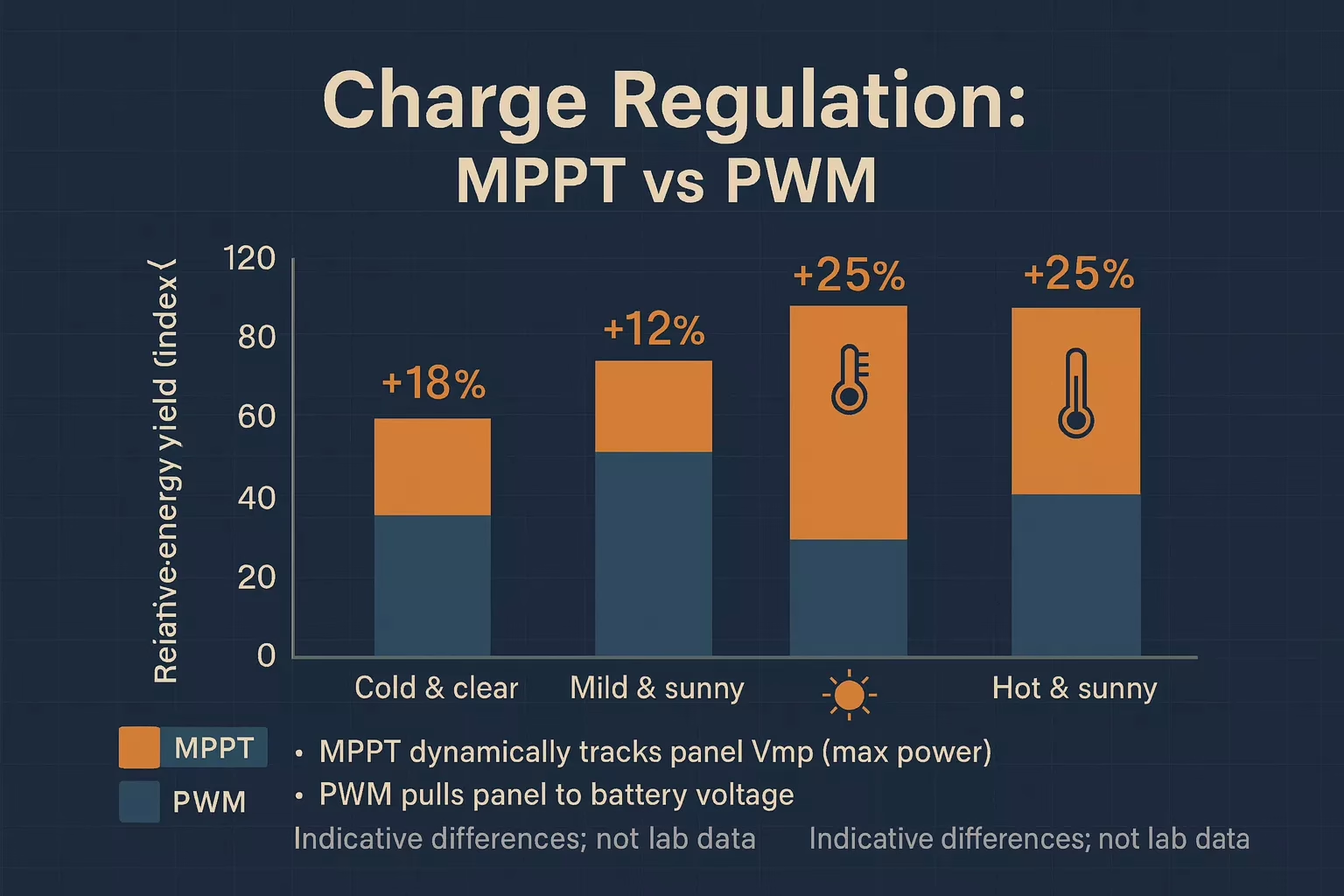
- PWM (Pulse-Width Modulation): Simple, robust, and economical. Best where module voltage closely matches battery voltage and ambient temperatures are mild.
- MPPT (Maximum Power Point Tracking): Continuously seeks the voltage/current sweet spot. Typical 10–30% harvest gain versus PWM, particularly in cold or variable irradiance. For most professional street lights, MPPT is the pragmatic default.
Energy Storage: Battery Chemistries Compared
LiFePO₄ vs. NMC vs. GEL/AGM
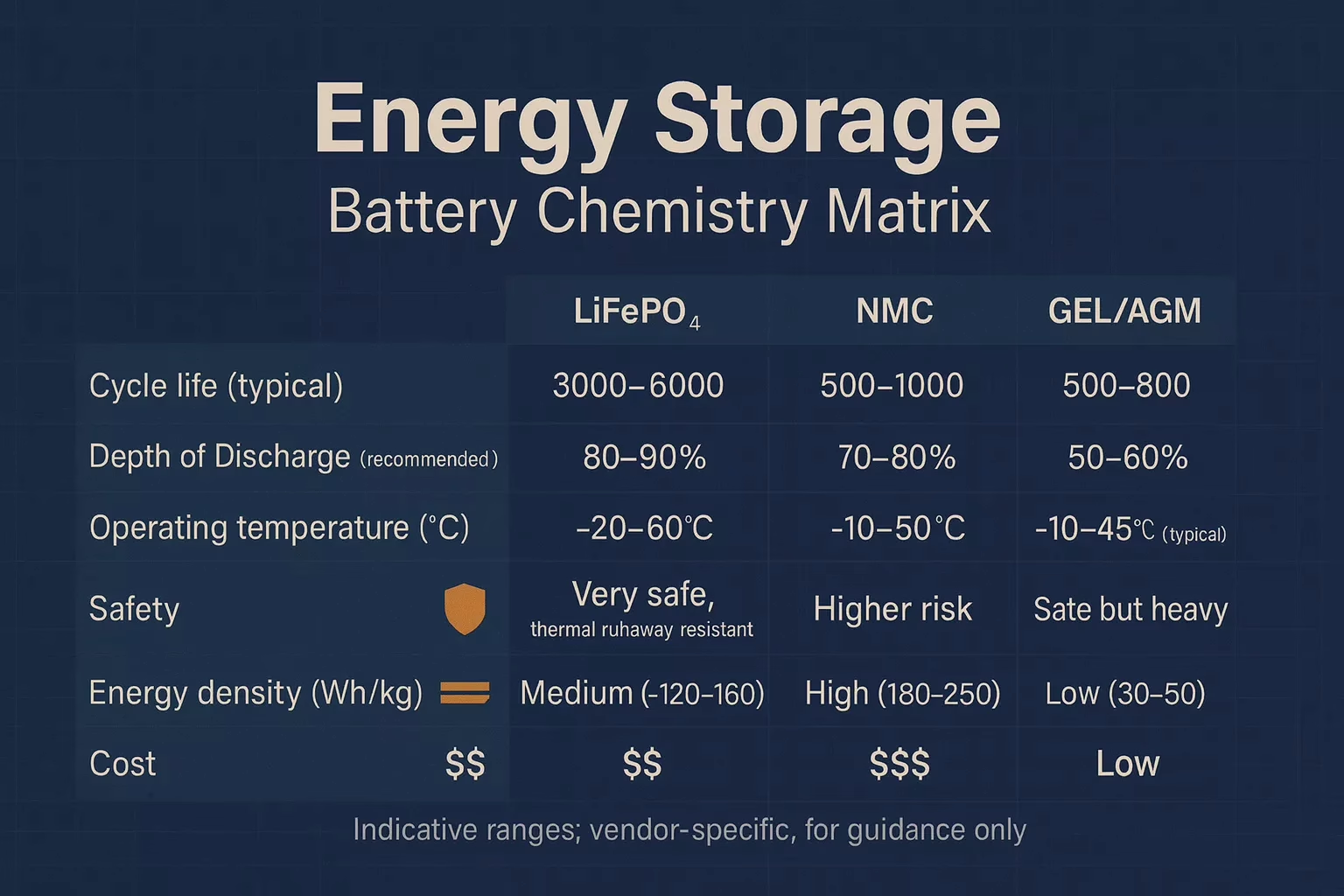
- LiFePO₄ (LFP): Long cycle life, thermal stability, wide usable DoD, excellent for daily cycling.
- NMC: Higher energy density but more temperature-sensitive; needs meticulous BMS oversight.
- GEL/AGM Lead-Acid: Lower upfront cost; heavier, shallower DoD, and shorter life under daily cycling.
Depth of Discharge, Cycle Life, and Temperature Effects
Cycle life scales inversely with DoD: shallow discharges last longer. Lithium performance declines in cold; batteries prefer temperate microclimates with thermal buffering. In polar winters, enclosure insulation and low-temperature charging strategies are indispensable.
Battery Management System (BMS): Guardians of Longevity
Protections: OVP, UVP, OCP, Short-Circuit, Thermal
The BMS prevents over-voltage (OVP) and under-voltage (UVP), guards against over-current (OCP) and short circuits, and throttles operation during extreme temperatures. This is the “immune system” of the storage pack.
Cell Balancing and State-of-Charge Estimation
Active or passive balancing harmonizes cell voltages. Accurate state-of-charge (SoC) estimation blends coulomb counting with open-circuit voltage models to avoid drift. Precision here translates directly into usable autonomy.
LED Light Engine: Luminous Efficiency and Color Quality
Drivers: Constant-Current, Dimming, and Flicker Control
High-efficacy LEDs demand steady current. Drivers with 0–10V, PWM, or DALI-2 control enable stepped or smooth dimming. Well-designed drivers suppress stroboscopic effects, improving visual comfort and camera compatibility.
CCT, CRI, S/P Ratio, and Nighttime Visibility
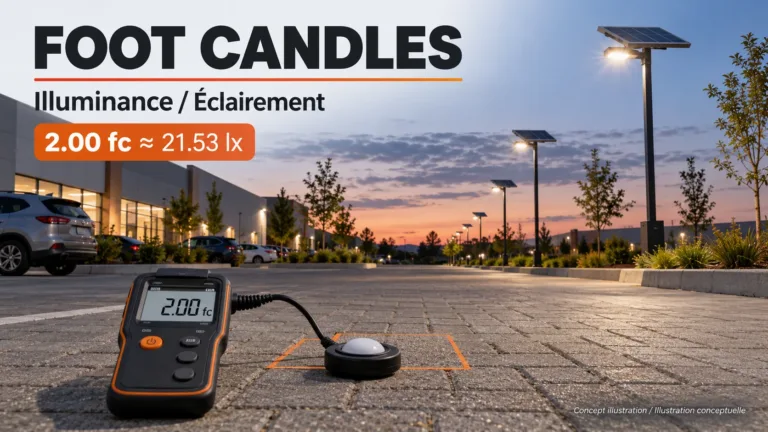
Correlated color temperature (CCT) of 3000–4000K balances visibility and circadian impact. CRI ≥70 suffices for most roads, though higher CRI aids facial recognition in pedestrian zones. The scotopic/photopic (S/P) ratio matters at low light levels; it can allow lower photopic lux for equivalent perceived brightness.
Optics and Photometry: Putting Light Where It’s Needed
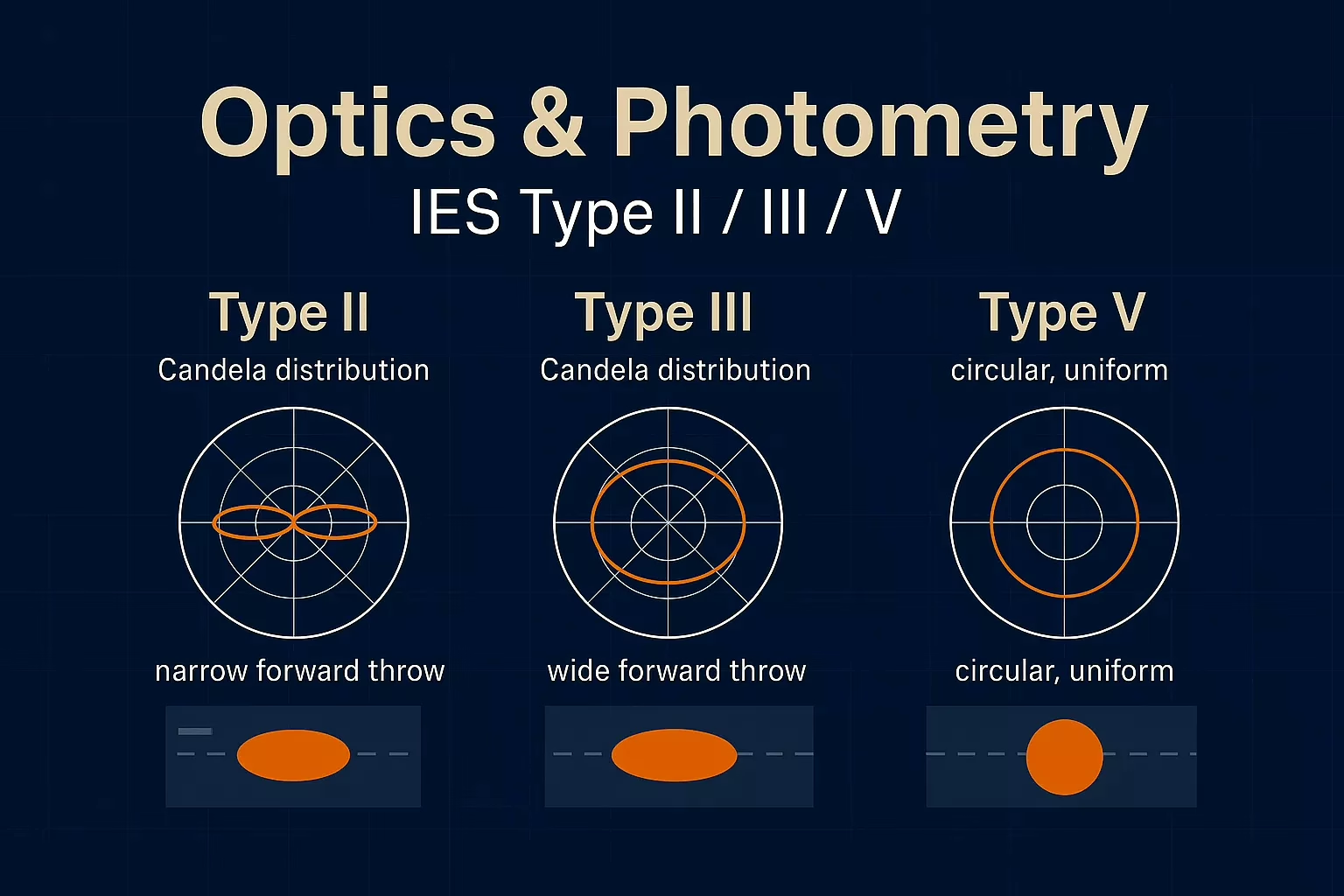
IES Distribution Types (II, III, V)
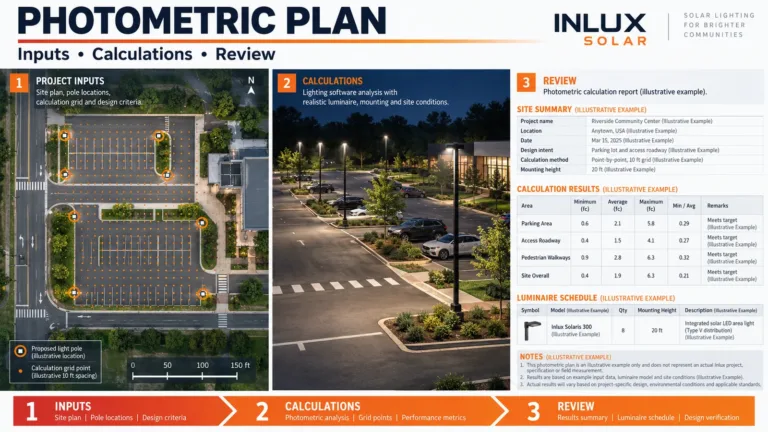
Type II and III push light laterally along roadways and sidewalks; Type V radiates symmetrically for plazas and car parks. Precision TIR lenses or hybrid reflectors sculpt the beam, reducing waste.
Glare, Cutoff, and Uniformity Ratios
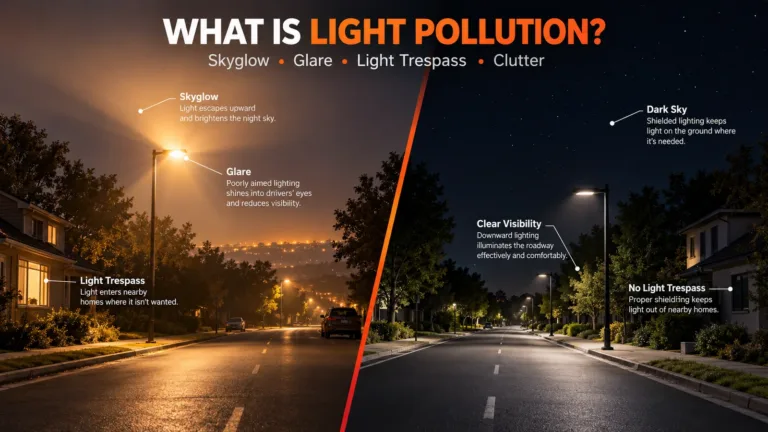
Full cutoff optics limit uplight and glare. Target uniformity ratios such as Avg/Min ≤ 3:1 on local roads, adjusted to regional codes. Good optics mean fewer poles and less energy for the same visual outcome.
Control Intelligence: From Dusk-to-Dawn to Adaptive Profiles
Photocells, Real-Time Clocks, and Astronomical Timers
Photocells trigger at a calibrated threshold (e.g., 30–70 lux). Astronomical timers use latitude/longitude to predict dusk/dawn, enabling deterministic schedules without sensors. Hybrids are common for resilience.
Motion Sensing: PIR vs. Microwave Radar
PIR detects warm bodies; microwave radar senses motion via Doppler shifts and works in fog or light foliage. Adaptive dimming—say 30% baseline rising to 100% when motion is detected—saves energy while preserving safety.
Smart Connectivity: Mesh, LoRaWAN, and NB-IoT
Networked lights support remote commissioning, fault flags, and energy analytics. Mesh (2.4 GHz) is nimble over dense clusters; LoRaWAN excels at long-range, low-bit-rate telemetry; NB-IoT/LTE-M provides carrier-grade backhaul. Over-the-air (OTA) firmware keeps fleets current.
How Solar Street Light Works: Power Budgeting & Sizing
Worst-Month Method and Autonomy Days
Design for the worst insolation month, not the annual average. A simple first-pass:
Battery (Wh) = Load (W) × Hours/night × Autonomy days ÷ (DoD × η_system)
PV (W) ≈ Load (W) × Hours/night ÷ (PSH_worst × η_MPPT × η_wiring)
Where PSH = peak sun hours; η terms capture real-world losses.
Losses: Wiring, Conversion, and Parasitic Loads
Account for cable voltage drop (<3%), driver efficiency, BMS overhead, and idle consumption of radios or sensors. These “small” losses compound.
Thermal Management: Heat as the Invisible Adversary
LEDs and batteries detest heat. Heatsinks with high surface area, thermal vias, and conductive housings wick heat away. Battery enclosures should avoid solar gain; thermal pads and ventilation help. Every 10°C of excess junction temperature can markedly reduce lumen maintenance.
Poles and Mounting: Wind Engineering and Structural Details
Pole height sets spacing and uniformity. Evaluate EPA (effective projected area) and local basic wind speed; select foundations accordingly. Correct arm length and tilt maintain photometric intent and eliminate self-shading on the panel.
Environmental Hardening: IP/IK Ratings, Corrosion, and Surge
For outdoor duty, IP66–IP67 enclosures resist dust and jets of water; IK08–IK10 survive vandalism. Marine or desert environments call for powder-coat systems, anodizing, and stainless fasteners. Surge protection devices (e.g., 10–20 kV) shield electronics from lightning transients.
Soiling and Albedo: Cleaning, Dust, and Yield Degradation
Dust, pollen, and bird droppings deflate yield. In arid zones, soiling can shave 5–20% from harvest. Hydrophobic glass, steeper tilt, and periodic cleaning restore performance. Local ground albedo (snow, pale concrete) can slightly bump winter yield via reflected irradiance.
Worked Example: Sizing a Typical Urban Solar Street Light
- Illuminator: 30 W LED, average 11 hours/night.
- Nightly energy: 330 Wh.
- Autonomy: 3 days; DoD: 80% (LFP); η_system: 0.9 →
Battery ≈ 330 × 3 ÷ (0.8 × 0.9) ≈ 1,375 Wh → ~12 V 115 Ah LFP (or 24 V 60 Ah). - Worst-month PSH: 3.5 h; η_MPPT × η_wiring: ~0.9 →
PV ≈ 30 × 11 ÷ (3.5 × 0.9) ≈ 105 W.
Add 20–30% design margin → ~130–150 W PV and ~1.4 kWh battery.
Adaptive dimming can cut this substantially.
Installation and Commissioning: Checklists That Prevent Headaches
- Verify pole plumb, torque fasteners, and anti-seize stainless hardware.
- Orient PV to true south/north; confirm tilt.
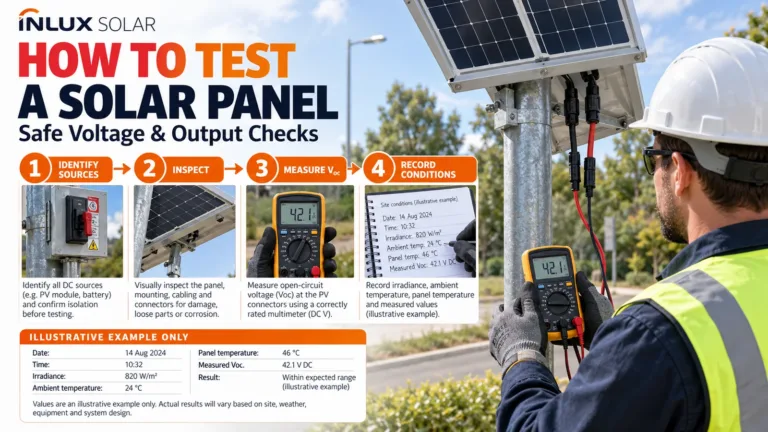
- Qualified personnel should follow the exact product manual and applicable site safety procedures for PV electrical checks. Do not improvise short-circuit tests from this article.
- Update firmware, set schedules, and run a 24-hour functional soak test.
- Record baseline telemetry for future comparison.
Operating Modes: Constant, Stepped, and Adaptive Dimming
- Constant: Fixed output through the night; simplest, least efficient.
- Stepped: 100% for evening traffic, 60% at midnight, 30% pre-dawn.
- Adaptive: Sensor-driven, raises illuminance only when presence is detected. This strategy can halve nightly energy without compromising safety.
Maintenance and Lifecycle: Predictive vs. Preventive Routines
Annual inspections catch loose hardware, yellowed lenses, or cracked gaskets. Clean modules, check surge protectors, and review BMS logs for abnormal cell drift. Predictive analytics—using current/voltage signatures—flag degradation before failure.
Failure Modes and Troubleshooting: Signal, Not Noise
- Night-short runtime: Battery aging, unexpected loads, or soiling.
- Intermittent shutoff: Thermal derating, BMS UVP thresholds, or wiring intermittence.
- Dim light: Driver faults, LED array degradation, or lens contamination.
Methodical diagnosis starts with the PV I-V check, proceeds to battery SoC, then driver output.
Sustainability and Circularity: Designing Beyond First Life
Select chemistries with proven recycling pathways. Modular designs allow battery repowering and optics upgrades without scrapping the entire luminaire. Life-cycle assessment (LCA) uncovers hidden embodied impacts and steers procurement toward lower-carbon BOMs.
Compliance and Standards: The Rulebook That Matters
- Lighting: IES roadway guidance, EN 13201 for European projects.
- Electrical: IEC/UL for luminaire safety; surge and EMC standards.
- Batteries: UN38.3 transport, IEC 62133 for safety.
- Environment: RoHS and applicable corrosion/finish standards.
Climate and Latitude Considerations: Tropics to High-Latitude Winters
In monsoon regions, sizing must defeat multi-day overcast. In high latitudes, shallow winter sun and snow cover demand generous PV and storage, plus low-temperature charging strategies. Desert installations prioritize thermal shielding and abrasion-resistant coatings.
Cost of Ownership and ROI: Numbers That Decide Projects
Capex is only half the tale. Model TCO over 10–15 years: cleaning intervals, battery repower, failure rates, and avoided trenching or metering costs. Adaptive lighting and remote diagnostics shrink OPEX, often flipping ROI decisively positive.
Best-Practice Checklist: A Concise Field Reference
- Design to worst-month PSH with ≥20% margin.
- Prefer MPPT and LiFePO₄ for daily cycling.
- Specify optics by IES type to the roadway class.
- Enforce IP66/IK08 minimum; include surge protection.
- Implement stepped/adaptive dimming with motion sensing.
- Validate with a commissioning log and baseline telemetry.
- Schedule cleaning and yearly torque/inspection routines.
- Plan for mid-life battery repower and OTA firmware updates.
Solar street lights succeed when every subsystem—PV, storage, optics, controls, and mechanics—works in quiet concert. Do that, and dusk turns into reliable, efficient illumination night after night.