When planning an efficient road lighting system, brightness is always a major concern. After confirming the road width and surrounding conditions, we can reasonably plan: how many light poles should be installed, and how tall should they be? Within the project budget, what wattage of solar street light should be chosen to achieve sufficient illumination?
Many people think that choosing higher-wattage solar street lights is enough, as a 100W solar street light is usually brighter than a 60W one. However, many solar street light manufacturers will not tell you: sometimes a 100W solar street light is not as bright as another supplier’s 80W light. Why is that? The answer is: wattage does affect solar street lights, but the most direct parameter is lumens.
How to Check Parameters (Wattage and Lumens) When Choosing the Brightest Solar Street Lights
Understanding Watts & Lumens – two completely different physical attributes
Parameter
What it measures
Use in a purchasing decision
Watt (W)
Electrical power at the stated input boundary.
Compare the actual operating demand; do not confuse LED power with solar-panel power.
Lumen (lm)
Total visible light output from the complete luminaire.
Compare tested output for the offered configuration, not just the LED-package rating.
Lux (lx)
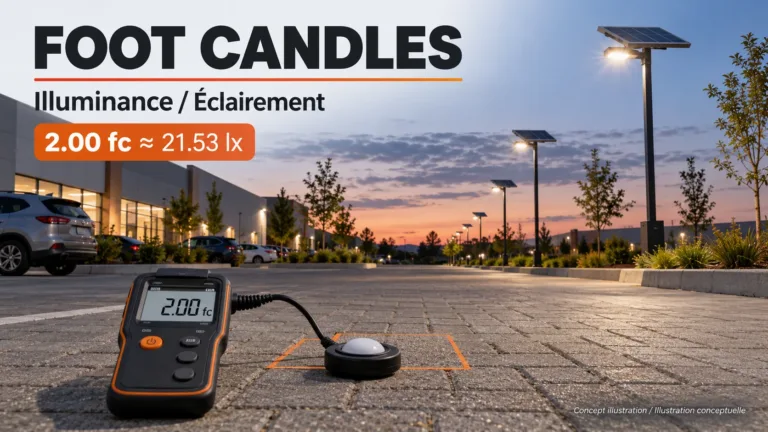
Illuminance on the specified surface.
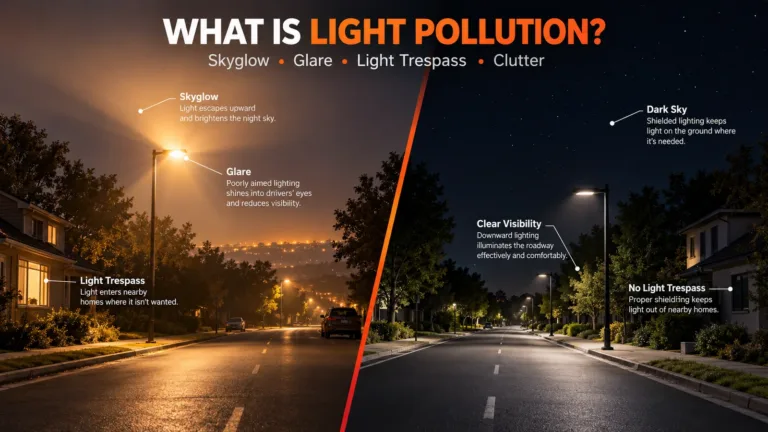
Check the road layout and required light levels together with uniformity and glare; lumens alone do not establish road performance.
Relationship Between Watts and Lumens
There is a physical formula:
Lumens=Wattage×Luminous Efficiency
Here, Luminous Efficiency is the key variable connecting energy consumption and brightness. Its definition: the efficiency of converting electrical energy into visible light, i.e., Luminous Efficiency = Lumens / Watt.
Example:
Solar street light A: 120 lm/W, consuming 80W, it can output 9,600 lumens of light.
Solar street light B: 80 lm/W, consuming 100W ,it can only output 8,000 lumens of light.
As we explained before: “Lumen is the unit of luminous flux, which represents the total amount of visible light emitted by a source.” So, by comparison, it’s clear why sometimes a 100W solar street light may appear dimmer than another 80W light—the key factor is luminous efficacy.
Before this explanation, many people only focused on wattage (power) when choosing lights, while overlooking luminous efficacy (lm/W). But according to the formula Lumens = Power × Luminous Efficacy:
Power determines how much electricity the solar street light consumes.
Luminous efficacy determines how much visible light is produced per unit of electricity.
The final lumen output (luminous flux) is the combined result of both.
Therefore, when aiming for brighter and more energy-efficient lighting under the same power consumption, we must pay close attention to the luminous efficacy parameter.
Components Affecting Luminous Efficiency of Solar Street Lights
Taking JAGUAR (INL-AIT5) from the world’s leading solar street light manufacturerInlux solar as an example,It uses an LED module as the light source. The finished lumen efficacy of the 60-Watt JAGUAR (INL-AIT5) can reach up to 220 lm/W, which is more than 50% higher than that of ordinary solar street lights.
1. Super Bright PCT 5050 chips (from Lumileds, CREE, etc.), efficiency up to 260 lm/W 2. Patented glue process eliminates air layers, reducing light loss by 5%
1. Ordinary 2835/3030 chips have small heat dissipation, low efficiency. 5050 chips max ~220 lm/W 2. Low-transparency packaging + poor layout blocks light
LED Lens
Lens material & design
Lens affects light refraction and loss
High-transparency Japanese PC material (>98% transmittance), UV-resistant, PMMA; 5-year outdoor exposure reduces transmittance only 2-3%
Ordinary PC 85-88% or glass 90%
Tempered Glass
High-transparency protective glass
Reduces light loss, protects LED lens from impact and environmental damage
High-transparency glass, 98% transmittance, ~8% higher than ordinary glass
Ordinary glass: lower transmittance, less durable
Summary: The JAGUAR (INL-AIT5) stands out from ordinary solar street lights because its components, materials, craftsmanship, technology, and protection create stable bright solar street lights with minimal light loss.
Compare the LED Component and the Finished Luminaire Separately
Comparison
What must match
Why it matters
LED component
Exact device, test current, temperature and color specification.
A package label such as 2835, 3030 or 5050 is not a universal performance ranking.
Complete luminaire
The offered model, optic and operating setting, with measured lumens and electrical input.
Driver, optical and thermal design affect the result; a component figure is not the finished light output.
Road lighting
The proposed pole positions, mounting height, road geometry and applicable lighting criteria.
More lumens do not by themselves resolve dark areas, glare or poor distribution.
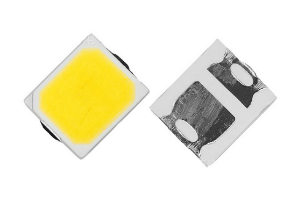
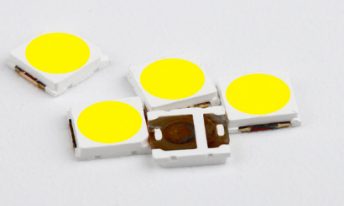
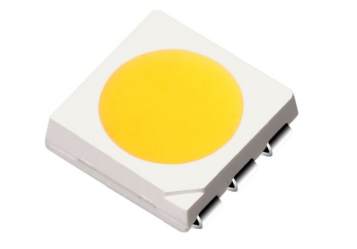
Existing package images illustrate appearance; they are not comparative test results.
2835 package reference
3030 package reference
5050 package reference
The DOE explanation of LED efficacy distinguishes source performance from luminaire performance. FHWA roadway-lighting guidance also considers distribution, uniformity and glare. These are design principles, not a new Inlux product rating or a substitute for local requirements.
High-Transparency LED Lens & Patented Glue Process: To maximize light delivery to target areas, 3030 & 5050 chips are paired with high-transparency Japanese PC LED lenses, increasing luminous efficiency by ~5%. The patented glue process eliminates air gaps between LED chips and lenses, further boosting efficiency by >5%.
Tempered Glass: Some solar street lights add high-transparency glass to protect the lens and improve light output. Overall transmittance reaches 98%, ~8% higher than ordinary glass.
High-Efficiency Solar Street Lights Deliver Higher Cost-Effectiveness
A project requiring 12,000 lumens:
Using Inlux Solar 220 lm/W high-efficiency LED lamp, only 55W is needed.
Using traditional 130 lm/W LED lamp, 92W is required.
Inlux Solar’s LED lamp consumes only ~60% of the wattage compared to ordinary solar street lights, meaning its solar street light system requires fewer solar panels and smaller batteries to achieve the same operating hours and cloudy-day autonomy, saving significant costs while ensuring bright solar LED lighting.
4. How to Select the Solar Street Light with the Highest Luminous Efficiency
When it comes to municipal or infrastructure projects, how can you choose bright solar street lights with the highest luminous efficiency? Here are the key steps:
Compare useful lighting, not the largest number Start with measured luminaire output and the actual electrical input at the quoted setting. Then compare how the proposed optics, mounting height and pole positions deliver the required road lighting. A higher lumen total can still be the wrong choice if distribution, uniformity or glare is unsuitable.
Check finished lumen efficiency, not just LED chip lumen efficiency Many manufacturers list the lumen efficiency of the LED chip itself, which can be misleading. The light emitted from the LED chip passes through air layers, the LED lens, and tempered glass before becoming the final output. The true performance is reflected in the finished lumen efficiency, which is the critical metric for solar LED lighting.
Identify the actual LED component Record the manufacturer and exact part number, not only a package-size label. Compare the device under the stated operating and test conditions, then verify the complete luminaire. Do not treat 5050, 3030 and 2835 as a fixed best-to-worst order.
Check the transmittance of the LED lens and tempered glass Ask the solar street light manufacturer for the transmittance values of both the LED lens and tempered glass. These components significantly influence the final luminous efficiency. High-transparency LED lenses combined with tempered glass are essential to maximize the brightness and performance of bright solar street lights.
How to Verify Solar Street Light Brightness
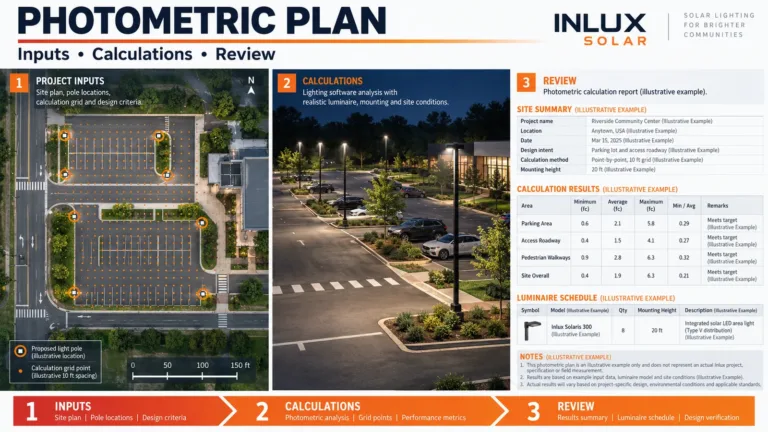
During Design & Quotation Stage: Suppliers can generate lighting simulation reports using IES files and software like DIALUX based on project road conditions. This allows precise brightness planning before installation.
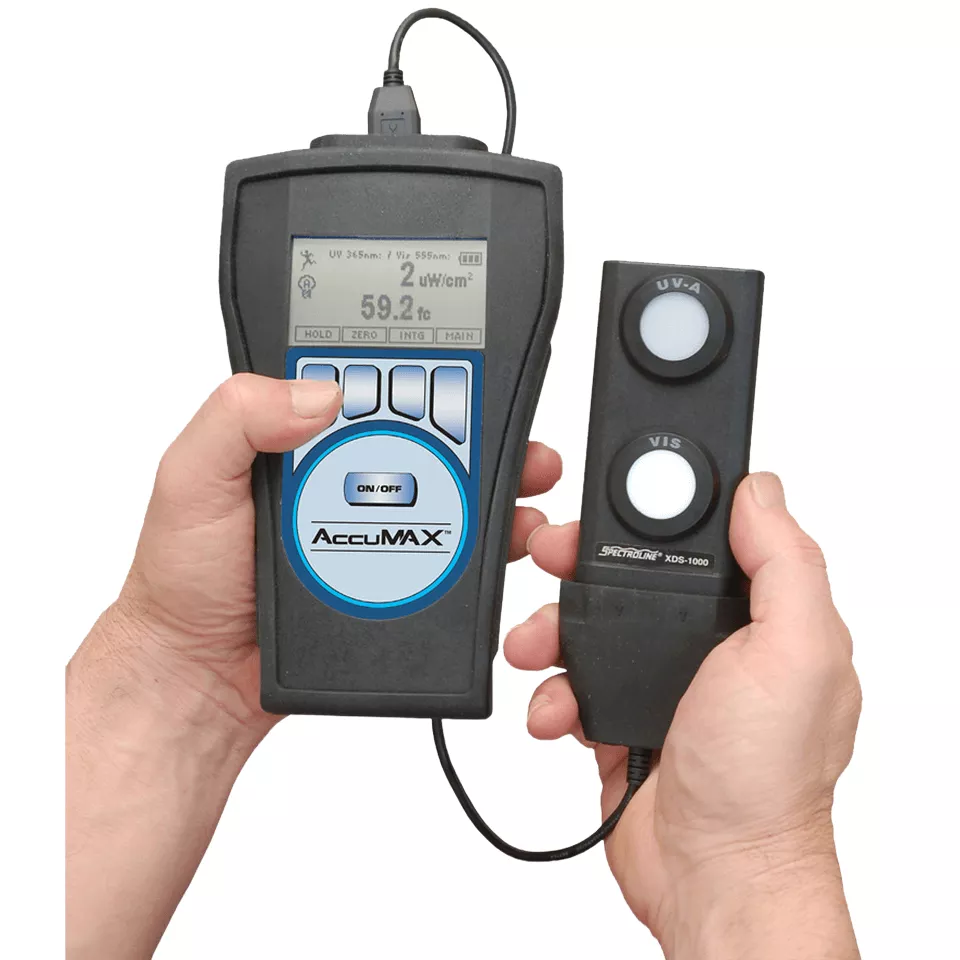
After Installation: Use a lux meter to measure center and average brightness. Inlux Solar projects show deviations within 10% of simulation reports. Many ordinary solar street lights underperform, indicating inflated lumen specifications.
Regardless of location or scenario, stable bright solar street lights are always the core criterion for selection.
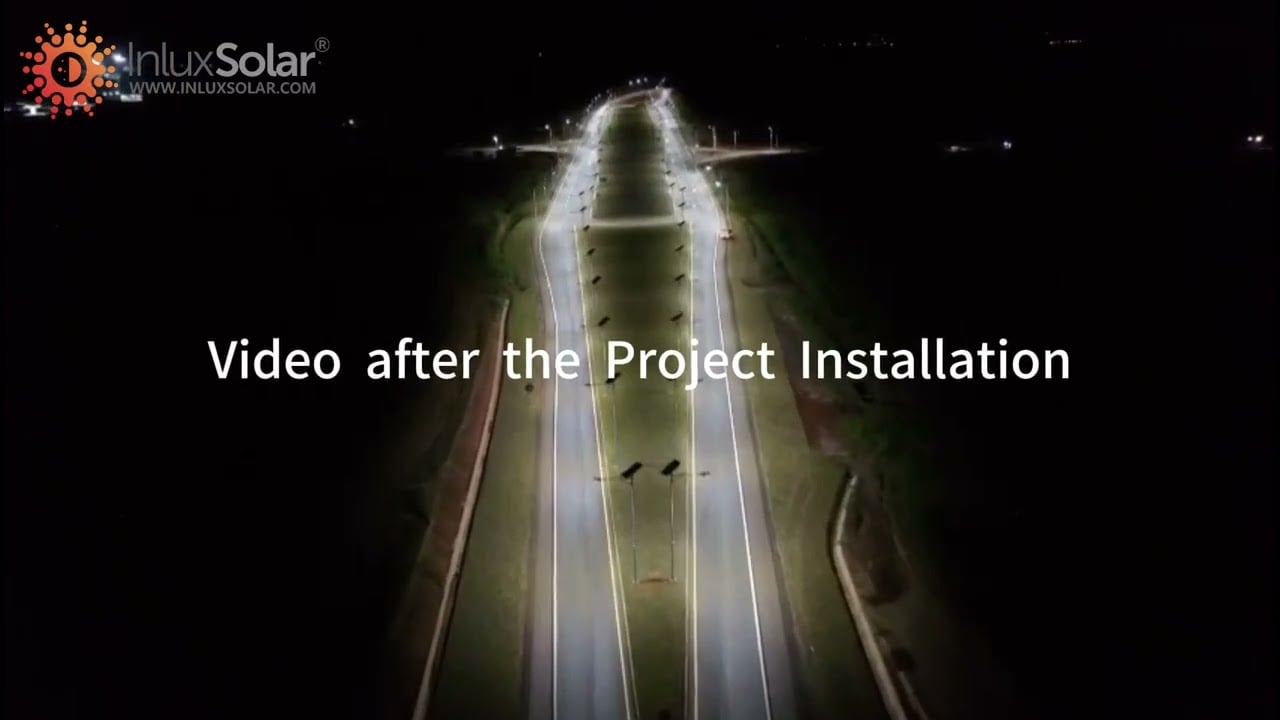
Here, let’s take a look at an Inlux Solar highway solar street lighting project in Paraguay through a video, showcasing the entire process from initial parameter configuration and DIALux simulation to the final on-site implementation.
Inluxsolar Provides Premium Solar Street Light Solutions
If you have high requirements for the brightness of solar street lights, Inluxsolar will be your best choice compared with other solar street light manufacturers! Their core technical advantage lies in producing brighter solar street lights than their competitors.
Experience: Over 1,000 successful installations worldwide, including local governments, military, educational institutions, and UN projects. Free customized solutions are available.
Technical Specs:
Thick galvanized steel poles with excellent corrosion resistance
Each PV panel tested via EL for high-efficiency solar conversion
LiFePO4 battery with 0.5 depth of discharge, 5-day off-grid autonomy, 7-year average lifespan
Choose bright solar street lights with high luminous efficiency from Inluxsolar for your projects and ensure professional solar LED lighting solutions designed by a trusted solar street light manufacturer.
Share your love
Inlux Solar Engineering Team
Inlux Solar Engineering Team is the technical content team behind Inlux Solar’s solar street lighting guides, project insights, and product engineering resources. The team works with Inlux Solar’s R&D, technical, production, and quality-control departments to explain solar street light design, component selection, photometric planning, project specification, installation, and long-term reliability for municipal, commercial, EPC, and infrastructure buyers.
Our content is based on Inlux Solar’s factory experience, field project records, product test data, and engineering support for global solar lighting projects, including UNHCR, UNDP, municipal, refugee-camp, highway, industrial, and public-area lighting deployments. Inlux Solar operates a 28,000 m² manufacturing facility with 10 production lines, 30+ engineers, 60+ patents, and 300+ product certificates.
Articles by the Inlux Engineering Team are written or reviewed with input from technical, R&D, production, and QC staff to keep recommendations practical, specification-ready, and aligned with real project conditions.