There is no defensible single street light cost until the quote scope is defined. A fixture-only price excludes the arm, pole, foundation, trenching, cable, grid connection, installation, commissioning, energy, maintenance, and replacement parts. A complete off-grid solar system has a different cost structure because it replaces trenching and utility electricity with a solar array, battery, controller, and future battery service.
Quick answer: Published municipal LED conversion examples range from about
$150to$2,500 per light, but those figures describe different ownership and installation scopes. A new street light with a pole, foundation, civil work, and electrical connection is not comparable with a fixture-only retrofit. Build the budget from a defined bill of quantities and a lifecycle period.
For municipality, EPC, developer, and facility-owner budgets, compare three numbers separately:
- equipment price
- complete installed cost
- total cost of ownership over the selected analysis period
First Define What the Price Includes
The question “How much does a street light cost?” can refer to several different purchases. Quotes should only be compared after every supplier uses the same system boundary.
| Cost question | Scope that should be included | Common exclusions to check |
|---|---|---|
| Fixture-only price | Luminaire, LED module, driver, optic, housing, surge protection, and selected controls | Arm, pole, foundation, cable, installation, freight, tax |
| Pole package price | Fixture, arm, pole, base plate or embedded section, access door, fasteners | Foundation design, concrete, excavation, crane, wiring |
| Grid LED conversion | New luminaire and control, removal, installation, commissioning, disposal | Pole replacement, underground cable repair, utility ownership charges |
| New grid street light | Design, fixture, arm, pole, foundation, trenching, cable, switchgear, grid connection, installation | Utility upgrades, unusual ground conditions, traffic management |
| Complete solar street light | LED fixture, PV module, battery, controller, pole, brackets, foundation design inputs, installation scope | Freight, duties, civil work, local labor, site-specific foundation |
| Lifecycle cost | Initial installed cost, energy, inspections, cleaning, repairs, planned replacements, ownership fees | Financing, escalation, incentives, residual value unless stated |
This scope distinction explains why two credible project figures can differ by more than ten times. One may be a utility tariff conversion on an existing pole, while another includes asset acquisition, controls, installation, and utility charges.
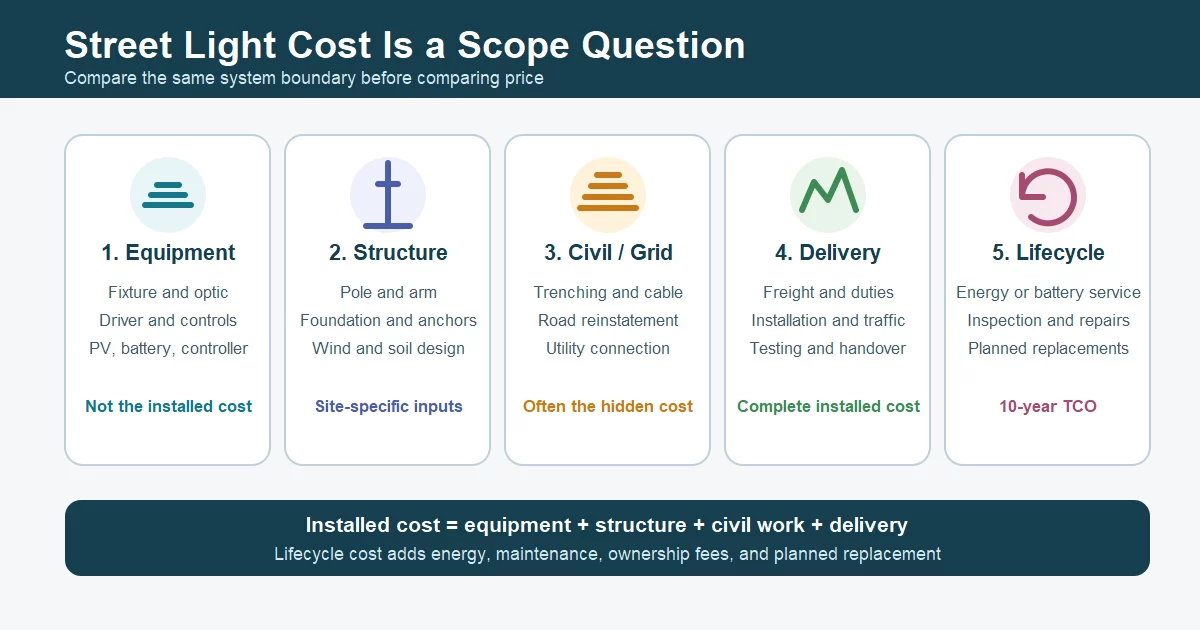
Use this basic equation for a new installed light:
Installed cost per light =
equipment
+ pole and arm
+ foundation
+ civil and electrical work
+ freight, duties, and local delivery
+ installation and traffic control
+ testing and commissioning
If a proposal omits one of these categories, label the omission before comparing totals.
Official Project Benchmarks
Public projects are useful for understanding cost scope, but historical averages are not current supplier quotations. The following examples are conversion programs, not universal prices for new poles.
| Project or source | Year and scope | Published figures | Derived value | Use with caution |
|---|---|---|---|---|
| Maryland Energy Administration review | 2020 municipal and utility LED conversions in Maryland and Virginia | Examples from $150 to $2,500 per light | Not normalized because ownership and tariff arrangements differ | Do not apply the range to a new pole and foundation |
| Portland LED replacement program | Conversion of 46,700 HPS streetlights; $18.5 million total project cost | 20 million kWh and $1.5 million projected annual savings | About $396 per converted light ($18.5m / 46,700) | Program average, not a fixture price or new installation quote |
| Collierville conversion project | 7,450 fixtures; $8,869,625 project cost; $670,000 annual savings | 13-year stated payback | About $1,191 project cost and $90 annual savings per fixture | Average does not reveal every site or utility line item |
| Boston LED initiative | City system of 64,000 lights; separate materials, installation, incentive, net-cost, and savings figures | $6.8m materials, $742k installation, $3.8m utility incentive, $3.7m city net cost, $2.8m annual savings | No per-light figure used here | The reported system count may not equal the denominator for every cost line |
| Kansas City conversion | 88,871 streetlights converted | $2.5m estimated annual energy savings and $993k maintenance savings | No installed cost can be derived | The city page does not provide total project cost |
The lesson is not that every street light should cost within one broad range. The lesson is that street light installation cost depends on ownership, existing assets, civil work, controls, utility rules, and what the published total actually includes.
Cost Stack for a New Street Light
Photometric design and project requirements
A budget starts with road geometry and required lighting performance, not wattage. Record road width, lane count, pedestrian areas, conflict zones, mounting height, pole spacing, surface conditions, operating schedule, and the applicable lighting class.
An IES or LDT file and a DIALux calculation help establish the fixture, optic, output, spacing, uniformity, and glare performance. Without this work, an apparently cheaper light may require more poles or fail the acceptance criteria. Use the IES and DIALux project checklist before locking the bill of quantities.
Fixture and controls
The luminaire cost changes with:
- required delivered lumens and optical distribution
- driver quality and dimming protocol
- surge protection level
- housing, corrosion protection, ingress protection, and impact rating
- photocell, timer, motion control, or networked controller
- warranty scope and replacement logistics
Compare the complete configuration, not only nominal wattage. Project-grade LED street lights should be selected against photometric and environmental requirements.
Pole, arm, and foundation
The street light pole cost is affected by mounting height, bracket geometry, steel grade, galvanizing or coating, wind zone, luminaire and solar-module projected area, base-plate or embedded design, and local structural requirements.
Foundation cost then depends on soil bearing conditions, groundwater, frost depth, excavation access, reinforcement, concrete, anchor bolts, and engineering approval. A generic pole price cannot establish the installed pole cost without these inputs. The pole height and spacing guide explains why geometry affects both lighting performance and quantity.
Trenching, cable, and grid connection
For a new grid installation, civil and electrical work can be larger than the luminaire cost. The budget may include:
- pavement, shoulder, or landscaped-area excavation
- conduit, cable, pull boxes, and earthing
- road crossing or directional boring
- switchgear, metering, and control cabinets
- utility design, connection, or ownership charges
- surface reinstatement and traffic management
Distance to a suitable electrical connection and the surface being disturbed are therefore critical inputs. A solar system can avoid much of this work, but it adds PV, battery, controller, and solar-specific structural requirements.
Installation, testing, and commissioning
Installation scope may include mobilization, boom truck or crane time, pole erection, electrical termination, aiming, control setup, night inspection, photometric acceptance, documentation, and training.
Define who supplies labor, lifting equipment, concrete, water, storage, security, and traffic control. Also state whether the quotation covers one sample site, a pilot section, or full deployment. Unit rates can change with quantity, access, and project sequencing.
Freight, duties, and local delivery
Long poles and batteries affect packaging and shipping. For solar systems, lithium batteries require compliant transport documentation and packaging. Request the Incoterm, container plan, destination charges, duties, taxes, inland delivery, storage, and insurance as separate lines.
The lowest factory price is not necessarily the lowest landed or installed cost.
Solar Street Light Equipment Planning Ranges
Inlux Solar’s 2026 solar street light price guide currently shows the following indicative equipment-planning ranges:
| System type | Indicative planning range |
|---|---|
| All-in-One | $120-$280 |
| All-in-Two | $220-$450 |
| Split Type | $350-$650 |
| Solar High Mast | $1,500-$5,000+ |
These are not complete installed-project prices and are not a standing quotation. Configuration, output, battery capacity, autonomy, solar resource, pole, controls, quantity, freight, duties, foundation, and installation can materially change the result.
For a project budget, request a configured system based on:
- project latitude and reliable solar-resource data
- nightly operating hours and dimming schedule
- required days of autonomy
- minimum design temperature and battery operating limits
- mounting height, pole spacing, wind load, and corrosion environment
- required illuminance, uniformity, and glare criteria
- monitoring, communication, and control requirements
How Much Does a Street Light Cost per Month?
For a grid-connected street light, calculate electricity from actual input power rather than the product name.
Annual electricity use (kWh) =
input watts / 1000
x operating hours per day
x 365

Annual electricity cost =
annual electricity use
x local tariff per kWh
Example, using a user-supplied tariff assumption:
100 W / 1000 x 12 hours/day x 365 = 438 kWh/year
438 kWh x $0.15/kWh = $65.70/year
$65.70 / 12 = $5.48/month
This example is a calculation method, not a universal electricity price. Replace 100 W, 12 hours, and $0.15/kWh with the measured input power, control schedule, and applicable tariff.
Some utility-owned street-light tariffs bundle energy, maintenance, asset ownership, or service charges. In that case, multiplying kWh by a retail tariff will not reproduce the bill. Obtain the actual utility schedule and separate energy from fixed or ownership charges.
An off-grid solar street light normally has no monthly utility electricity bill, but it does not have zero operating cost. Include inspection, cleaning where required, vegetation control, troubleshooting, communications, and expected battery or electronic-component service.
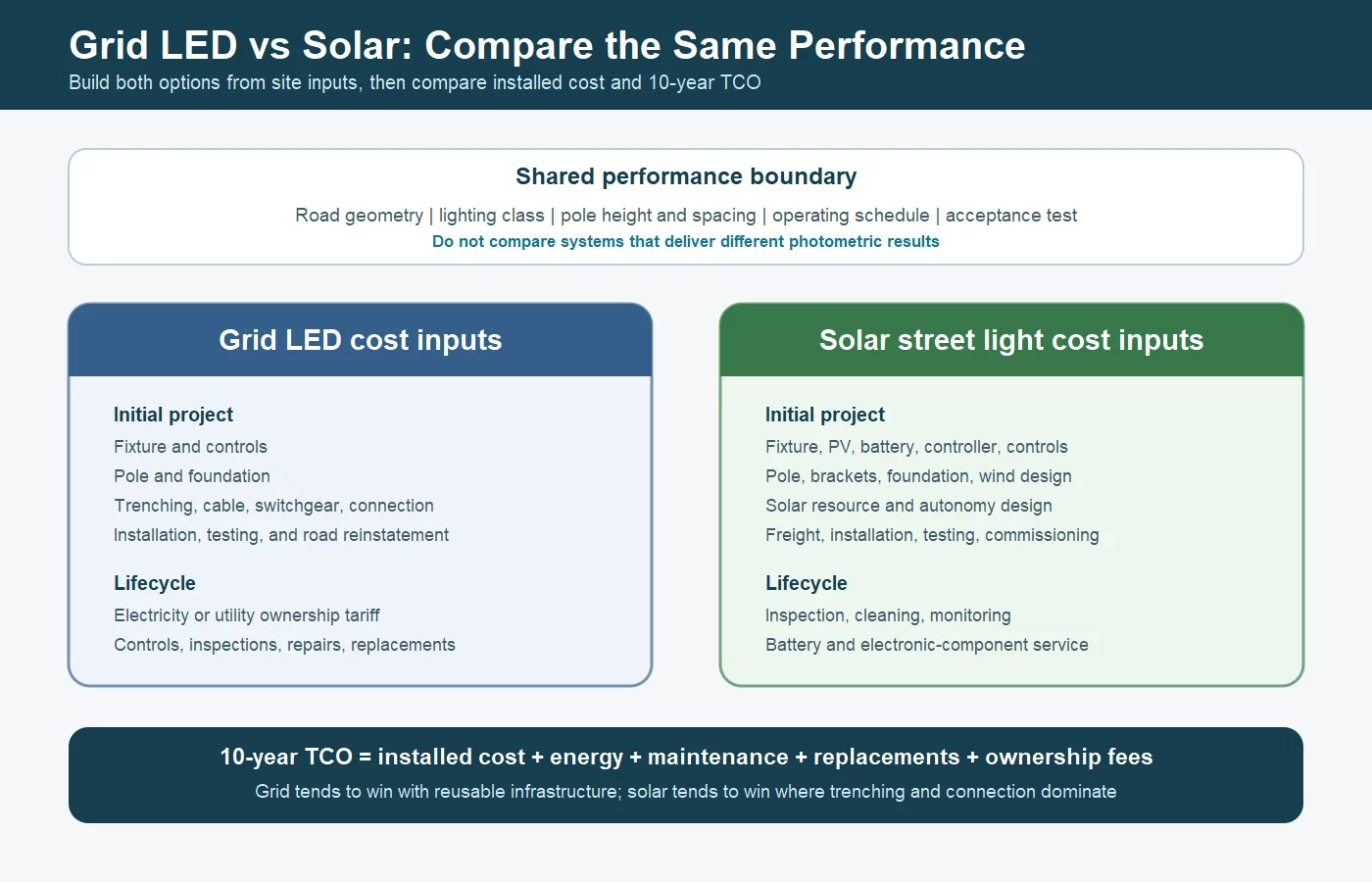
Grid LED vs Solar: Which Has the Lower Total Cost?
Neither technology is automatically cheaper at every site. Compare the full project boundary.
| Project condition | Grid LED may be stronger when | Solar may be stronger when |
|---|---|---|
| Existing infrastructure | Serviceable poles, cable, and power are already present | No serviceable cable or grid point exists |
| Civil work | Minimal trenching and reinstatement are required | Long trenching, road crossings, or remote connections dominate cost |
| Solar resource | Shade, climate, or site constraints limit reliable generation | Solar resource and module exposure support the required autonomy |
| Operating profile | High, continuous output is required and grid supply is reliable | A designed dimming schedule can meet the lighting requirement |
| Maintenance access | Utility service and replacement crews are readily available | Modular local maintenance is practical and grid faults are difficult to reach |
| Controls | Existing network infrastructure can be reused | Standalone schedules and remote solar monitoring meet the project need |
| Resilience | Grid outages are acceptable or backed up | Independent operation during grid outages is valuable |
The comparison must use equivalent photometric performance. A lower-output solar light and a higher-output grid light are not a valid cost comparison if they do not meet the same road-lighting requirement.
For a broader system decision, review the road and street lighting solution and compare both options with the same geometry, lighting class, operating schedule, and acceptance method.
Build a 10-Year Total Cost of Ownership
Use a project-specific analysis period and document every assumption.
10-year TCO =
initial installed cost
+ electricity or ownership charges
+ scheduled inspections and cleaning
+ expected repairs
+ planned component replacements
+ monitoring and communication fees
- verified incentives
- residual value, if the procurement method recognizes it
For each line, record:
- quantity and unit
- source of the estimate
- base year and currency
- tax and duty treatment
- replacement interval
- escalation or discount assumption
- owner responsible for the cost
Do not add a tax credit, grant, customs exemption, or financing incentive unless the project owner has verified current eligibility in the relevant jurisdiction. Policies change, and a generic website statement is not sufficient for a procurement model.
The U.S. Department of Energy Better Buildings ownership analysis framework is useful because it separates initial purchase, installation, energy, maintenance, ROI, payback, and total cost of ownership. The same discipline can be applied outside the United States with local inputs.
RFQ Checklist for a Defensible Budget
Provide the same input package to every bidder:
Site and lighting performance
- project location and coordinates
- road cross-section, width, lanes, sidewalks, and conflict areas
- existing and proposed pole height and spacing
- applicable standard or owner performance criteria
- target average illuminance or luminance, uniformity, and glare limits
- required IES/LDT files and DIALux report
Operating and environmental conditions
- dusk-to-dawn hours and dimming schedule
- minimum and maximum temperature
- wind, corrosion, dust, humidity, flood, and lightning conditions
- reliable solar-resource basis for an off-grid design
- required autonomy and battery reserve
Commercial scope
- fixture-only, pole package, conversion, or complete installed system
- quantity, delivery sequence, and pilot requirement
- foundation and civil-work responsibility
- freight term, duties, taxes, local delivery, and storage
- installation, commissioning, acceptance testing, and training
- warranty coverage, exclusions, response time, and spare-parts plan
Evidence and acceptance
- photometric files tied to the quoted model
- component datasheets and certificates
- battery, controller, driver, and surge-protection details
- pole and foundation design inputs
- manufacturing and project references
- inspection plan, serial traceability, and acceptance records
Inlux Solar has delivered 300,000+ units across 60+ countries and completed 1,000+ projects. Its standard warranty is five years. These facts support supplier due diligence, but they do not replace a project-specific design or quotation. Use the manufacturer sourcing checklist to compare technical and commercial submissions consistently.
Frequently Asked Questions
How much does one street light cost?
It depends on whether the price covers only the luminaire, a pole package, an LED conversion, a complete new grid installation, or an off-grid solar system. Published municipal conversions range widely because ownership and installation scope differ. Request a line-item bill of quantities before comparing unit prices.
How much does it cost to install a street light?
Installation can include excavation, foundation, pole erection, trenching, cable, grid connection, traffic control, electrical termination, testing, and commissioning. The installed cost cannot be estimated reliably from the fixture price alone. Road surface, utility distance, soil, access, and quantity are major variables.
How much does a street light pole cost?
Pole cost changes with height, material, steel grade, coating, bracket design, wind load, projected area, base configuration, and structural requirements. The foundation, crane, excavation, concrete, wiring, and installation are usually separate unless the quote explicitly includes them.
How much does a street light cost per month?
For a grid light, multiply actual input power by operating hours and the applicable electricity tariff, then add any utility ownership, maintenance, or service charges. A 100 W light operating 12 hours per day uses 438 kWh per year. At an illustrative $0.15/kWh, that is $65.70/year or $5.48/month for energy only.
Is a solar street light cheaper than a grid street light?
Solar can have a lower total cost where trenching, road crossings, or grid connections are expensive. Grid LED can be more economical where serviceable infrastructure already exists. Compare equivalent lighting performance and include battery service, energy, civil work, maintenance, and ownership charges over the same analysis period.
Does a solar street light have zero maintenance cost?
No. It avoids a utility electricity bill but still requires inspection, cleaning where necessary, vegetation control, troubleshooting, and planned service for batteries and electronic components. Maintenance access and spare-parts strategy should be included in the TCO.
What information is needed for a solar street light quotation?
Provide location, road geometry, pole height and spacing, lighting criteria, operating schedule, autonomy, solar resource, temperature, wind and corrosion conditions, quantity, freight destination, installation scope, controls, warranty, and acceptance requirements. Better inputs produce a more comparable and defensible quotation.
Request a Scope-Based Project Budget
For a municipal, EPC, industrial, or commercial project, send the site location, road cross-section, pole height and spacing, target lighting performance, operating schedule, quantity, freight destination, and whether the budget should include poles, foundations, installation, and commissioning.
Inlux Solar’s engineering team can prepare a configured system proposal, photometric files, BOQ scope, and quotation for comparison.
Request a scope-based street-light budget
Technical References
- Maryland Energy Administration: LED Streetlight Conversions in Maryland and Virginia
- Federal Highway Administration: Portland LED Lights Replacement Program
- Town of Collierville: Streetlight Conversion Project
- U.S. Department of Energy Better Buildings: Cost Savings Analysis for LED Street Lighting Ownership
- U.S. Department of Energy: Boston’s LED Street Lighting Initiative
- Kansas City Public Works: Streetlights