Municipalities around the world are under pressure to do more with less: upgrade old lighting, reduce energy bills, and meet sustainability targets—often with limited budgets and aging infrastructure. That is exactly where all-in-one solar street lights have become a serious alternative to traditional grid-powered systems.
Instead of running cables, building transformer rooms and dealing with complex civil works, cities can deploy complete solar lighting units that integrate the LED fixture, solar panel, battery and controller in a single assembly.
This guide is written for city engineers, consultants and project owners who are planning municipal lighting projects in 2026. It explains what all-in-one solar street lights are, when they are the right choice, and how to specify them correctly so you avoid under-sized, unreliable systems.
1. What Is an All-in-One Solar Street Light?
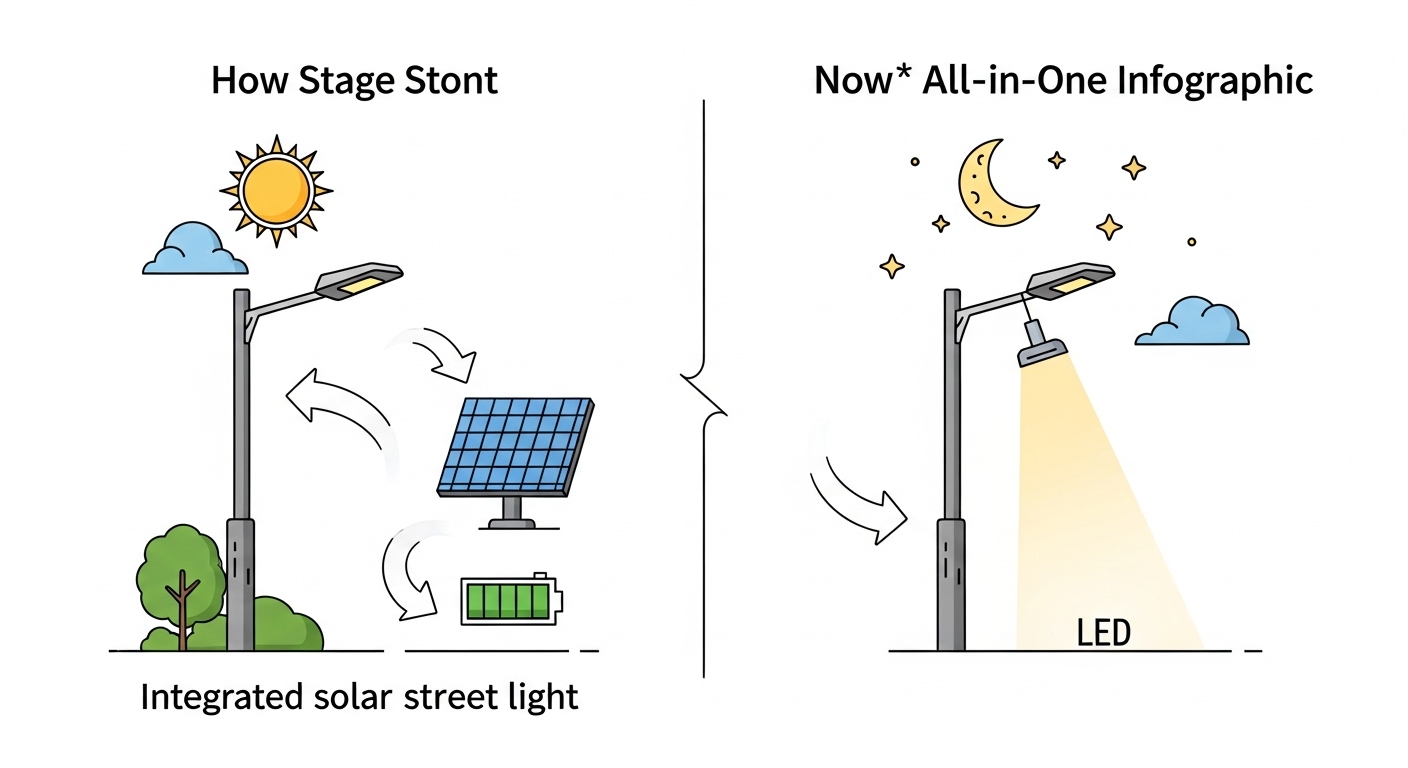
An all-in-one solar street light is a standalone outdoor lighting system where all major components are integrated into one compact unit, usually mounted at the top of a pole:
- High-efficiency LED module – provides directional, low-glare lighting for roads, walkways or parking lots.
- Monocrystalline solar panel – charges the battery during the day.
- Lithium battery pack (often LiFePO₄) – stores daytime energy for night operation.
- Charge controller & smart driver – manages charging, discharging, dimming and protections.
- Optional motion sensor & communication module – enables adaptive lighting and remote monitoring.
This “all-in-one” construction is different from traditional split-type solar street lights, where the panel is separate from the luminaire and battery. By integrating everything into one compact head, installation becomes faster and aesthetics are often cleaner.
2. Why Municipalities Are Choosing All-in-One Solar Street Lights
For municipal projects, the main drivers are not just “green image”. They are hard costs and reliability.
2.1 No trenching or cabling
On many urban or peri-urban roads, civil works can account for 40–60% of a traditional grid-powered lighting project:
- Trenching and backfilling along the road
- Laying underground cables and conduits
- Building feeder pillars and transformer rooms
- Restoring pavements and landscaping
All-in-one solar street lights remove most of these costs. Each pole is a self-contained system, so you mainly pay for:
- Poles and foundations
- The integrated solar light heads
- Basic wiring inside the pole
- Foundation and erection labour
For rural or new roads with rocky ground, wetlands or complex underground utilities, the savings are even more dramatic.
2.2 Works where the grid is weak or non-existent
Many municipalities have unreliable grids—voltage drops, frequent outages or long distances to the nearest connection point. Extending medium-voltage lines just to power a few kilometres of lighting can be financially impossible.
All-in-one solar street lights:
- Operate completely off-grid
- Are not affected by blackouts
- Can be deployed in stages without waiting for grid expansion
This is especially important for:
- Peri-urban expansions
- Access roads to industrial zones
- Rural feeder roads and village streets
- Coastal or mountainous areas where grid extension is expensive
2.3 Lower operating and maintenance costs
Well-designed systems can achieve:
- Zero electricity bills from the grid
- Low maintenance (LED lifetime 50,000+ hours, LiFePO₄ battery 8–12 years in many cases)
- Reduced risk of cable theft and vandalism
For municipalities with limited O&M budgets, converting a portion of their network to solar can free up funds for other priorities.
3. When All-in-One Solar Street Lights Are (and Aren’t) a Good Fit
Not every situation is ideal for all-in-one designs. Choosing the right technology for the right place is critical.
3.1 Good use cases
All-in-one solar street lights work particularly well for:
- Collector and local roads with moderate traffic
- Residential streets and housing estates
- Village roads and rural town centres
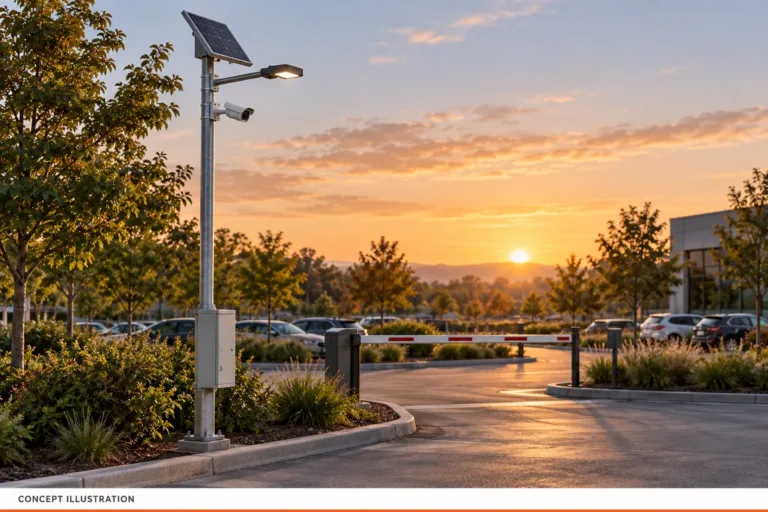
- Parking lots at municipal buildings, schools, hospitals, bus depots
- Parks, plazas and pedestrian pathways
- Access roads to industrial facilities, warehouses, water plants, etc.
In these areas, lighting levels are moderate, pole heights are usually 5–9 m, and the grid may be weak or absent.
3.2 Less ideal cases (consider split-type or hybrid)
For some projects, you may prefer split-type solar or AC-solar hybrid systems:
- Very wide roads or highways requiring tall poles (12–15 m) and high lumen packages
- Locations with long, harsh winters, heavy snow cover or extremely low solar radiation
- Projects demanding high vertical illuminance, such as large roundabouts with heavy truck traffic
- Situations where you want large solar arrays tilted separately from the light direction (e.g. high latitudes)
In these scenarios, split-type or hybrid designs can offer more flexibility in panel size and tilt angle. Compare the available system architectures in our commercial solar street lights overview before selecting a project configuration.
4. Key Design Parameters for Municipal Projects
The biggest reason solar street lighting projects fail is under-sizing. To avoid that, you need to design from the road and lighting requirements backwards—not from a catalogue forward.
4.1 Road type and lighting class
Start by defining the road category and target lighting class:
- Urban main road, collector road, residential street, rural road, or parking lot?
- What is the expected traffic volume and speed?
- Are there specific national or regional standards you must follow?
Many markets take reference from standards such as EN 13201 (road lighting) or IES recommendations for typical illuminance and uniformity levels for different road types.
4.2 Illuminance and uniformity
For each road type, define:
- Average horizontal illuminance (e.g. 5–20 lux depending on class)
- Minimum uniformity (e.g. 0.3–0.4)
- Glare limitations
All-in-one fixtures with asymmetric road optics (Type II/III/IV style distributions) are designed to spread light along the carriageway while controlling glare.
4.3 Pole height and spacing
For most municipal applications, all-in-one solar street lights are used with 5–9 m poles:
- 6 m poles – small roads, residential streets, footpaths
- 8 m poles – typical urban collector roads and parking lots
- 9 m poles – wider roads or higher mounting for better uniformity
Spacing depends on:
- Road width
- Output of each luminaire
- Optical distribution
- Required illuminance class
Typical spacing may range from 20–35 m for many local roads, but should be confirmed by a DIALux / lighting calculation.
4.4 LED power and lumen output
Avoid the temptation to size only by Wattage. You should look at:
- System efficacy (lumens per Watt)
- Required lumens on the road surface
- Dimming profile across the night
High-quality all-in-one solar street lights commonly use 140–200 lm/W LED modules. For example:
- 30 W @ 160 lm/W ≈ 4,800 lm
- 50 W @ 160 lm/W ≈ 8,000 lm
Depending on your road type and spacing, you may need 20–60 W per pole.
4.5 Battery capacity and autonomy days
Battery sizing is critical for reliability:
- Define the operation hours per night (e.g. 12 hours)
- Define the dimming schedule (e.g. 100% for first 3 hours, 70% next 3 hours, 40% until dawn)
- Choose autonomy days (how many continuous cloudy/rainy days the system should survive)
For municipal projects, 2–3 days of autonomy is common; in harsh climates, some cities prefer 3–5 days.
Lithium iron phosphate (LiFePO₄) batteries are widely used because they:
- Offer longer cycle life
- Are more stable and safer
- Support deeper discharge with lower degradation
4.6 Solar panel sizing
The solar panel must be able to:
- Recharge the battery daily under typical local solar irradiation
- Recover from several cloudy days without permanently depleting the battery
This is why serious manufacturers always ask for the project location (city, country) and try to design based on local solar data, not just generic “100 W panel” numbers.
5. Smart Control Strategies for All-in-One Systems
Modern all-in-one solar street lights are not just “on at sunset, off at sunrise”. Smart control helps you balance safety, comfort and battery life.
Common strategies include:
- Time-based dimming:
- 100% output in the evening when traffic is highest
- Gradual dimming to 50–40% after midnight to save energy
- Motion-based (PIR) dimming:
- Maintain a base level (e.g. 30–40%)
- Boost to 100% when vehicles or pedestrians are detected
- Remote monitoring and control:
- GSM/LTE or LoRa modules send status data (battery, panel, failures) to a central platform
- Operators can adjust profiles remotely
For municipalities, remote monitoring is especially useful for:
- Large-scale installations
- Critical areas (hospitals, bus terminals, important intersections)
- Reducing night patrols and manual inspection
6. Step-by-Step Selection Guide for Municipal Buyers
To make this practical, here is a simple step-by-step process you can follow when specifying all-in-one solar street lights for your project.
Step 1 – Define the project scope
- Road type(s) and widths
- Length of the road / size of the area
- Required lighting class or standards
- Any local design guidelines or tender requirements
Step 2 – Choose pole height and layout concept
- Decide whether poles will be installed single-sided, staggered or opposite
- Select preliminary pole height (e.g. 6, 8 or 9 m) based on road width
- Estimate initial spacing (for example, 3–4 times the mounting height as a starting point)
Step 3 – Request photometric design
Ask your solar street light manufacturer to provide:
- DIALux or other lighting calculations
- Recommended wattages and optics for each road type
- Confirmed pole spacing and layout
Professional design support is a strong indicator of a capable supplier. For municipal projects, it is often better to work with a dedicated qualified solar street light manufacturer instead of generic traders.
Step 4 – Verify solar and battery sizing for your location
Provide at least:
- Exact city and country
- Typical climate (hot, cold, coastal, dusty, etc.)
- Any special requirements (e.g. 4–5 autonomy days, very long nights, extreme temperatures)
Check that the proposed configuration:
- Uses an adequate panel size for your solar resource
- Provides enough battery capacity for your dimming profile and autonomy target
- Includes proper protections for overcharge, over-discharge, temperature and short circuit
Step 5 – Check quality, certifications and warranty
For municipal projects, you should look for:
- LED drivers and components from reputable brands
- Photometric tests (LM-79 / EN standards)
- Safety standards and relevant certificates (e.g. CE, RoHS, IEC tests as applicable in your region)
- A realistic warranty (e.g. 3–5 years system warranty, long life battery) backed by a manufacturer with real track record
Step 6 – Evaluate after-sales and spare parts support
Ask the manufacturer:
- How they handle warranty claims
- Whether spare parts (battery, driver, LED module) are available
- If they provide installation guides, training or remote support
- Whether they can customise dimming profiles for your specific project
7. All-in-One Examples and a Municipal Project Reference
The three configurations below are illustrative all-in-one examples. The linked Bamako project page provides a separate reference for an all-in-two system. Exact specifications must be tailored to each project’s lighting requirements and site conditions.
Example 1 – Residential street
- Road width: 6–8 m
- Pole height: 6 m
- Layout: single-sided
- Typical luminaire: 20–30 W all-in-one solar street light
- Spacing: 20–25 m
- Dimming: 100% for first 4 hours, 60% for next 3 hours, 40% until dawn
- Autonomy: 2–3 days
Example 2 – Urban collector road
- Road width: 10–14 m
- Pole height: 8 m
- Layout: staggered
- Typical luminaire: 40–60 W all-in-one solar street light
- Spacing: 25–35 m
- Dimming: 100% until midnight, 70% for next 3 hours, 50% until dawn
- Autonomy: 2–3 days
Example 3 – Public parking lot
- Area: 40–60 m wide open lot
- Pole height: 6–8 m
- Layout: poles along perimeter and select interior rows
- Typical luminaire: 30–50 W all-in-one solar street light with wide parking-lot optics
- Spacing: 20–30 m depending on required lighting level
- Dimming: higher output at closing hours, deeper dimming during late night
Separate municipal project reference: Bamako (All-in-Two)
In 2025, the Bamako City Government replaced grid-powered street lights on its municipal roads with 3,162 JAGUAR 150W solar street lights supplied by Inlux Solar. The linked case study describes two sample units being tested on main roads — including through rainy nights — before a full rollout shipped in six containers. Read the full Bamako solar street light project case study, or see the JAGUAR all-in-two series used in the project.
8. Common Mistakes in All-in-One Solar Street Light Projects
Unfortunately, many disappointing projects share the same root causes. Avoid these mistakes to protect your investment.
- Buying purely on price and Wattage numbers
- High Watt doesn’t guarantee high performance; system efficacy, optics and battery sizing matter more.
- Ignoring local solar conditions
- Using the same configuration in a sunny desert and a cloudy coastal city is a recipe for blackouts.
- Undersizing the battery to cut cost
- This leads to deep discharges, shortened battery life and early failures.
- Random pole height and spacing
- Without proper lighting calculations, you can end up with bright spots and dark patches, failing to meet standards.
- Treating “solar” as maintenance-free
- Panels need periodic cleaning, and batteries will eventually need to be replaced. Plan for maintenance.
- No clear ownership of after-sales support
- Choosing trading companies with no engineering team often means you will be alone when issues arise.
9. Conclusion: Turning Solar Street Lighting into a Reliable Asset for Your City
All-in-one solar street lights are no longer a niche or experimental technology. For many municipal roads, residential streets, parking lots and public spaces, they offer a realistic way to:
- Avoid costly trenching and cabling
- Improve resilience against grid outages
- Reduce long-term energy and maintenance costs
- Deliver visible, green infrastructure improvements to citizens
The key is not just “buying solar lights”, but work with a specialized solar street light manufacturer that understands municipal standards, does proper design, and stands behind the project.
If you are planning a new road, upgrading a dark neighbourhood, or looking for a more sustainable way to light your city’s public spaces, all-in-one solar street lights should be on your shortlist—specified correctly, they can serve reliably for many years.