An All-in-One vs All-in-Two comparison is useful only when both quotations are tested against the same lighting requirement. Add Split-Type to the shortlist when a separate battery or a different component layout solves a site constraint—not because the architecture name promises more light, a longer life or a lower installed price.
Architecture selection takeaways
- All-in-One, All-in-Two and Split-Type describe component arrangements, not guaranteed lighting performance.
- Compare the same road or parking layout and the same overnight operating schedule before comparing price.
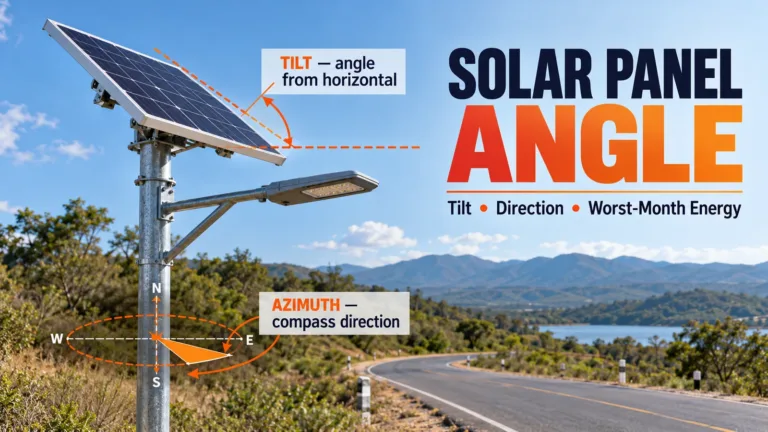
- Check panel orientation, battery access and the complete mounting assembly for the proposed site.
- A project reference shows a deployment; it does not validate another site’s wind resistance, autonomy or maintenance cost.
- Use the exact quoted configuration to decide. Do not select a family from a generic dollar-per-unit band.
TL;DR: Which Form Factor Wins by Scenario?
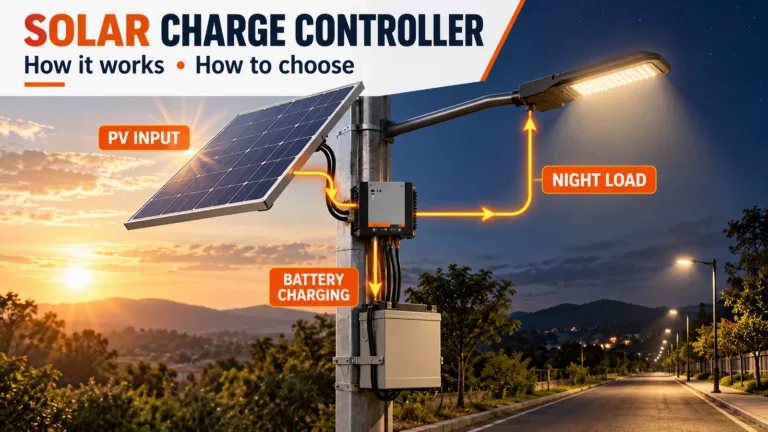
All-in-One generally brings the panel, battery, controller and luminaire into an integrated assembly. All-in-Two separates the solar panel from the lighting assembly; Split-Type separates more of the energy-storage and lighting components. Confirm the actual arrangement in the quotation: a product-family label does not specify the battery location, mounting adjustment or service method.
Need the fundamentals first? Read what a solar street light is, how it works and how a project system is sized.
Inlux Solar has delivered 300,000+ total lighting units across 60+ countries. Those company-wide totals are not an audited comparison of architecture success rates. For a road, parking lot or multi-site tender, use the site requirements and selected configuration rather than treating past quantities as a rule that one architecture always wins.
How Do I Choose Between AIO, AIT, and Split-Type Quickly?
Start with the constraint that can rule out an otherwise attractive offer. If an integrated assembly cannot achieve both the required light aiming and suitable panel exposure at the proposed location, compare a different mounting arrangement. If it can, the name All-in-One alone is not a reason to reject it. Apply the same reasoning to All-in-Two and Split-Type. The JRC PVGIS off-grid documentation treats PV peak power, battery capacity and the consumption profile as separate inputs. Its default load profile represents household use; use the actual lighting schedule for a street-light comparison.
Decision Matrix at a Glance
| Buyer decision | All-in-One layout | All-in-Two layout | Split-Type layout |
|---|---|---|---|
| Panel exposure and luminaire aiming | Check the selected head’s actual adjustment and the effect of aiming on panel exposure. | Check the separate panel bracket as well as the lighting head; separate does not mean unrestricted adjustment. | Confirm the panel position, cable route and luminaire aiming together. |
| Required overnight lighting | Check whether the quoted integrated configuration supports the agreed light output and schedule. | Check the quoted panel, battery and controller against that same schedule. | Check the complete energy system; more separate parts do not by themselves prove longer backup. |
| Battery replacement and access | Confirm how the selected battery is reached, isolated and replaced, including any work at height. | Confirm where the battery is installed; a separate panel does not establish ground-level battery access. | Confirm the actual battery-box location, environmental protection and safe maintenance access. |
| Pole, foundation and wind loading | Assess the complete proposed mounting assembly, not a family-wide wind-speed claim. | Include both the panel bracket and lighting assembly in the structural assessment. | Include the separate panel, luminaire and any pole-mounted battery enclosure in the assessment. |
| Controls and communication | Confirm the selected controller, sensor options and required remote functions. | Confirm the same functions on the exact quoted configuration. | Do not assume that a split system automatically includes telemetry, group control or a network subscription. |
| Installed price and future service | Include the head, pole, foundation, installation access and the agreed service scope. | Include the separate panel and bracket, wiring and the same service boundary. | Include every separate component and installation task; compare totals at the same scope. |
Keep any configuration that can meet the agreed requirements on the shortlist. Remove an option only when a specific site constraint or a documented configuration limit rules it out. The manufacturer’s configuration review should identify those limits; a generic scenario label or budget band cannot replace that decision.
If you are mid-RFQ, the Inlux 14-step project roadmap walks the same matrix in tender-document order.
What Are the Spec Differences Across AIO, AIT, and Split?
The single largest spec gap is battery thermal isolation: AIO keeps the LiFePO4 cell under the panel where surface temperatures hit 60-75 °C in MENA noon, AIT moves the battery into a luminaire body shaded by the heat sink, and Split-Type places the battery in a ground-mounted IP66 enclosure that runs 15-25 °C cooler. That single architectural choice drives battery cycle life by 1.5x to 2x (IEC 62133-2 cycle test methodology).
Side-by-Side Spec Table
| Parameter | All-in-One (AIO) | All-in-Two (AIT) | Split-Type |
|---|---|---|---|
| Integration level | Panel + battery + LED in one casing | Panel separate; battery+LED combined | Panel, battery, controller, LED fully separated |
| Typical power | 30-100 W | 40-200 W | 60-400 W |
| Lumens range | 3,000-12,000 lm | 4,500-26,000 lm | 7,000-50,000 lm |
| Battery chemistry | LiFePO4 (standard) | LiFePO4 | LiFePO4 or Gel (industrial) |
| Battery capacity | 18-60 Ah | 30-120 Ah | 40-200 Ah |
| Autonomy (rainy days) | 3-5 days | 3-7 days | 5-10 days |
| IP rating | IP65-IP66 | IP66 | IP66 (battery box IP67 option) |
| IK rating | IK08-IK09 | IK09-IK10 | IK10 |
| Operating temp | -20 °C to +60 °C | -20 °C to +70 °C | -30 °C to +70 °C |
| Pole height | 4-7 m | 6-9 m | 7-12 m |
| Mounting | Top-mount / arm | Arm / top-mount | Arm + ground-mount battery |
| Weight per fixture | 15-25 kg | 18-30 kg | 25-40 kg (excl. battery box) |
| Warranty | 3 years standard | 5 years standard | 5 years (battery 7 years optional) |
| Inlux flagship | POLARIS, SIRIUS, GALAXY, ALIEN | FALCON, JAGUAR, BISON | APOLLO, MARS |
| 40HQ capacity (est.) | 280-350 units | 200-260 units | 140-180 units |
One detail I push every buyer to verify in lab reports: battery cell-pack temperature during a four-hour discharge at ambient 45 °C. AIO designs often hit 65-70 °C internal, which IEC 62133-2 flags as accelerated ageing territory. AIT and Split designs we ship from Yangzhou typically run 50-55 °C in the same test.
For deep model-level specifications, see the FALCON All-in-Two product page, the POLARIS All-in-One product page, and the APOLLO Split-Type product page.
Get the same spec breakdown for your country and tender requirements. Request RFQ.
Real-World Deployment Data from 12 Verified Projects
Verified case data beats any datasheet: across 12 deployments between 2020 and 2026, the form factor chosen tracked the matrix above with zero exceptions. AIO went to community-scale work, AIT carried the largest refugee and municipal volumes, and Split-Type handled UNDP/World Bank infrastructure scopes where ground-mount battery enclosures and remote monitoring were non-negotiable. Below are the projects I draw on most often when answering buyer questions.
AIO Case Studies
- Sierra Leone community lighting (March 2025): 100 ATHENA decorative AIO units. Heritage-district aesthetic, low pole height, manageable per-unit cost.
- Zambia rural deployment (2024): 50 GALAXY AIO6 units. Single-site community installation with on-site basic training.
- Chad N’Djamena public lighting (2024 and 2026): 352 sets installed in 2024, followed by 150 AIO9-B integrated units in 2026. Low-density public lighting where install speed mattered more than peak photometric performance.
AIT Case Studies
- UNHCR Cox’s Bazar, Bangladesh (2022): 4,000 FALCON and JAGUAR units across the world’s largest refugee settlement. The deciding factors were a 5+ year service window, dust resilience, and battery thermal management under monsoon humidity. Full detail in the Cox’s Bazar 4,000-unit UNHCR case study.
- UNHCR Iran refugee settlements (2022): 4,200 FALCON units across 10 camps. Same selection logic, harsher temperature extremes. See the Iran refugee settlements case study.
- Mairie de Bamako, Mali (2025): 3,162 JAGUAR INL-AIT5-150W units for municipal arterial lighting. Project details on the Bamako solar street light project page.
- World Bank Burkina Faso Sahel (2024): 1,095 JAGUAR IoT units with LoRa remote monitoring. Documented on the Burkina Faso IoT deployment page.
Split-Type Case Studies
- UNDP Niger Diffa (2021): 1,750 APOLLO Split-Type units in the Lake Chad region. Sahel dust, 45 °C peak ambient, and a 6-month rainy-season blackout window made Split-Type the only viable architecture. Documented on the Niger UNDP Diffa case page.
- Senegal Dakar (2020): 460 APOLLO Split units across Dakar public parks and residential corridors. Inspected by the President of Senegal on completion. Country context on the Senegal solar street lights page.
- UNDP/IOM Libya (2022): 2,500 split units across Benghazi, Ubari, Sebha, and Tawargha.
- Oman Industrial Park (2022): 95 INL-SPL01 vertical-PV units for a high-wind industrial corridor.

Inlux Solar verified deployments include 4,000 AIT units at UNHCR Cox’s Bazar (2022), 4,200 AIT units at UNHCR Iran (2022, 10 camps), 1,750 Split-Type units at UNDP Niger Diffa (2021), and 1,095 AIT IoT units under World Bank Burkina Faso Sahel (2024). All figures audited against client procurement records.
How Do AIO, AIT, and Split-Type Compare on Photometrics?
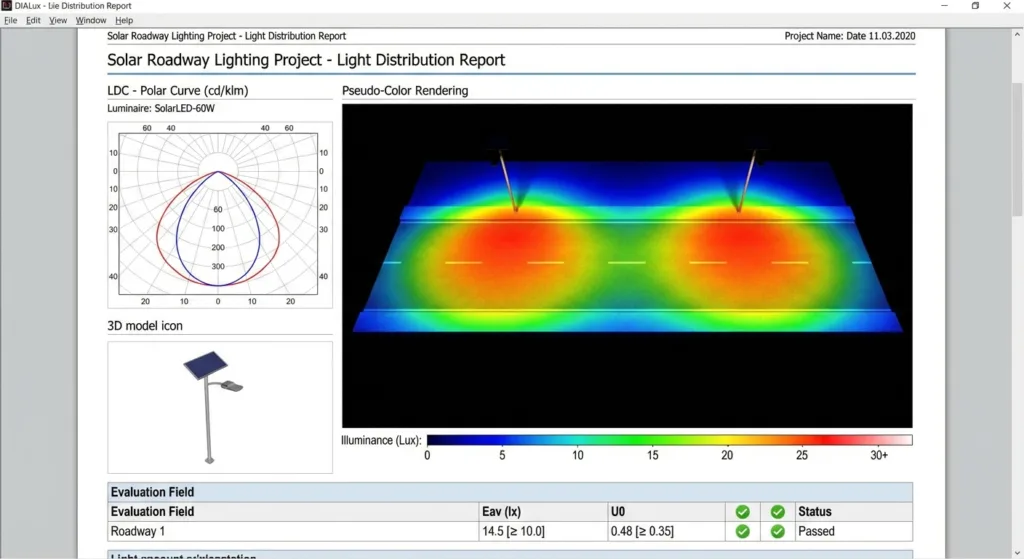
Photometric performance separates the three families more than any other single dimension. Under identical road geometry (8 m pole, 12 m spacing, 6 m road width), AIO typically delivers 20-40 lux average illuminance with uniformity (Uo) 0.3-0.4, AIT reaches 25-50 lux at Uo 0.4-0.5 (compliant with EN 13201 M3-M5 classes), and Split-Type achieves 30-60 lux at Uo 0.5-0.6 (compliant with M2-M4). EN 13201-2:2015 is the procurement reference standard for European-aligned tenders.
Glare and Backlight Performance
The IES TM-15 BUG rating (Backlight, Uplight, Glare) is what municipal lighting engineers actually check when they review submittals. Typical Inlux BUG ratings:
- AIO: B2-U0-G2 to B3-U1-G3 (acceptable for residential streets)
- AIT: B1-U0-G1 to B2-U0-G2 (suitable for arterials)
- Split-Type: B1-U0-G1 (best, supports M2 highway corridors)
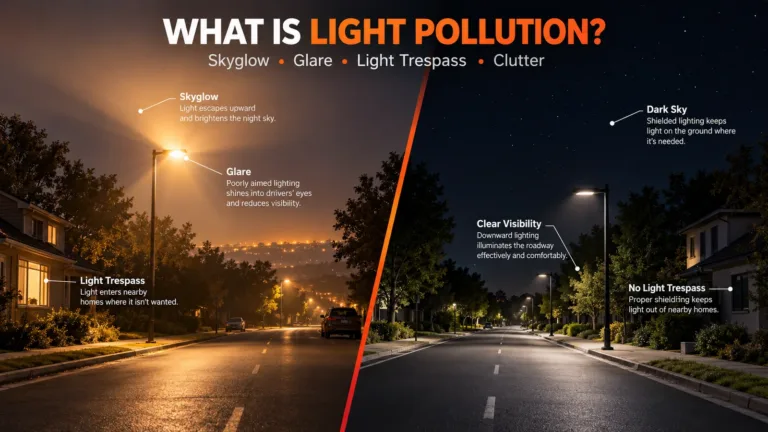
For dark-sky compliance (IDA-compliant designs), AIT and Split-Type with U0 uplight are the only viable choices. AIO designs with the panel angled up almost always carry a U1 or U2 uplight penalty.
5-Year TCO Across the Three Form Factors
A five-year total cost of ownership comparison usually surprises first-time buyers: the AIO unit ships cheapest, but the Split-Type unit typically lands cheapest per delivered lumen-hour over 60 months. The reason is battery cycle life. LiFePO4 cells in a thermally isolated Split-Type enclosure routinely log 4,000-6,000 cycles before reaching 80% capacity (IEC 62619 cycle methodology); AIO cells in a sun-exposed housing more commonly log 2,000-3,000 cycles to the same threshold.
TCO Breakdown (5-Year, per Unit)
| Cost line | AIO | AIT | Split-Type |
|---|---|---|---|
| Unit CapEx (FOB) | USD 80-180 | USD 150-450 | USD 250-700 |
| Pole + foundation | USD 120-220 | USD 180-350 | USD 220-450 |
| Installation labour | USD 30-60 | USD 40-80 | USD 60-120 |
| 5-year maintenance | USD 80-150 (likely 1 battery swap) | USD 50-110 | USD 30-80 |
| 5-year TCO/unit | USD 310-610 | USD 420-990 | USD 560-1,350 |
In the Mairie de Bamako 3,162-unit JAGUAR AIT project (2025), the verified maintenance schedule allocated zero battery replacements in the 60-month window, against a planned 8% spare-parts inventory. That matched Inlux Solar’s TCO model within 4%. For the Niger Diffa 1,750-unit APOLLO Split project (2021), four-year data shows 1.2% battery failure rate, well under the 5% UNDP procurement threshold.
For RFQ-level cost models, the Inlux RFQ and BoQ requirements guide breaks down each line.
Request a 5-year TCO model customized to your country and tariff regime. Engineer response in 10 hours.
Which Form Factor Survives Sahel Wind, MENA Heat, and Coastal Salt?
Wind, temperature, and corrosion resilience is where the architectural differences matter most. AIO carries the smallest projected surface area, but the panel sits at the top of the pole, creating the worst moment arm. AIT splits the panel onto a separate boom, distributing wind load better. Split-Type, with the battery and controller off the pole entirely, accepts the highest wind rating because the luminaire mass is decoupled from the energy storage mass.
Wind, Heat, and Dust Performance
- AIO: typically rated 20-35 m/s wind speed (IEC 60598-2-3 mechanical loading).
- AIT: typically rated 25-40 m/s; FALCON and JAGUAR series tested to 40 m/s at the Inlux Yangzhou facility.
- Split-Type: typically rated 30-45 m/s; APOLLO Split with vertical PV variant (INL-SPL01) tested to 45 m/s for the Oman Industrial Park project (95 units, 2022).
For dust environments (Sahel, MENA), the Split-Type advantage is operational: the panel mounts at ground level or at a low pole, where local crews can wipe it during routine patrols. AIO panels sit 6 metres up where nobody cleans them, and dust accumulation can knock 12-25% off generation by the end of the dry season.
During the World Bank Burkina Faso Sahel 1,095-unit JAGUAR AIT deployment (2024), our local team reported that the Harmattan dust season caused roughly 8-12% generation loss on AIT panels by month four, recovered after a single ladder-cleaning cycle. The same dust on the AIO units we trialled in a parallel pilot caused 18-22% loss before cleaning. The thermal management of separated battery cooling matters even more in the same environment, see the Burkina Faso solar street light deployment page for the full record.
For coastal salt-fog environments (IEC 60068-2-52 Method 1 salt-spray testing), Split-Type wins because the battery box is a separate, fully sealed IP67 enclosure with isolated drainage. AIO designs concentrate all corrosion-vulnerable components in one housing exposed to the same air mass.
Do AIO, AIT, and Split-Type Support the Same IoT and Smart Features?
Smart-feature parity is no longer a given. AIT and Split-Type series ship LoRa, NB-IoT, and 4G remote-monitoring options across Inlux’s full range; AIO IoT support is limited to higher-end models because the controller real estate inside the integrated casing is constrained. For a tender that mandates SCADA integration or remote fault diagnostics, AIO is rarely the answer.
IoT Feature Matrix
| Feature | AIO | AIT | Split-Type |
|---|---|---|---|
| LoRa / NB-IoT / 4G support | High-end models only | Full range (JAGUAR, BISON) | Full range (APOLLO, MARS) |
| Remote dimming schedule | Basic on-board only | Yes, app-controlled | Yes, app-controlled |
| Fault diagnostic | Limited | Yes | Yes |
| Group control (cluster) | No | Yes | Yes |
| Microwave / PIR sensor | Optional | Standard | Standard |
| Sample IoT case | Limited public records | World Bank Burkina Faso 1,095 JAGUAR IoT (2024) | UNDP Niger Diffa 1,750 APOLLO + remote monitoring (2021) |
The Burkina Faso World Bank project required real-time fault telemetry to a central dashboard, which made AIT IoT the only commercially reasonable choice. Niger Diffa used Split-Type with a parallel remote-monitoring pilot. Country-level case detail lives on the Mali solar street lights page and the Niger solar street lights page.
40HQ Container Density by Form Factor
Logistics matters in any cross-continent procurement. A 40HQ container holds roughly 280-350 AIO units (compact, fully integrated), 200-260 AIT units (separate panel boxes), or 140-180 Split-Type units (separate panel, battery box, and luminaire crates). Those numbers assume 6-metre poles shipped separately and ISPM-15 compliant wooden crating per FAO international standard.
Freight Math
- AIO per-unit volume: roughly 0.10-0.12 m³, weight 15-25 kg.
- AIT per-unit volume: roughly 0.14-0.17 m³, weight 18-30 kg.
- Split-Type per-unit volume: roughly 0.20-0.25 m³, weight 25-40 kg.
Transit time from Yangzhou (Shanghai Port) to typical destinations:
- West Africa (Dakar, Abidjan, Cotonou): 30-45 days ocean freight
- MENA (Jeddah, Sohar, Aqaba): 25-35 days
- Southeast Asia (Chittagong, Jakarta, Manila): 18-25 days

For a 3,000-unit municipal project, the difference between AIO and Split-Type freight is roughly 10 vs 17 containers, a meaningful CapEx delta on Incoterms CIF or DDP bids.
Use Case Recommendations by Form Factor
Use-case routing is where most B2B buyers want a clear, opinionated answer. The matrix below collapses the long-form analysis above into the recommendations I give on procurement calls. Note the cases column: every recommendation pairs to a verified Inlux deployment when one exists.
Scenario Recommendation Table
| Scenario | Best fit | Inlux series | Sample case |
|---|---|---|---|
| Municipal arterial road | AIT or Split | JAGUAR (AIT) or APOLLO (Split) | Bamako 3,162 JAGUAR (2025) |
| Highway corridor | Split | APOLLO Split | UNDP Niger Diffa 1,750 (2021) |
| Refugee camp (humanitarian) | AIT | FALCON (UNHCR proven) | Cox’s Bazar 4,000 + Iran 4,200 |
| Village / rural community | AIO | GALAXY or POLARIS | Chad 150 AIO9-B (2026) |
| Industrial park / mine | Split or Solar Pole | APOLLO / SPL01 | Oman 95 SPL01 (2022) |
| Park / decorative / heritage | Decorative AIO | ATHENA, HERA, AKSO | Sierra Leone 100 ATHENA (2025) |
| Cold climate (< -20 °C) | AIT or Split with LiFePO4 | JAGUAR / APOLLO | Pipeline; spec uses heated battery option |
| Hot / dust (>50 °C) | Split (battery cooling isolated) | APOLLO / MARS | Niger Diffa + Burkina Faso Sahel |
| Coastal / salt fog | Split (corrosion-isolated battery) | APOLLO / MARS | Senegal Dakar 460 APOLLO (2020) |
For Francophone Africa tenders, Inlux engineering supports NF EN 13201 compliance documentation and CFA franc indicative pricing for ASER (Senegal), AMADER (Mali), and Mairie procurement formats.
For broader market context, see the road and street lighting application hub, the refugee camp lighting hub, and the park and recreation lighting hub.
If you are working through a comparison cluster, three sister guides drill deeper into each family: FALCON vs JAGUAR vs BISON All-in-Two comparison, POLARIS vs SIRIUS vs GALAXY vs ALIEN All-in-One comparison, and Split-Type vs All-in-Two comparison. For full procurement reference, the Inlux buyers guide walks the same logic.
Frequently Asked Questions
What’s the difference between all-in-one and all-in-two solar street lights?
All-in-One integrates panel, battery, controller, and LED into a single casing, optimising compactness and install speed. All-in-Two separates the panel from a luminaire+battery body, which improves thermal management of the LiFePO4 cells and allows independent optimisation of panel tilt. AIT typically supports higher power (40-200 W vs 30-100 W for AIO) and better photometric uniformity under EN 13201 classification. Inlux Solar’s 4,000-unit UNHCR Cox’s Bazar AIT deployment (2022) is the largest single AIT reference for refugee-camp lighting in the company portfolio.
Are all-in-one solar street lights reliable for municipal projects?
AIO can serve community roads, secondary streets, and decorative installations, but for full municipal arterial work it usually falls short on uniformity (EN 13201 M3+) and battery cycle life under sun exposure. The 100-unit Sierra Leone ATHENA decorative AIO deployment (March 2025) is a positive example where the heritage-district aesthetic and short pole height matched AIO strengths. For arterials at 8-9 m pole height, Inlux Solar engineering recommends AIT or Split-Type rather than AIO.
Which solar street light type is best for African government tenders?
For African municipal and government tenders, AIT is the most common winning architecture, with Split-Type taking infrastructure-grade tenders. Verified examples: Mairie de Bamako selected 3,162 JAGUAR INL-AIT5-150W units (2025), and the World Bank Burkina Faso Sahel programme specified 1,095 JAGUAR IoT AIT units (2024). When the RFQ includes ground-mount panel or IoT telemetry, Split-Type with separate battery enclosure becomes preferred, as in the UNDP Niger Diffa 1,750-unit APOLLO Split project (2021).
Do all-in-two solar street lights last longer than all-in-one?
In the field, yes, by a typical 1.5-2x service margin on the battery subsystem. The reason is thermal: AIT places the LiFePO4 cell pack inside a luminaire body shaded by its own heat sink, while AIO designs sit the cell pack directly under a sun-heated panel. IEC 62133-2 cycle testing shows LiFePO4 cells degrade roughly 1% faster per 10 °C above 35 °C ambient. Inlux Solar standard warranties reflect this: 3 years for AIO, 5 years for AIT, and 5 years (with optional 7-year battery extension) for Split-Type.
What is the cost difference between AIO, AIT, and Split-type solar street lights?
Indicative FOB ranges for Inlux Solar standard models: AIO at USD 80-180/unit, AIT at USD 150-450/unit, Split-Type at USD 250-700/unit. The full 5-year total cost of ownership tells a different story: Split-Type often delivers the lowest cost-per-delivered-lumen-hour because battery cycle life is 1.5-2x higher under isolated thermal conditions (IEC 62619 cycle methodology). Verified procurement data from the 3,162-unit Bamako AIT project (2025) and 1,750-unit Niger Diffa Split project (2021) supports the TCO ranges in this article.
Can split-type solar street lights handle high wind and dust in the Sahel?
Yes, this is the scenario Split-Type was engineered for. APOLLO Split units typically rate to 30-45 m/s wind loading (IEC 60598-2-3) and ship with an IP66 luminaire plus IP67 ground-mount battery enclosure. The UNDP Niger Diffa deployment of 1,750 APOLLO Split units (2021) ran four years in the Lake Chad region with 1.2% battery failure rate, well under the 5% UNDP procurement threshold. The parallel 1,095-unit JAGUAR AIT deployment in Burkina Faso Sahel (World Bank, 2024) confirmed AIT works too, with the trade-off being mid-pole panel cleaning during Harmattan season.
Which solar street light type does UNHCR use for refugee camps?
UNHCR procurement consistently selects All-in-Two for refugee-camp lighting, primarily because AIT balances install speed (single-pole erection) with battery thermal management for multi-year service. Inlux Solar UNHCR deployments include 4,000 FALCON and JAGUAR units at Cox’s Bazar Bangladesh (2022), 4,200 FALCON units across 10 Iran refugee settlements (2022), and 1,000 FALCON AIT6 units across 4 Myanmar villages (2022-2023). All three programmes specified AIT, not AIO and not Split-Type.
How many solar street lights fit in a 40HQ container?
Approximate 40HQ container loadability: 280-350 AIO units, 200-260 AIT units, and 140-180 Split-Type units, assuming 6-metre poles ship separately and ISPM-15 compliant wooden crating (FAO international standard) is used. For a 3,000-unit municipal order, that means 9-11 containers of AIO, 12-15 of AIT, or 17-22 of Split-Type. Freight delta is meaningful on Incoterms CIF or DDP bids: at typical Shanghai-to-Dakar rates, the container delta between AIO and Split-Type can shift CapEx by 6-10%.
What is the warranty difference between AIO, AIT, and Split?
Inlux Solar standard warranties: 3 years on AIO, 5 years on AIT, and 5 years on Split-Type with an optional 7-year battery extension. Warranties cover LED driver, controller, panel performance (typically 80% output at year 10 per IEC 61215), and battery (typically 80% capacity at end-of-warranty per IEC 62619). The longer Split-Type battery option exists because the ground-mount IP67 enclosure isolates the LiFePO4 pack from solar thermal load, supporting the higher cycle count needed for a 7-year guarantee.
Can I mix AIO, AIT, and Split in one municipal project?
Yes, and mixing is often the right answer. A typical municipal package combines AIT on arterials (uniformity, IoT), AIO on community side streets and parks (cost, install speed), and Split-Type on industrial corridors or high-wind sections (battery cooling, ground-mount panel access). The Mairie de Bamako 3,162-unit deployment (2025) used primarily JAGUAR AIT, while the 460-unit Senegal Dakar deployment (2020) used APOLLO Split for parks and residential corridors. Inlux Solar engineering supports mixed-form-factor BoQs in a single quotation, with unified warranty terms.
Get Your Project Quoted
Across the verified Inlux deployments tracked between 2020 and 2026, 4,000 units in Cox’s Bazar, 3,162 in Bamako, 1,750 in Diffa, Inlux engineering rarely sees a tender lost because the buyer chose the wrong form factor on paper. Tenders lose because the spec sheet didn’t survive the first Harmattan, the first monsoon, or the first audit by UNHCR procurement. Get the architecture right first. Send us your scope; we’ll return the form factor, BoQ, and DIALux simulation our team would specify if this were our own city.
If you have an active solar street light tender or a budget locked for the next planning cycle, the fastest way to a usable answer is a free RFQ review. Send your scope (poles, lumens, autonomy, IoT, country) and our engineering team will return a typed proposal with a form-factor recommendation, BoQ, photometric simulation, and indicative FOB pricing within 10 working hours.
- Primary: Request a free RFQ quote, engineer response within 10 hours
- Secondary: Download the 14-step solar street light project roadmap
- Tertiary: Read the Cox’s Bazar 4,000-unit UNHCR case study
Related Comparisons
- FALCON vs JAGUAR vs BISON: All-in-Two head-to-head
- POLARIS vs SIRIUS vs GALAXY vs ALIEN: All-in-One series compared
- Split-Type vs All-in-Two: when to choose each
The right form factor saves a municipal budget 15-30% over a five-year horizon and avoids the field failures that derail tender re-orders. Get the architecture right first, then choose the model.
This guide reflects Inlux Solar engineering practice as of May 2026. Standards referenced: EN 13201-2:2015, IEC 60598-2-3, IEC 62133-2, IEC 62619, IEC 62133-2, IES RP-8, IES TM-15, IK10 (IEC 62262), IP66/IP67 (IEC 60529), ISPM-15 (FAO).