UN 38.3 refers to lithium battery design testing for transport, not a blanket approval for a solar street light. For a buyer, the useful document is a traceable test summary linked to the battery or battery-containing product being supplied. Start with the model identity, then check the report reference, test results and document completeness. A familiar logo or the words “UN38.3 certified” are not enough to establish that link.

Imagine approving a road-lighting order with a larger battery, then receiving the paperwork from the smaller version. Both packs use LiFePO4 cells and share the same nominal voltage. The paperwork can look convincing while still leaving the offered configuration unexplained. This guide helps procurement teams catch that gap. It is a document-review aid, not instructions for battery testing, dangerous-goods packing or legal clearance.
What UN 38.3 tells a solar lighting buyer
A test summary identifies the tested design and reports the relevant test outcomes. It does not tell you how many rainy nights a street light will operate, whether its enclosure will remain sealed, or how many battery replacement cycles your budget should allow. Those are separate performance and project questions.
The PHMSA test-summary guide explains the required information and gives a sample layout. Use the official guide to check completeness. The procurement checks below are a practical review sequence, not a replacement for the standard or the rules applicable to your shipment.
7 UN 38.3 document checks before order release
| Buyer check | What to compare | When to hold the review |
|---|---|---|
| 1. Offered identity | Quotation, battery label and summary model references | The seller provides a similar series name with no exact mapping |
| 2. Battery description | Chemistry, mass, physical description and rated energy | The description does not identify the offered pack |
| 3. Responsible organizations | Manufacturer contact details and laboratory identification | The issuer or source cannot be traced |
| 4. Report reference | Unique report identifier and report date | A screenshot omits the identifying information |
| 5. Testing scope | Recorded tests and results; applicable assembly references | Only a cell document is offered without an explanation of pack coverage |
| 6. Document basis | Manual edition, amendments and responsible person’s name and title | Required information is missing or conflicting |
| 7. Order continuity | Approved battery configuration and later substitutions | The order changes but nobody confirms document applicability |
These checks combine document completeness with purchasing controls. The final row is an order-management recommendation, not an extra UN test. Keep each discrepancy as a specific question: which model is covered, what changed, and who will provide the supporting explanation? A vague request for “more certificates” often produces more files without resolving the actual mismatch.
A worked example: the voltage matches, the battery does not
Consider a fictional offer for battery X-60: 12.8 V, 60 Ah. Its nominal energy is 12.8 × 60 = 768 Wh. The supplied test summary identifies X-40 at 12.8 V, 40 Ah, or 512 Wh. These are teaching values, not Inlux product specifications. The matching voltage does not explain the different model and energy rating.
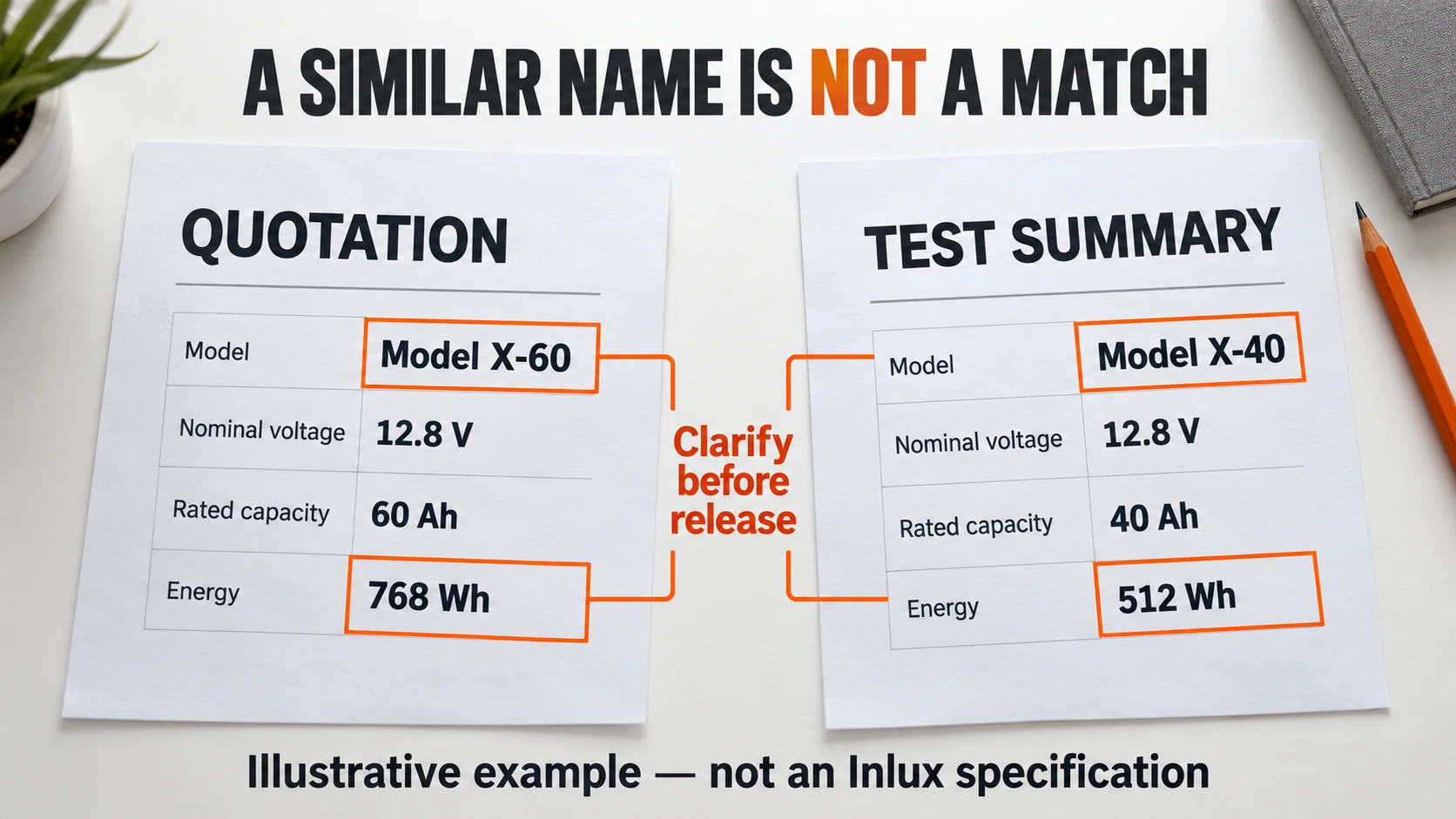
Do not rename the document, assume a larger battery is automatically covered, or accept “same factory” as the missing explanation. Ask the manufacturer to identify the offered design and provide the applicable summary or a documented explanation of the coverage. If one summary covers several products, locate the specific entry rather than rejecting a multi-model document merely because it is shared.
Check energy using nominal voltage, not the charging voltage or the LED wattage printed on the luminaire. The amp-hours to watt-hours guide explains that calculation. Correct arithmetic is a useful discrepancy check; it is not evidence that a pack passed transport testing.
A cell report is not a complete answer about the offered pack
A cell is a component. The street-light quotation may specify an assembled battery with its own connections, protection electronics, enclosure and model identity. A document for the cell is useful background, but the buyer still needs to understand how the supplied battery configuration is covered.
Ask this narrowly: “Does this UN 38.3 test summary identify the assembled battery in our quotation, or only its cells? Please show the applicable model entry and explain any assembly provisions relied on.” Leave the determination of testing applicability to the manufacturer and qualified specialists. Do not turn this purchasing check into an instruction to perform short-circuit, overcharge or other abuse tests on site.
Keep the test summary, SDS and transport decision separate
The UN 38.3 test summary, a safety data sheet and a shipment review have different jobs. A summary links a design to testing; an SDS communicates safety information; the transport review addresses the proposed movement. Filing one of them under “battery documents” does not make the other questions disappear.
A general compliance sentence on an SDS is not the complete test summary described by PHMSA. Equally, possessing a summary does not decide every packing, marking, documentation or carrier-acceptance question. IATA’s battery guidance is a starting point for the qualified person arranging air transport; the applicable current rules and operator requirements still need checking.
Describe the actual shipment to that specialist: new equipment with batteries installed, equipment accompanied by separately packed batteries, or standalone replacement packs. Do not choose a UN shipping number from a blog headline. A later shipment of spare batteries can require a different review from the original lighting order. Damaged or suspect batteries need specialist handling rather than the routine new-product process.
Make the document review part of the solar lighting quotation
Start with the configuration, not the certificate gallery. For All-in-One solar street lights in the offer, identify the battery fitted inside the quoted unit. For All-in-Two systems, confirm the offered battery arrangement and how it will be supplied. The product-family label alone is not a battery model reference.
In the quotation review, keep a single record linking the lighting configuration, battery identity, rated energy, document references, destination and intended shipping arrangement. Ask for unresolved differences to be recorded before the agreed release point. If a supplier offers a capacity upgrade or alternative pack, reopen the applicability question for that change instead of assuming the original paperwork follows it automatically.

A useful request is: “Please identify the battery configuration in this offer, provide the applicable UN 38.3 test summary, and explain any difference between the quoted model and the model shown in the documents. State which transport review remains outstanding for the intended destination and shipment arrangement. Do not substitute the battery without written agreement.”
Inlux Solar’s standard warranty is 5 years. That commercial commitment does not replace battery transport evidence or confirm document availability for an unspecified configuration. Use the packaging and shipping page for logistics scope, then send the project and battery requirements with your RFQ. Ask what can be supplied for the selected configuration and when; this article does not promise a public download or immediate delivery of engineering files.
UN 38.3 FAQ for solar street light procurement
Is UN 38.3 a certificate for the whole solar street light?
No. It concerns lithium battery transport testing. It does not demonstrate the complete light’s illumination, ingress protection, autonomy or service life. Request evidence for those requirements separately, matched to the offered configuration.
Does a UN 38.3 test summary expire every year?
PHMSA’s guidance does not give summaries an annual expiry. A design change that requires retesting requires new or revised summary information. An older date alone is not a reason to reject a document, but the buyer must still establish that it applies to the supplied design and intended shipment.
Must the test summary travel inside every carton?
PHMSA explains that the information must be made available, rather than necessarily accompanying every shipment. Agree how your team and the relevant supply-chain parties can access the applicable summary. Other shipment documents and any carrier-specific requirements are separate matters.
Can one UN 38.3 summary cover several battery models?
Yes, PHMSA allows a combined document when the required information is present. Check that your offered model can be identified and that the relevant report number and date are available. A broad product-family heading without a clear connection to your battery is not a resolved procurement check.
Does LiFePO4 chemistry remove the need to check transport documents?
No. Do not treat a LiFePO4 label as a transport exemption. Identify the actual battery, obtain its applicable documentation and have the shipment assessed under the relevant current rules. Chemistry also does not prove that a document for one pack covers another pack.
What should I send when requesting a solar lighting quotation?
Send the site and destination, required quantity, operating schedule, preferred system type, and any battery or tender-document requirements. If a battery has already been proposed, include its exact model and rated energy. State whether replacement packs will be shipped separately so that the logistics discussion reflects the real purchase.