A surge protection device limits transient overvoltage by diverting or limiting surge current. It is also called a surge protective device, or SPD. For a solar or LED lighting purchase, its biggest number is rarely the best starting point. First identify the circuit, then check the rating conditions and the equipment it must protect. A device intended for an AC distribution board is not automatically suitable for a battery circuit or a sensor connection.
This is a datasheet-reading guide, not an installation procedure. It addresses the component choice before a quotation is approved. For site layout, bonding responsibilities and commissioning records, use the separate solar street-light lightning and surge protection guide. Qualified electrical personnel must select and install protection under the applicable rules and the manufacturers’ instructions.
1. Start with the circuit, not the surge protection device label
In its overview, the NEMA Surge Protection Institute explanation covers both power and signal applications. That distinction matters on a lighting pole: the PV input, battery circuit, LED supply and communication connection do not necessarily have the same voltage, current, grounding arrangement or signal requirements. Write down which interface is being protected before asking a supplier for a part number.
A nominal-voltage match is not a compatibility approval. Ask for the permitted operating range, AC or DC suitability, connection modes and the exact application stated by the manufacturer. For a PV input, the relevant voltage check must account for the array’s maximum voltage under the design conditions. Do not use the battery’s nominal voltage to select a protector for the panel side.
For equipment options, the All-in-One lighting collection and All-in-Two lighting collection describe different equipment arrangements. Neither name identifies every internal electrical interface. Request the protection choice for the offered configuration; do not add a generic module to a sealed light because it fits physically.
2. Read the voltage and current fields separately
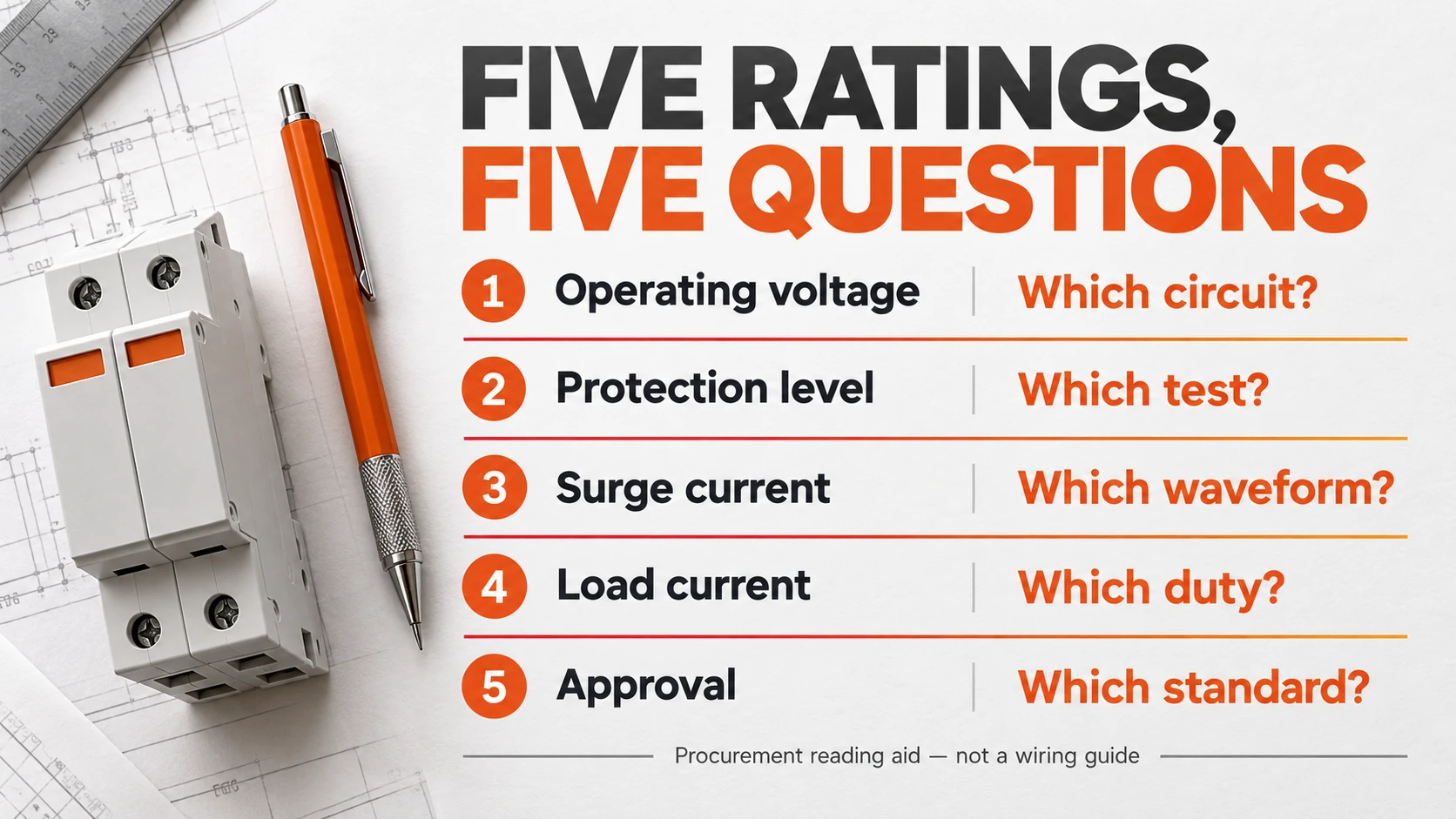
A surge protection device datasheet can contain several voltage and current values. They describe different duties and test conditions. The following reading order helps a buyer notice missing information; it does not provide project-specific acceptance thresholds.
| Datasheet field | Question answered by this SPD rating | Purchase check |
|---|---|---|
| Uc / maximum continuous operating voltage | What voltage can be applied continuously under the stated conditions? | Match the circuit and application; this is not the protection level. |
| Up / voltage protection level | What limiting-voltage performance is declared under a stated test? | Keep the test conditions and protection mode with the value. |
| In, Imax or Iimp | What surge-current test capability is declared? | Compare like waveforms and classifications, not only the largest kA. |
| Rated or load current, where applicable | What normal current may the specified path carry? | Do not use a surge-current number as a continuous-load rating. |
| Approval and application details | Under which standard and conditions was the device evaluated? | Match the exact model, circuit and required compliance evidence. |
Schneider Electric’s installation-characteristics guidance distinguishes continuous operating voltage from voltage protection level and explains why installed performance also depends on the installation. A component’s Up is therefore not a guarantee of the voltage that every downstream electronic part will experience. Coordination belongs to the system designer.
Do not rank two offers by lower Up alone. A seemingly attractive value is irrelevant if the device is unsuitable for the normal circuit voltage, application or protection mode. Ask the supplier to identify the circuit and the basis of the comparison on the same document. Missing compatibility data is a reason to request clarification, not to guess a suitable setting.
3. A real example: 5 kA does not mean a 5 kA load
For a documented example, the official Phoenix Contact TTC-6P-1X2-M-24DC-UT-I product data provides a useful reading example. This measurement-and-control protector lists nominal voltage 24 V DC, maximum continuous operating voltage 30 V DC and rated current 600 mA at 56 °C. It separately lists nominal discharge current 5 kA with an 8/20 µs waveform for specified protection modes.
Those entries are not interchangeable. The 5 kA entry describes a brief surge test, while the 600 mA entry concerns rated operating current under the stated conditions. This is a manufacturer example, not an Inlux specification, a recommended street-light component or permission to route a luminaire’s power through that signal protector. Its other electrical characteristics must also match the intended interface.
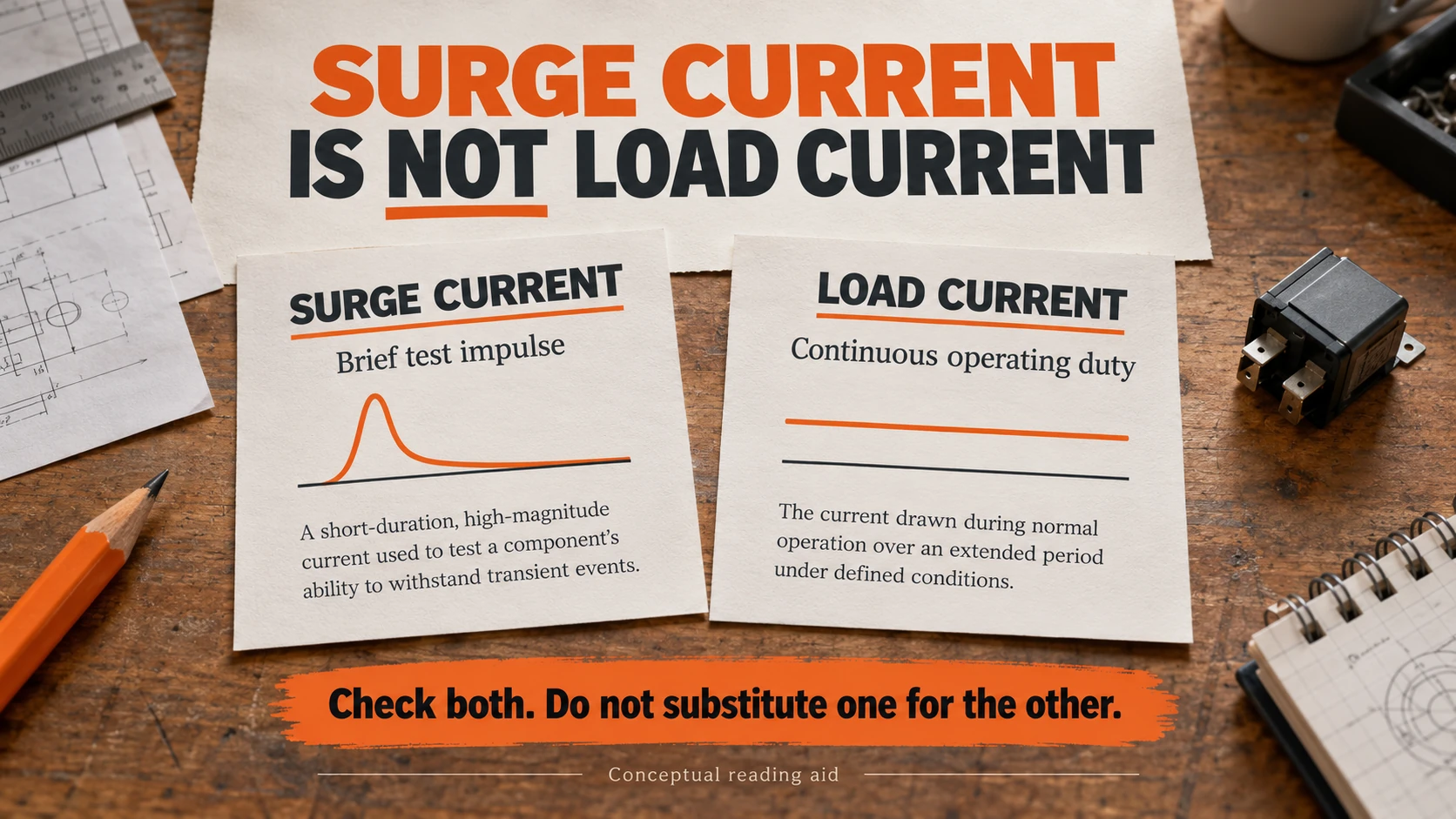
Apply the same discipline when reviewing a lighting quotation. If the proposed surge protection device has a series current path, ask about its permitted load and associated voltage drop or signal effects. If it is connected in a different arrangement, use the manufacturer’s applicable specifications rather than transferring the signal-protector example. A drawing and exact part identification must resolve that distinction.
For current calculations elsewhere in the lighting circuit, the wire-gauge selection guide addresses conductor selection separately. Cable capacity, overcurrent protection and surge protection are related design tasks, but one rating cannot stand in for all three.
4. Keep the test standard attached to Type 1, 2 or 3
IEC-oriented guidance distinguishes surge test waveforms: the Schneider Electric SPD explanation describes 10/350 µs for Type 1 and 8/20 µs for Type 2. NEMA’s explanation of ANSI/UL 1449 types instead describes permitted installation applications. These are not interchangeable shorthand systems. Record the standard, declared type and exact device together.
Similarly, In, Imax and Iimp should not be copied into one undifferentiated “surge capacity” column. They identify different declared test quantities. Ask for the waveform, protection mode and whether a quoted figure applies per mode, per pole or to an assembly. A higher headline number does not, by itself, establish that a device will protect the selected LED driver or controller better.
For an international tender, specify the compliance basis required by the project rather than asking for every familiar acronym. Check that any certificate or test evidence identifies the offered variant. A statement about a product family is not enough to resolve an undocumented substitution, and this article does not establish which local rules apply to your installation.
5. Buy a serviceable protection arrangement
A surge protection device is not a lifetime guarantee against every electrical fault. Ask how its status is indicated, what a failure indication means for that model and how replacement is handled safely. A remote contact, where provided, is useful only if the project includes a way to read and act on it. Do not assume that a working lamp proves its protection remains serviceable.
Keep the approved part and replacement identity in the purchase record. Where a design uses replaceable cartridges, confirm the compatible base and cartridge together; physical similarity is not approval. Ask whether protection loss interrupts the lighting or leaves it operating, and establish the inspection response. Do not ask maintenance crews to unplug, bridge or replace a device while energized.
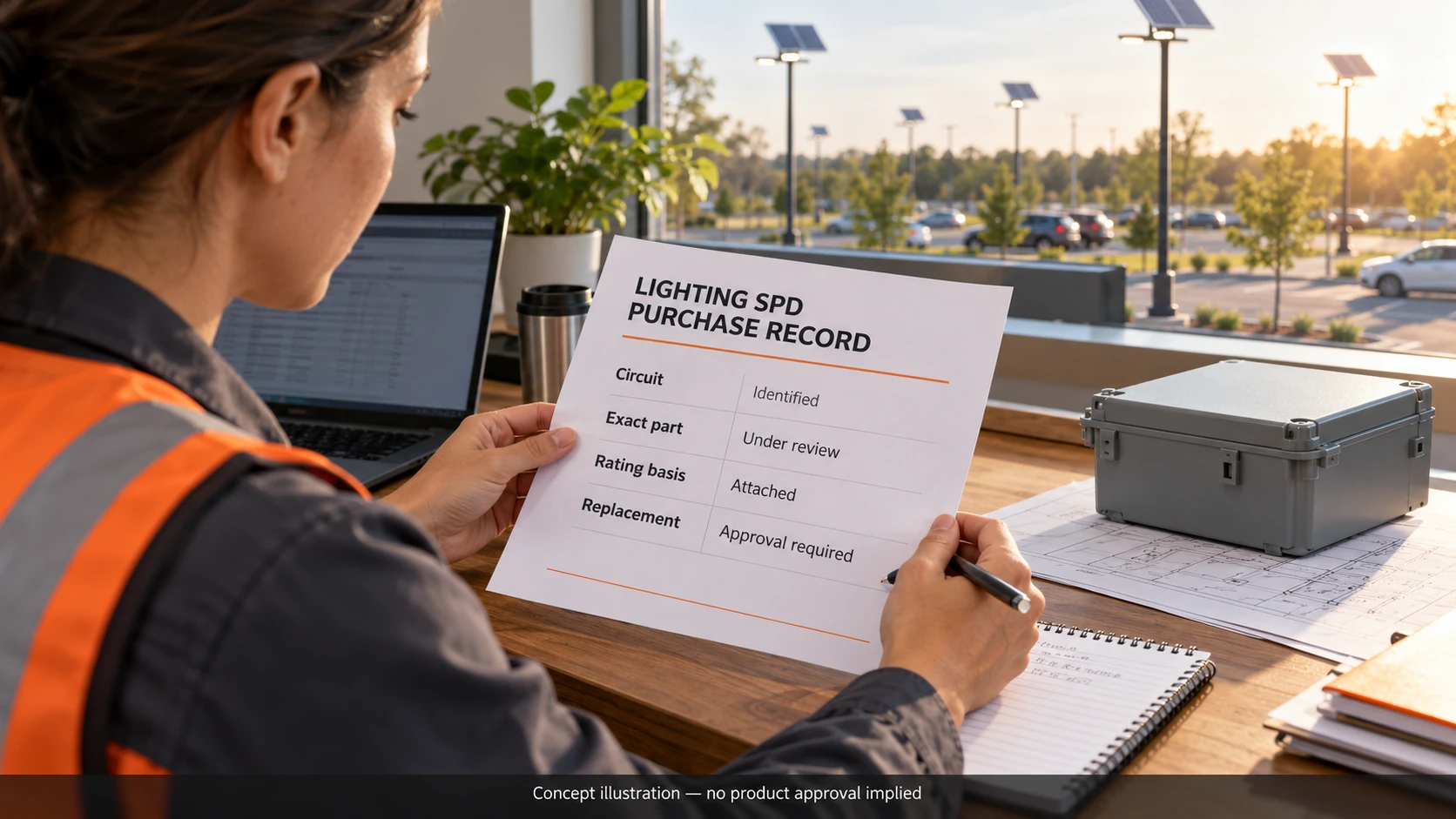
For solar street lights, identify who verifies the protection arrangement when the controller, driver or battery configuration changes. An approved original part cannot automatically validate a later substitution elsewhere in the system. Keep the exact configuration, installation instructions and service responsibilities attached to the order so a replacement decision is not reduced to matching a housing or headline kA value.
Surge protection device questions from lighting buyers
What does a surge protection device do?
It limits transient overvoltage by diverting or limiting surge current under its specified conditions. It does not supply backup energy, regulate every sustained voltage problem or replace the installation’s other protective measures.
Can I use an AC surge protector on a DC solar circuit?
Only if the exact product is explicitly approved for that DC application and operating conditions. Do not infer DC suitability from a similar nominal voltage or enclosure. PV, battery and signal interfaces require their own compatibility review.
Is a higher kA rating always better?
No. Compare the same test quantity, waveform and protection mode after establishing circuit compatibility. Surge-current capability alone does not establish voltage protection performance, normal load capability or installed coordination.
Is a surge protection device the same as a circuit breaker?
No. An SPD addresses transient overvoltage; a circuit breaker provides its specified switching and overcurrent-protection functions. The required protection and coordination must be designed together. Do not remove one because the other is present.
Does an SPD make a solar street light lightning-proof?
No. It is one part of a coordinated protection arrangement, not a promise that every strike or fault will cause no damage. Site exposure, equipment compatibility and the complete installation still require professional assessment.
How do I know when the SPD needs replacement?
Follow the exact device’s status indication and service instructions, together with the project inspection procedure. A fault indication or suspected damage calls for qualified assessment. Do not bypass a failed device or use a generic replacement interval as a substitute for its instructions.
Request a lighting offer with an identified protection scope
Inlux Solar’s standard warranty is five years. That term is not a claim that any SPD will survive every surge or that all damage is covered. Ask for the offered protection scope and component coverage in the project quotation. Include the site location, system arrangement, required compliance basis and service-access constraints.
For a new project, compare the available solar street-light systems from Inlux Solar and commercial parking-area solar lights. To compare a defined configuration, request a configuration-specific lighting quotation. For replacement work, supply the installed part identification and fault history so the proposed change can be reviewed, rather than chosen from a generic surge rating.