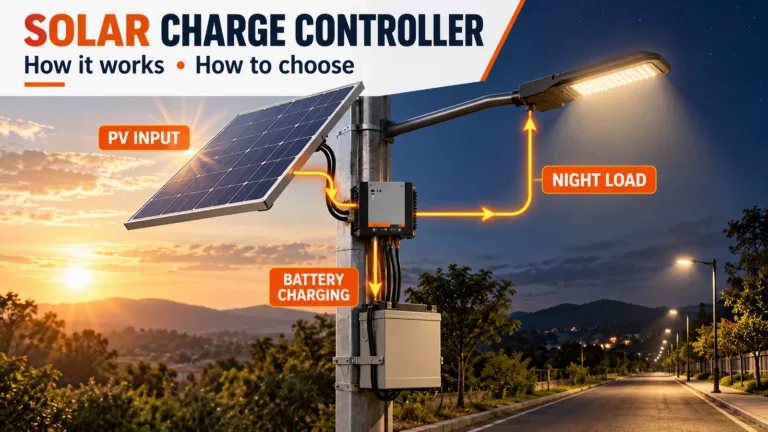
A supplier says a light has a “huge battery” and promises all-night runtime. On paper, the watt-hours look fine. In the field, the light starts shutting off early after a few cloudy days. What went wrong? In many projects, the problem is not just battery size — it is energy loss across the whole system. Battery round-trip efficiency is one of the missing numbers. If you ignore it, your runtime math will look clean in Excel and fail on the pole.
Quick Takeaways (TL;DR)
- Round-trip efficiency (RTE) means how much useful energy you get back out compared with what you put in during charging.
- RTE is not the same as “system runtime efficiency.” Battery loss is only one part of the chain.
- Even with a good battery chemistry, runtime can still fail because of controller losses, driver losses, standby loads, wrong dimming, or poor worst-month sizing.
- For tenders, ask for usable Wh, not just nominal battery capacity.
- For solar street lights, RTE belongs inside an energy budget sheet, alongside PSH, autonomy, dimming profile, and charging assumptions.
Internal hubs: Resources Hub · Guides Hub · Tender Pack · Autonomy Calculator · How Solar Street Light Works
What Round-Trip Efficiency Actually Means
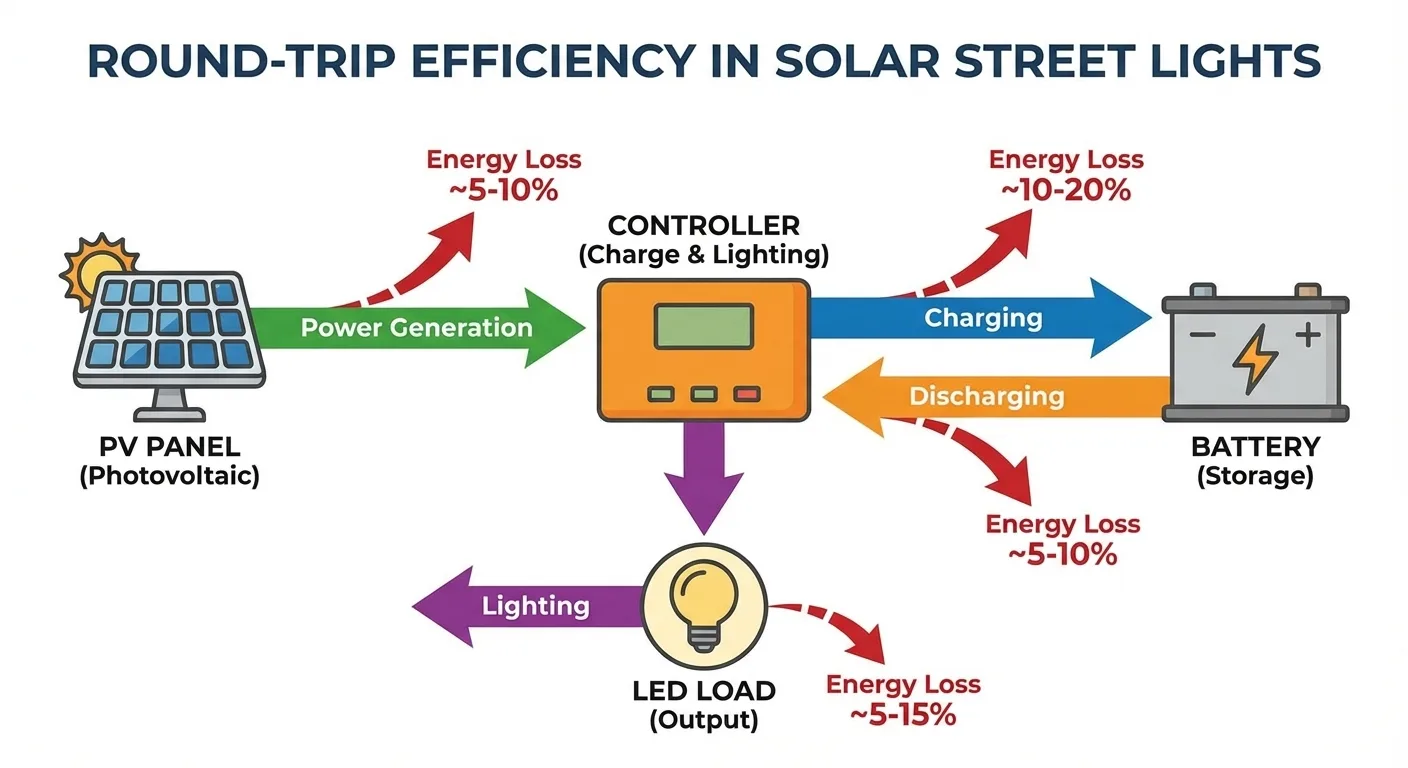
Round-trip efficiency is the ratio of useful energy out to useful energy in over a full charge-discharge cycle. In plain language: if you put 100 Wh into storage and only get 90 Wh back later, the round-trip efficiency is 90%. In utility-scale storage terminology, this is the standard definition of round-trip efficiency definition.
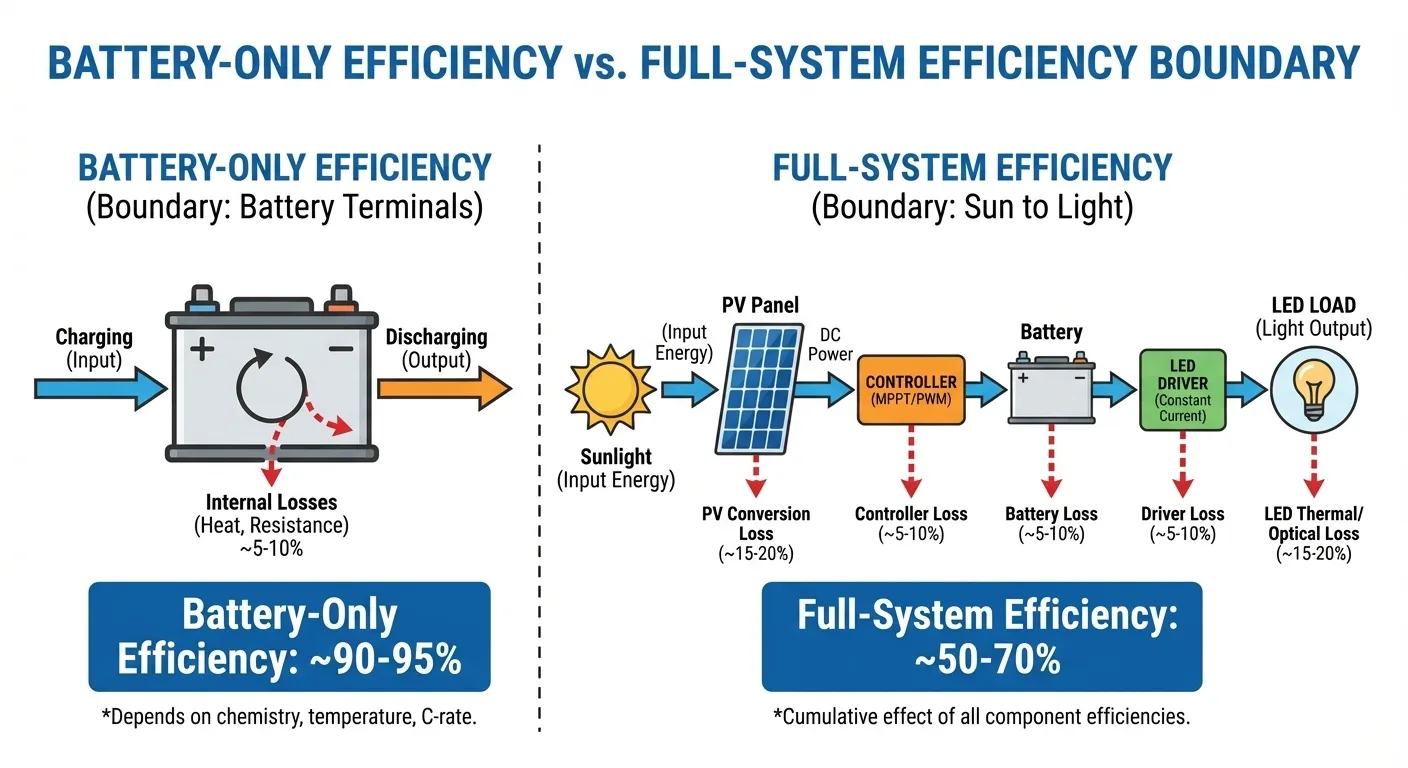
This sounds simple, but in solar street lights there are two different boundaries people often confuse:
- Battery-only efficiency — the battery cell / pack itself.
- System-path efficiency — PV, controller, battery, wiring, driver, logic, and LED delivery together.
That is why a bid can quote a “good battery chemistry” and still underperform in the field. If you want the system basics first, review: How Solar Street Light Works.
Why Chemistry Still Matters
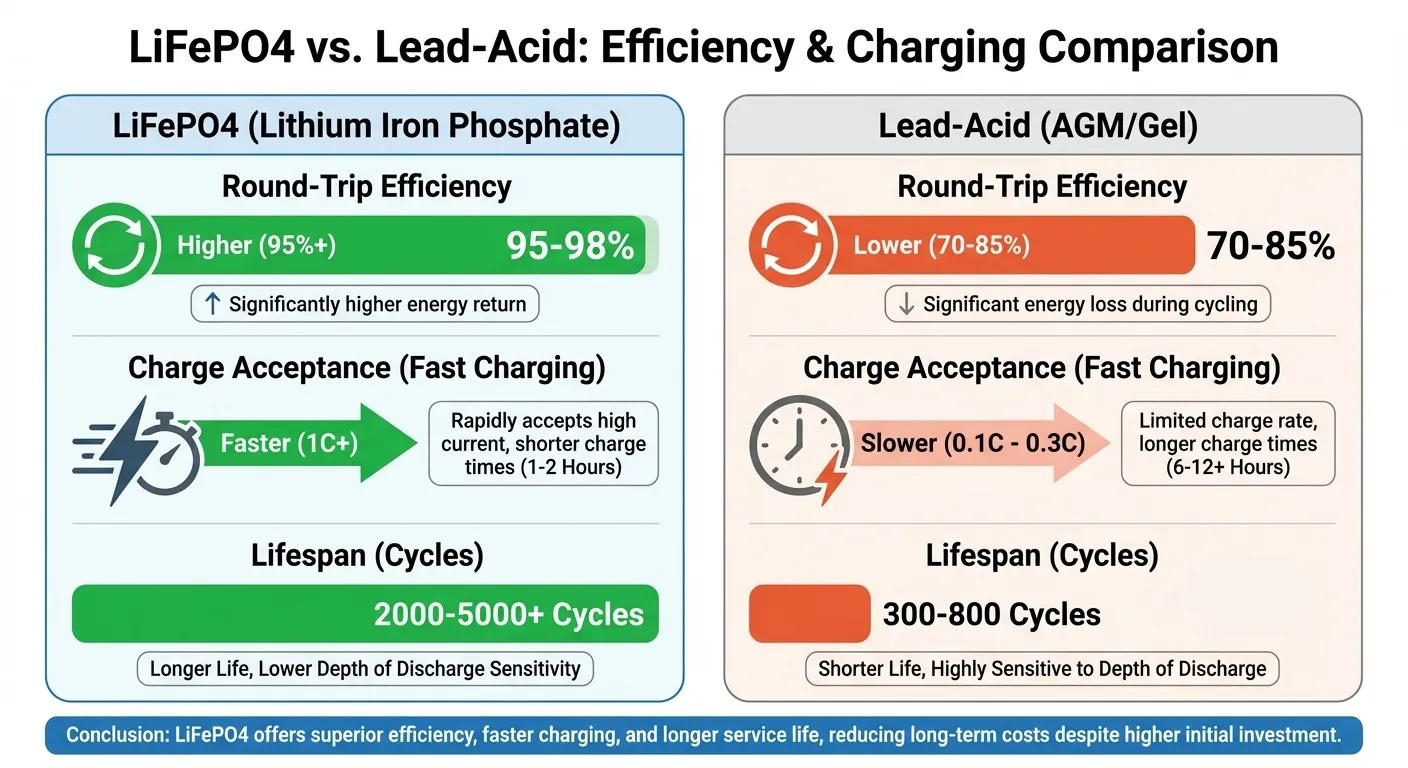
Buyers often compare batteries only by Ah or nominal Wh. That is incomplete. In practice, chemistry affects not only lifespan and safety, but also how much of the stored energy is realistically recoverable.
For project teams, the most useful takeaway is not “one chemistry is magic.” It is this: the same nominal battery capacity can deliver different real runtime depending on energy efficiency and charge acceptance.
A practical off-grid reference is Victron’s comparison of LFP vs lead-acid round-trip efficiency, which highlights why the same advertised capacity can behave very differently in real solar applications.
Related reading: LiFePO4 Battery Lifespan for Solar Street Lights · How Long Do Solar Lights Last at Night?
The Hidden Losses That Make Runtime Math Fail
Here is the classic mistake:
Nominal battery Wh × “marketing runtime assumption” ≠ guaranteed night lighting.
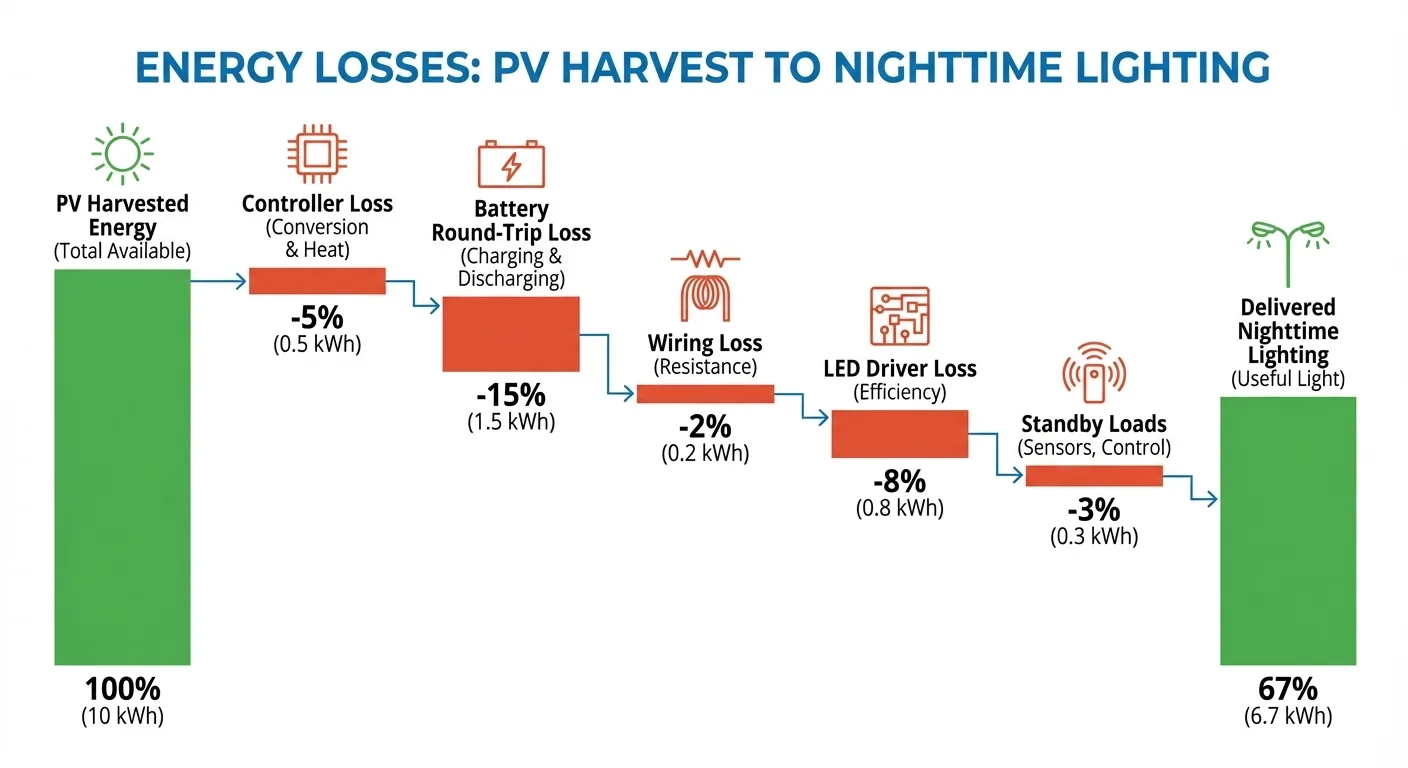
Real projects lose energy in several places:
- PV charging losses
- controller / MPPT losses
- battery round-trip losses
- wiring losses
- driver losses
- standby electronics / sensor / communication node loads
- temperature effects and aging
Once you understand this, you stop asking “How big is the battery?” and start asking: “How many usable Wh reach the load under declared conditions?”
A Better Runtime Formula for Solar Street Lights
Bad shortcut:
Runtime ≈ nominal battery Wh ÷ LED wattage
Better engineering shortcut:
Delivered runtime ≈ usable battery Wh × discharge-path efficiency ÷ average nightly load W
And for recharge sanity:
Daily recoverable energy ≈ PV harvest × controller efficiency × battery charge/discharge efficiency × delivery efficiency
This is why runtime and recharge must be evaluated together. A light may survive one night, but still fail over a week if the daily energy balance is negative. For that side of the math, pair this article with: Worst-Month PSH Sizing and Autonomy Days Calculation.
Worked Example: Why “Same Battery Size” Does Not Mean Same Runtime
Assume two solar street lights both advertise a 512 Wh battery pack.
- System A: better charge/discharge path, lower standby load, cleaner dimming profile
- System B: higher hidden losses, higher standby consumption, more aggressive full-power hours
On paper, the battery sizes match. In the field, System A may still last meaningfully longer because more of the stored energy actually reaches the LEDs.
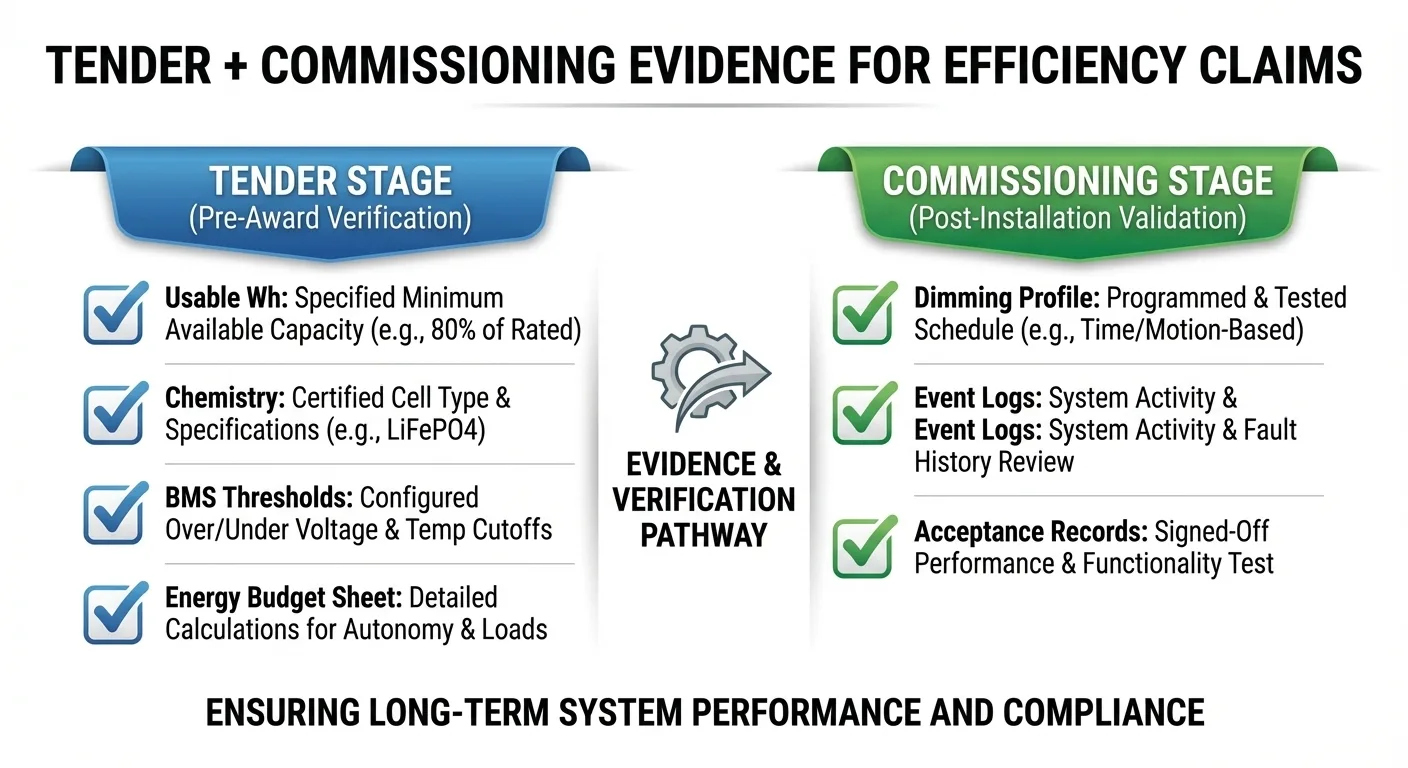
This is exactly why your tender should request:
- nominal battery Wh
- usable battery Wh
- dimming profile / Wavg
- controller type
- declared autonomy nights
- worst-month PSH assumption
Use this as the standard request form: Solar Street Light Project Input Sheet.
Why Mid-SOC Operation Feels More Stable
In real use, batteries often behave “happier” in the middle of their state-of-charge range than near completely full or nearly empty conditions. This is one reason well-sized systems feel more forgiving in the field: they spend less time living at stressful extremes.
For solar street lights, this matters because repeated deep discharge and full-stress recovery cycles accelerate complaints: short runtime, sluggish recharge, early cutoff, and warranty disputes.
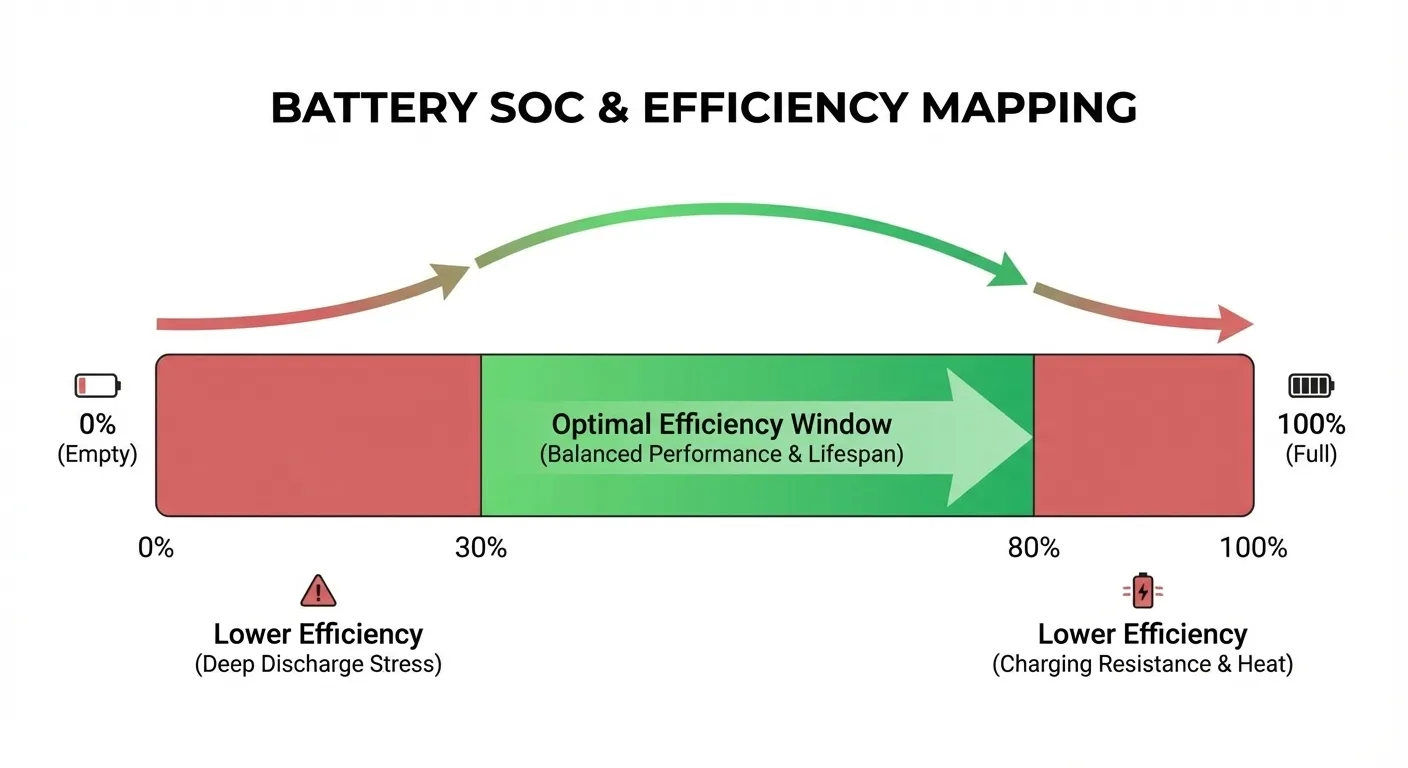
That rule of thumb is consistent with Battery University’s note on best battery efficiency in the mid-SOC range, which explains why systems that avoid the top and bottom extremes usually feel more stable in the field.
What RTE Should Mean in Tenders
Do not let suppliers hide behind one battery-efficiency number. In solar street lighting, RTE should be treated as part of a broader energy budget disclosure, not as a standalone marketing badge.
Ask for these five things together:
- Battery chemistry
- Nominal battery Wh
- Usable battery Wh
- Dimming profile / Wavg
- Worst-month recharge assumption
If one of these is missing, the runtime promise is not truly comparable. Pair this with a structured supplier evaluation framework. Related: Cloudy Weather Performance · Solar Street Light Guide: Types, Sizing, and FAQs
Copy/Paste Tender Clauses
Clause 1 — Usable energy disclosure
“Bidder shall declare nominal battery capacity and usable battery energy (Wh) under the proposed operating profile. Nameplate capacity alone is not sufficient for bid comparison.”
Clause 2 — Runtime comparability
“Bidder shall provide the declared dimming profile, average nightly power draw (Wavg), runtime hours, and claimed autonomy nights. Runtime claims without a declared load profile shall be treated as non-comparable.”
Clause 3 — Energy budget disclosure
“Bidder shall provide an energy budget sheet including PV input assumptions, controller type, charging efficiency assumption, battery usable Wh, and worst-month recharge basis.”
Clause 4 — No silent substitutions
“No substitution of battery chemistry, BMS thresholds, controller/MPPT type, or firmware dimming profile is permitted without written approval.”
Commissioning Checks That Protect You Later
- Record dimming profile actually loaded on site
- Map battery/controller serials to pole IDs
- Capture PV orientation and shading photos
- Keep acceptance records for settings, wiring, and event logs if available
These are boring when the project is healthy — and priceless when runtime disputes begin. Use: How to Fix Solar Lights · Autonomy Calculator · All-in-One Solar Street Lights
FAQ
What is round-trip efficiency in a battery?
It is the percentage of useful energy you get back after charging and discharging compared with the energy put in.
Is round-trip efficiency the same as runtime?
No. Runtime depends on usable Wh, system losses, dimming profile, and actual nightly load.
Why does the same battery size produce different runtime on different lights?
Because battery size is only one variable. Controller losses, driver losses, standby loads, and settings also matter.
Is battery chemistry relevant to runtime?
Yes. Chemistry affects energy efficiency, charge acceptance, temperature behavior, and aging.
Should I compare Ah or Wh?
For project-grade evaluation, compare usable Wh, not just Ah.
What is “usable Wh”?
It is the portion of battery energy that can realistically be delivered within protection limits and operating conditions.
Why do runtime calculations fail after cloudy days?
Because negative daily energy balance accumulates. The system may survive one night but lose ground over several days.
Does round-trip efficiency include controller and driver losses?
Not always. That depends on the system boundary being used. Ask the supplier what exactly is included.
What should I request in tenders instead of a vague efficiency claim?
Request usable Wh, dimming profile, Wavg, autonomy nights, and worst-month recharge assumptions.
Is nominal battery capacity enough for comparison?
No. Nominal capacity without usable-energy assumptions is not a reliable basis for runtime comparison.
Why do well-sized systems feel more stable?
Because they avoid operating near empty or stressed conditions too often and maintain healthier energy margins.
Can a high-efficiency battery still fail in a poor system design?
Yes. Good battery chemistry cannot rescue bad sizing, bad dimming, shading, or excessive hidden loads.
How does this connect to autonomy days?
Autonomy tells you how many nights the battery can support operation without recharge. Efficiency affects how much usable energy is actually available.
How does this connect to worst-month PSH?
Worst-month PSH determines whether the system can recharge sufficiently during the hardest part of the year.
What is the fastest buyer-side check I can do?
Ask for usable Wh and the exact dimming profile. If the supplier cannot provide both, the runtime claim is weak.
Do standby electronics really matter?
Yes. Across many nights, small standby loads can noticeably reduce delivered lighting runtime.